

Highlights
- India keeps LPG among the cheapest globally despite rising import costs.
- West Asia disruption lifts LPG benchmark nearly 46% since February.
- Government absorbs rising under-recovery to stabilise domestic prices.
India’s domestic LPG pricing system continues to remain significantly below international levels even as global energy markets face volatility due to the West Asia crisis. According to the Ministry of Petroleum & Natural Gas, Indian households still pay among the lowest cooking gas prices globally, supported by government interventions and subsidy mechanisms.
The update comes amid rising global crude and LPG benchmarks driven by supply disruptions through key energy routes, including the Strait of Hormuz, which plays a major role in India’s import chain.
 Source: Analysis by Kalkine
Domestic LPG Prices Remain Below Global Levels
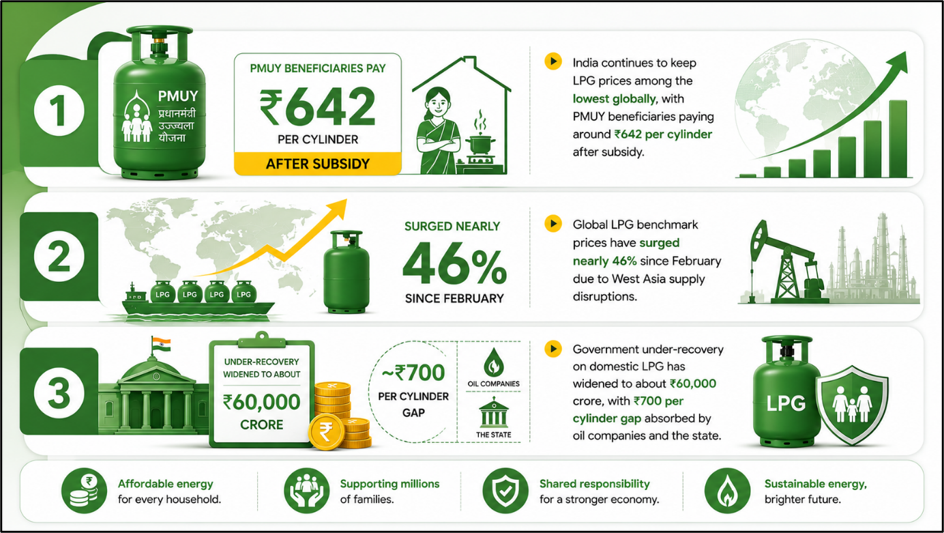
The government stated that the effective price paid by Pradhan Mantri Ujjwala Yojana (PMUY) beneficiaries stands at ₹642 per 14.2 kg cylinder after direct benefit transfer of ₹300 per refill for the first four cylinders annually. Non-PMUY consumers pay around ₹942 per cylinder.
Despite international pressures, these prices remain significantly lower than the estimated supply cost of over ₹1,600 per cylinder, indicating a large government-supported gap between market-linked cost and consumer pricing.
India continues to compare favourably with neighbouring and advanced economies, where LPG prices remain substantially higher due to market-linked pricing structures.
Global Benchmark Pressures Rise
The Saudi Contract Price (CP), which acts as a benchmark for India’s LPG imports, has risen sharply due to geopolitical disruptions. The government noted that the LPG benchmark has increased by about 46% between February and June 2026, reflecting tighter global supply conditions.
Propane and butane prices, key components of LPG, have also risen significantly during this period, increasing import costs for India. However, domestic prices have not been fully adjusted in line with these global movements.
Under-Recovery and Fiscal Burden
The difference between international LPG prices and domestic retail prices has resulted in an under-recovery of around ₹700 per cylinder. This cost is absorbed by public sector oil marketing companies and partly compensated by the government.
The cumulative under-recovery on domestic LPG has increased to approximately ₹60,000 crore in the latest financial year, compared to ₹41,338 crore in the previous year. The Union Cabinet has approved ₹30,000 crore compensation to support oil marketing companies.
This mechanism allows households to continue receiving subsidised LPG despite volatility in global energy markets.
Supply Chain Stability During West Asia Disruption
Despite disruptions in the Strait of Hormuz, through which a significant portion of India’s LPG imports pass, the government stated that there has been no shortage of petroleum products in the country.
India maintained uninterrupted supply through coordinated shipping arrangements, diversification of import sources, and increased domestic LPG production. Supply was also secured from alternative regions including the United States, Canada, and Algeria.
Domestic LPG production was reportedly increased by more than 60% during the disruption period to reduce import dependency pressures.
Policy Measures and Demand Management
To ensure supply efficiency, several demand-side measures were implemented. These include expansion of piped natural gas usage and stricter monitoring of LPG distribution to prevent diversion into commercial markets.
OTP-based delivery verification has been expanded significantly to reduce leakage and ensure subsidy targeting accuracy.
The government also reiterated that commercial LPG cylinders are fully linked to international prices and revised monthly, unlike domestic cylinders, which are partially insulated from global volatility.
Comparative LPG Pricing Snapshot
India’s domestic LPG prices remain lower compared to several countries:
- Pakistan: higher than India’s effective PMUY pricing
- Nepal and Bangladesh: significantly above Indian subsidised rates
- United States, Australia, Canada: substantially higher market-linked prices
This pricing gap highlights the extent of subsidy support extended to Indian households.
Key Risks
- Continued rise in global LPG benchmarks increasing subsidy burden.
- Higher fiscal strain due to expanding under-recovery gap.
- Supply chain disruption risks via geopolitical chokepoints.
- Dependence on imports despite domestic production increase efforts.
Outlook
India’s LPG pricing system remains heavily influenced by global energy markets but partially shielded through government subsidies and compensation mechanisms. While international prices have risen due to geopolitical tensions, domestic consumers continue to benefit from controlled pricing. However, sustained high global prices could further widen the subsidy gap and increase fiscal pressure.
Summary
India continues to maintain one of the lowest LPG prices globally despite a sharp rise in international benchmarks driven by West Asia disruptions. The government absorbs significant under-recovery costs to protect households, especially under PMUY. While supply has remained stable and diversified, rising global prices have increased fiscal pressure, making energy pricing a key policy balancing factor.
FAQs
Q: Why are LPG prices in India lower than international markets?
A: Government subsidies and controlled pricing mechanisms reduce consumer burden despite global market-linked import costs.
Q: What is PMUY LPG subsidy benefit?
A: PMUY beneficiaries receive ₹300 per cylinder for the first four refills annually through direct benefit transfer.
Q: How has West Asia affected LPG prices?
A: Disruptions have increased global LPG benchmarks, raising import costs and widening under-recovery in India.