

Highlights
- India retains EU export access for aquaculture, honey and eggs beyond September 2026.
- EU regulation updated amid antimicrobial resistance concerns affecting food exports.
- Fisheries exports to EU valued around USD 1.59 billion remain supported.
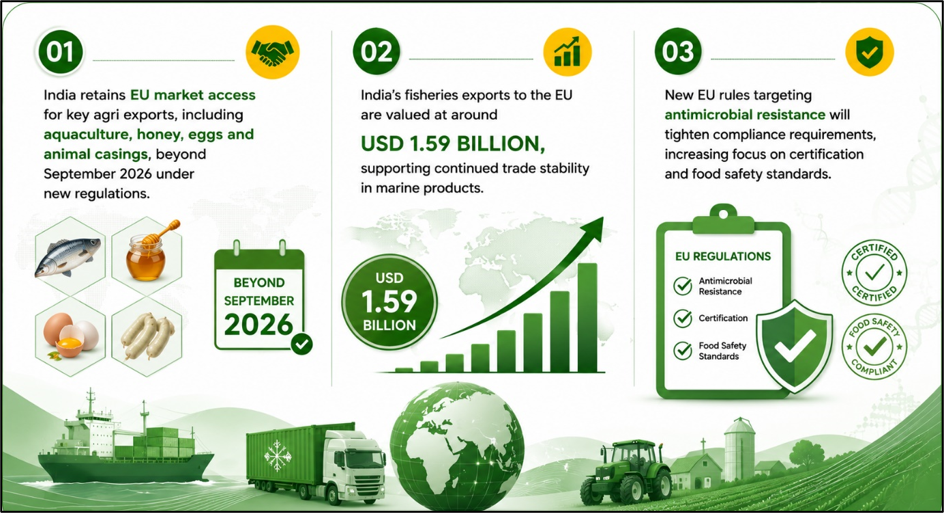
India has secured continued market access for key agri and marine export categories to the European Union beyond September 2026, following its inclusion in the updated EU authorised country list under revised food safety regulations.
The development comes under Commission Implementing Regulation (EU) 2026/1189, which amends Regulation (EU) 2021/405 in response to rising concerns over antimicrobial resistance (AMR). The updated framework introduces stricter compliance requirements for countries exporting animal-origin products to the EU market.
Source: Analysis by Kalkine
Regulatory Update and Compliance Framework
The European Union’s revised regulation will come into effect from September 2026 and applies to exports of aquaculture products, eggs, honey, and animal casings. The regulatory change is aimed at strengthening food safety and addressing antimicrobial resistance risks across imported food supply chains.
India’s inclusion in the authorised list ensures that exports of these products can continue without disruption beyond the implementation deadline, maintaining continuity in access to a key global market.
Significance for India’s Export Sector
The EU remains an important destination for India’s fisheries and marine products. Current exports of fish and fishery products from India to the European Union are valued at approximately USD 1.59 billion.
Continued access is expected to support stability in export flows across aquaculture and related segments, which include processed seafood, honey-based products, and animal-derived food ingredients.
The decision also supports broader agri-export diversification efforts, especially for sectors that depend on high-value international markets with stringent quality standards.
Institutional Coordination and Compliance Strengthening
The outcome follows sustained engagement by the Department of Commerce, Ministry of Commerce & Industry, along with technical coordination from the Export Inspection Council (EIC).
The EIC has strengthened India’s Official Control System through enhanced inspection, testing, and certification procedures aligned with EU food safety requirements.
Additional support has been provided by the Marine Products Export Development Authority (MPEDA), which works closely with exporters and approved establishments to ensure compliance with international standards.
Quality Standards and Market Alignment
India’s export system for animal-origin products has undergone continuous upgrades to align with international regulatory expectations, particularly those of the European Union.
The revised framework emphasizes antimicrobial resistance control, requiring stricter monitoring of production practices, residue management, and certification systems across the supply chain.
Indian authorities have indicated continued engagement with EU regulators to ensure smooth implementation of the new requirements and avoid trade disruptions.
Impact on Export Competitiveness
Maintaining EU market access is significant for exporters operating in aquaculture and related agricultural segments. The regulatory continuity provides clarity for long-term planning and supports ongoing trade relationships with European buyers.
It also reinforces India’s position as a consistent supplier in regulated global food markets, where compliance and certification play a central role in trade eligibility.
Key Risks
- Stricter EU compliance norms may increase certification costs for exporters.
- Antimicrobial resistance rules may require changes in production practices.
- Delays in regulatory alignment could affect shipment timelines.
- Dependence on EU demand may expose exporters to market concentration risks.
Outlook
India’s continued access to the European Union market reflects ongoing alignment with global food safety and export standards. While regulatory requirements are becoming more stringent, institutional strengthening by Indian agencies is expected to support compliance and sustain export flows. The development provides medium-term visibility for exporters in aquaculture and allied sectors, though adaptation costs and regulatory complexity remain important considerations.
Summary
India has secured continued access to the European Union market for aquaculture, honey, eggs, and animal casings beyond September 2026 under updated EU regulations addressing antimicrobial resistance. The decision ensures continuity for exports worth over USD 1.59 billion in fisheries alone. Strong coordination between Indian regulatory bodies and EU authorities has supported compliance alignment, helping maintain trade stability while adapting to stricter global food safety standards.
FAQs
Q: What products are covered under India’s EU export access extension?
A: Aquaculture products, honey, eggs, and animal casings are included under continued EU authorisation.
Q: Why did the European Union update its export regulations?
A: The update addresses antimicrobial resistance concerns and strengthens food safety requirements for imports.
Q: How important is the EU market for India’s fisheries exports?
A: The EU imports around USD 1.59 billion worth of fish and fishery products from India.