

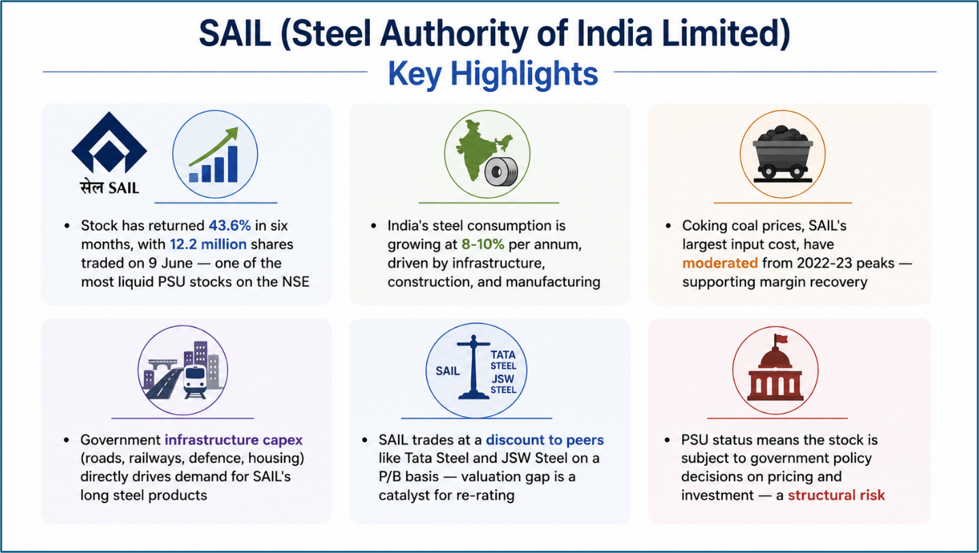
At Rs 186.3, Steel Authority of India has outperformed peers on the back of domestic infrastructure demand and easing coking coal costs. Is the rally backed by fundamentals — or is this primarily a sentiment trade?
Why Has SAIL Surged?
Infrastructure-Led Steel Demand
India's government has been executing the largest infrastructure investment programme in the country's history. The National Infrastructure Pipeline, PM Gati Shakti, and dedicated rail freight corridors together represent several lakh crore of steel-intensive construction. SAIL, with its five integrated steel plants and specialised product portfolio including rails, structural steel, and plates, is a direct beneficiary of this spending surge.
Railways alone represent a large and growing demand source. Indian Railways has been ordering record quantities of rails as it expands track kilometres, upgrades to higher-speed routes, and builds new dedicated freight corridors. SAIL is the primary domestic rail supplier and benefits from preferential government procurement policies that favour domestic PSU producers.
Input Cost Relief
Coking coal — the key raw material for blast furnace steelmaking — saw its price spike to unprecedented levels following the Russia-Ukraine conflict in 2022-23. This crushed steel sector margins globally and hit SAIL particularly hard given its blast furnace-heavy production mix. Since then, coking coal prices have moderated significantly, and SAIL's margins have been recovering. Any further softening of coking coal would provide additional margin uplift.
A USD 10/tonne reduction in coking coal price improves SAIL's EBITDA per tonne by approximately Rs 700-800 — a direct earnings translation that the market has begun to price in as the commodity cycle turns.
Sector Insights: India Steel in an Upcycle
India is the world's second-largest steel producer and is expected to become the largest outside China by 2030. Domestic steel consumption per capita is still well below global averages, leaving a long runway for demand growth as urbanisation and industrialisation continue. The government's Production Linked Incentive schemes for automobiles, electronics, and solar panels add industrial demand on top of construction-led consumption.
Import competition from China has been a periodic risk, with Chinese mills flooding global markets when domestic demand is weak. Anti-dumping duties and the Bureau of Indian Standards' mandatory quality norms have provided some protection to Indian producers, but the risk of a sharp Chinese export surge remains a structural overhang.
Technical View
SAIL has pulled back 8.5% in the past week from higher levels, suggesting some near-term profit-taking after the six-month run-up. The stock has been in an uptrend on monthly charts but faces resistance in the Rs 190-200 zone — a level it has tested and failed to sustain on multiple prior occasions. A decisive break above Rs 200 on high volume would signal the next leg of the rally.
Support on pullbacks is at Rs 160-170, where prior resistance has now become support. With 12.2 million shares trading daily, SAIL is one of the most liquid equities on the NSE — which means institutional moves are well-reflected in the price and the stock is less prone to manipulation. RSI on weekly charts is moderately elevated but not in extreme overbought territory.Bull, Base, and Bear Case
Bull Case — Rs 240-270
Coking coal prices fall further, domestic steel prices remain firm on strong infrastructure demand, and SAIL delivers meaningful EBITDA margin expansion toward Rs 8,000-9,000 per tonne. Government announces SAIL modernisation or partial disinvestment — triggers PSU re-rating. Target: Rs 240-270.
Base Case — Rs 160-200
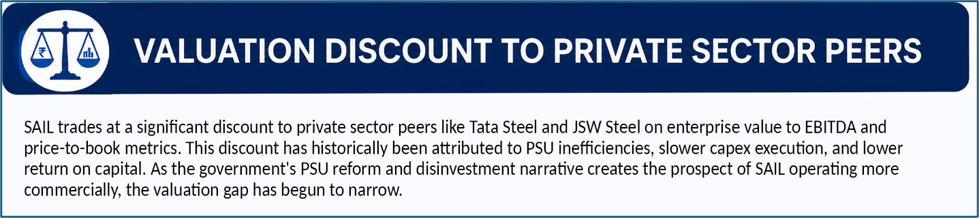
Margins recover gradually, infrastructure demand stays robust, and the valuation discount to peers narrows modestly. Consolidation near current levels with episodic volatility around commodity price movements.
Bear Case — Rs 110-140
Chinese steel dumping intensifies, coking coal prices rebound on supply disruptions, and domestic steel prices fall. EBITDA turns negative in a quarter — triggering a de-rating to near book value.
What Next?
Watch coking coal spot prices, domestic steel hot-rolled coil prices, and quarterly order disclosures from Indian Railways. Any government announcement on SAIL capacity expansion or modernisation would be a positive catalyst. The upcoming budget cycle and infrastructure spending data will be key macro variables. SAIL is a commodity-linked play — position sizing should reflect the earnings volatility inherent in the business.
Disclaimer
This article is for informational purposes only and does not constitute financial advice or a recommendation to buy or sell any securities. All market data as at 9 June 2026. Past performance is not indicative of future results. Investors should conduct their own due diligence and seek independent financial advice before making any investment decisions.