

Highlights
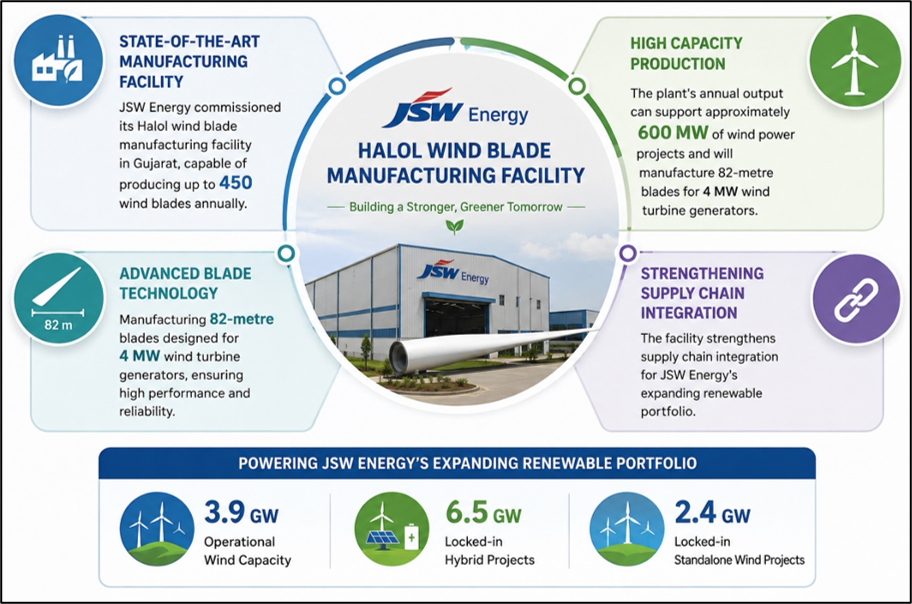
- JSW Energy commissioned its wind blade manufacturing plant at Halol, Gujarat.
- The facility can produce up to 450 wind blades annually.
- The company aims to strengthen supply chain integration for wind projects.
JSW Energy Limited (NSE:JSWENERGY) has announced the commissioning of its wind blade manufacturing plant at Halol, Gujarat, a development that forms part of the company's efforts to integrate its wind energy value chain. The announcement was made through a regulatory filing dated June 8, 2026.
According to the company, the facility is expected to support its growing renewable energy portfolio while helping manage supply chain requirements for future wind projects. The commissioning comes as JSW Energy continues expanding its presence in India's renewable energy sector.
Source: Analysis by Kalkine
Wind Capacity Expansion Drives Manufacturing Push
JSW Energy currently operates an installed wind energy capacity of 3.9 GW. In addition, the company has 6.5 GW of locked-in hybrid capacity where wind power forms an important component, along with 2.4 GW of locked-in standalone wind projects.
To support this growing project pipeline, the company has established the Halol manufacturing facility and is also progressing with another wind blade manufacturing plant at Chitradurga, Karnataka, which is in advanced stages of commissioning.
The expansion reflects the company's focus on supporting future wind energy requirements through internal manufacturing capabilities.
Plant Capacity and Production Details
The fully commissioned Halol facility has an annual production capacity of up to 450 wind blades. According to the company, this production capability is equivalent to supporting approximately 600 MW of wind power projects annually.
The plant will manufacture 82-metre wind turbine blades designed for 4 MW Wind Turbine Generators. These components form a critical part of wind power generation infrastructure and are essential for project execution timelines.
The facility is expected to play a role in supporting the company's upcoming wind projects while addressing manufacturing and logistics requirements.
Supply Chain Integration Takes Centre Stage
JSW Energy stated that the new manufacturing facility will help de-risk its supply chain by reducing dependence on external blade suppliers. The company noted that in-house manufacturing capabilities can assist in meeting domestic content requirements outlined by the Ministry of New and Renewable Energy (MNRE).
The company further stated that internal production could reduce logistics and other input-related costs associated with wind projects. According to the announcement, this may help improve project economics while reducing exposure to fluctuations in wind blade input prices.
Management Commentary on the Development
Commenting on the commissioning, Mr. Sharad Mahendra, Joint Managing Director and CEO of JSW Energy, said:
"The commissioning of our Halol wind blade manufacturing plant is a defining milestone in our journey towards building a resilient and self-reliant renewable energy platform. By bringing critical manufacturing capabilities in-house, we are not only securing our supply chain against volatility but also enhancing the cost competitiveness and returns of our wind portfolio. This reinforces our commitment to delivering sustainable, long-term value for all our stakeholders as we accelerate towards our renewable growth ambitions."
Broader Capacity Growth Plans Remain in Focus
JSW Energy currently has a total locked-in generation capacity of 32.1 GW. This includes 13.7 GW of operational capacity and 13.8 GW under construction across thermal, hydro and renewable energy assets. The company also has a project pipeline of 4.6 GW.
In energy storage, the company has a locked-in capacity of 29.6 GWh, comprising 26.4 GWh of pumped hydro storage and 3.2 GWh of battery energy storage systems.
The company has stated its objective of reaching 30 GW of generation capacity and 40 GWh of energy storage capacity by 2030, while targeting carbon neutrality by 2050.
Key Risks to Monitor
- Renewable project execution delays could impact expansion timelines.
- Supply chain disruptions may affect manufacturing operations.
- Regulatory policy changes could influence renewable investments.
- Raw material price fluctuations may affect project economics.
Today's Share Performance
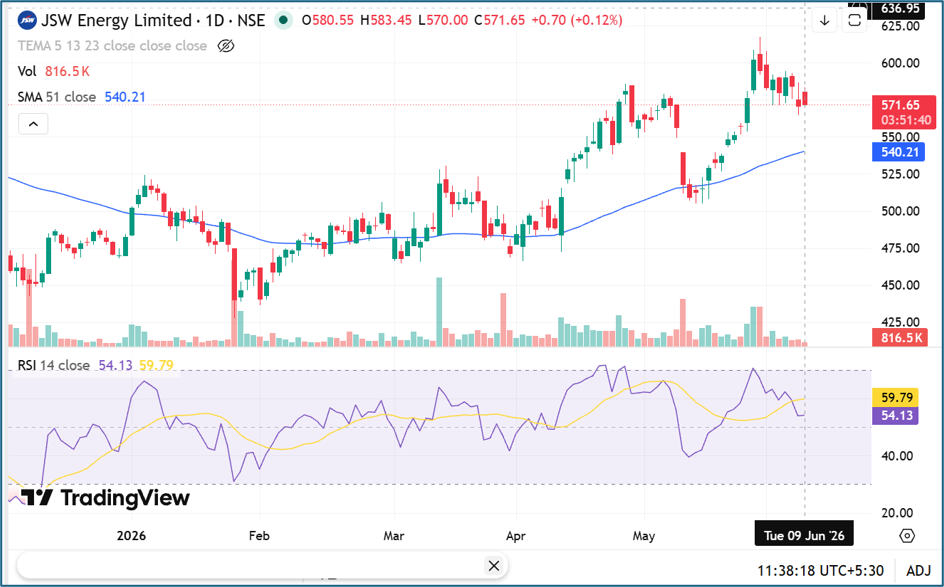
JSW Energy shares were trading at INR 571.65 as on June 9, 2026, down INR 0.70or 0.12 percent from the previous close of INR 570.95. The stock opened at INR 580.55 and touched an intraday high of INR 583.45 before declining to a low of INR 570.00. The volume-weighted average price (VWAP) stood at INR 575.44 during the session.
Source: TradingView
Summary
JSW Energy has commissioned its wind blade manufacturing plant at Halol, Gujarat, adding in-house manufacturing capability to its renewable energy operations. The facility can produce up to 450 wind blades annually and is designed to support the company's expanding wind project portfolio. The development forms part of JSW Energy's broader renewable energy growth strategy and supply chain integration efforts.
FAQs
Q: What did JSW Energy announce on June 8, 2026?
A: The company announced the commissioning of its wind blade manufacturing plant at Halol, Gujarat.
Q: What is the annual capacity of the Halol facility?
A: The plant can manufacture up to 450 wind blades annually, supporting around 600 MW projects.
Q: Why is the Halol plant important for JSW Energy?
A: It supports supply chain integration, domestic manufacturing requirements and future wind energy project execution.