

Highlights
- Gold remained near an 11-week low as easing tensions between Iran and Israel reduced safe-haven demand.
- Markets are closely watching upcoming U.S. CPI data for clues on inflation and interest-rate expectations.
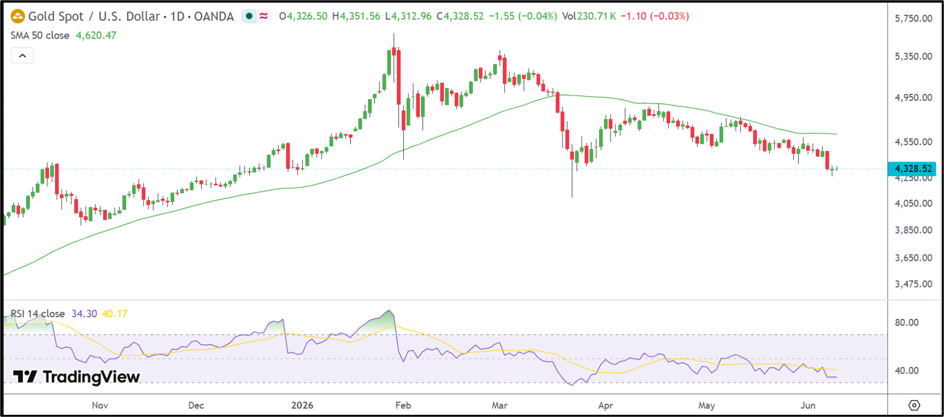
- Bullion continues to trade below its 50-day SMA, reflecting a weaker near-term technical structure.
Iran-Israel Ceasefire Reduces Safe-Haven Demand for Gold
Gold prices remained under pressure after signs of easing geopolitical tensions in the Middle East reduced demand for traditional safe-haven assets. The halt in direct hostilities between Iran and Israel helped improve overall market sentiment, prompting investors to rotate toward risk-sensitive assets.
While geopolitical uncertainty remains a key factor for precious metals, the recent de-escalation has softened immediate concerns surrounding energy supply disruptions and broader regional instability. As a result, gold has struggled to attract sustained buying interest despite lingering global uncertainties.
US CPI Data Emerges as the Next Major Market Catalyst
Investor attention has now shifted toward the upcoming U.S. Consumer Price Index (CPI) report, which could play a critical role in shaping expectations for future monetary policy decisions.
A stronger-than-expected inflation reading could reinforce expectations that interest rates may remain elevated for longer. Such a scenario could support the U.S. dollar and bond yields, creating additional headwinds for non-yielding assets like gold. Conversely, softer inflation data may revive expectations of policy easing and provide support for bullion prices.
Higher Rate Expectations Continue to Pressure Bullion
Gold has faced persistent pressure in recent sessions as markets reassess the outlook for interest rates following resilient economic data. Elevated borrowing costs typically reduce the attractiveness of holding non-income-generating assets, limiting upside momentum for precious metals.
The combination of easing geopolitical concerns and uncertainty surrounding inflation data has kept traders cautious, with many preferring to wait for clearer macroeconomic signals before establishing fresh positions.
Gold Remains Below Key Moving Average
From a technical perspective, gold is currently trading near $4,328.52, while remaining below its 50-day SMA of $4,620.47. The price structure continues to reflect a cautious bias, with recent rebounds struggling to establish sustained upward momentum.
The broader trend remains under pressure if gold continues to trade beneath its key moving average, although upcoming economic data could influence short-term direction.
Momentum Indicator Signals Weakness
The 14-day RSI currently stands at 34.30, indicating weakening momentum. While the indicator is approaching oversold territory, it has yet to show a decisive reversal signal, suggesting that traders remain cautious ahead of key inflation data.
Key Technical Levels
Gold is likely to find immediate support near $4,220.31, while a deeper decline could expose the next support area around $4,112.09. On the upside, initial resistance is positioned near $4,436.73. If buyers regain control, the commodity could attempt a move toward the next resistance zone around $4,544.95. These levels may become increasingly important as markets react to both geopolitical developments and upcoming U.S. inflation figures.
 Source: TradingView
Key Risks
- Higher-than-expected U.S. inflation could strengthen the dollar and pressure gold prices.
- Further easing of Middle East tensions may reduce safe-haven demand.
- Rising bond yields could limit investor interest in precious metals.
- Unexpected geopolitical developments could increase market volatility.
Summary
Gold remains near an 11-week low as easing tensions between Iran and Israel reduce demand for safe-haven assets. At the same time, investors are awaiting crucial U.S. CPI data that could influence inflation expectations and the future interest-rate outlook. With bullion trading below its 50-day SMA and momentum indicators remaining soft, traders are closely monitoring upcoming economic releases for signs of the next directional move.
FAQs
Why is gold trading near an 11-week low?
Gold has weakened as easing tensions between Iran and Israel reduced safe-haven demand, while expectations for elevated interest rates continue to weigh on sentiment.
Why is the U.S. CPI report important for gold?
Inflation data can influence interest-rate expectations. Higher inflation could support the dollar and bond yields, while softer inflation may improve the outlook for gold.
What are the key levels traders are watching?
Key support levels are located near $4,220.31 and $4,112.09, while resistance levels are positioned around $4,436.73 and $4,544.95.