

Highlights
- Longer loan tenures reduce monthly EMIs but increase total interest payments.
- Step-up EMI plans rely on future income growth and repayment capacity.
- Borrowers should assess overall loan costs, not just initial affordability.
Rising property prices have made homeownership increasingly challenging for many buyers, particularly first-time purchasers. As a result, lenders are offering longer home loan tenures of up to 25-30 years and flexible repayment structures designed to lower initial EMI obligations. While these options can improve affordability in the short term, they may substantially increase the overall cost of borrowing.
For many borrowers, a lower EMI can make a home purchase appear more manageable. However, financial experts often caution that monthly affordability and long-term affordability are not always the same thing.
Source: Analysis by Kalkine
Why Long-Tenure Home Loans Are Becoming Popular
Longer repayment periods are gaining popularity among younger homebuyers who are facing rising property prices and larger financing requirements.
By extending the loan tenure, borrowers can reduce their monthly repayment burden and potentially qualify for a larger loan amount. This approach can provide greater financial flexibility during the initial years of homeownership when expenses are often higher.
Many borrowers also expect their incomes to rise over time, allowing them to manage repayments more comfortably or make partial prepayments in the future.
The Hidden Cost of Lower EMIs
The primary advantage of a long-tenure home loan is a lower EMI. However, this benefit comes with a trade-off.
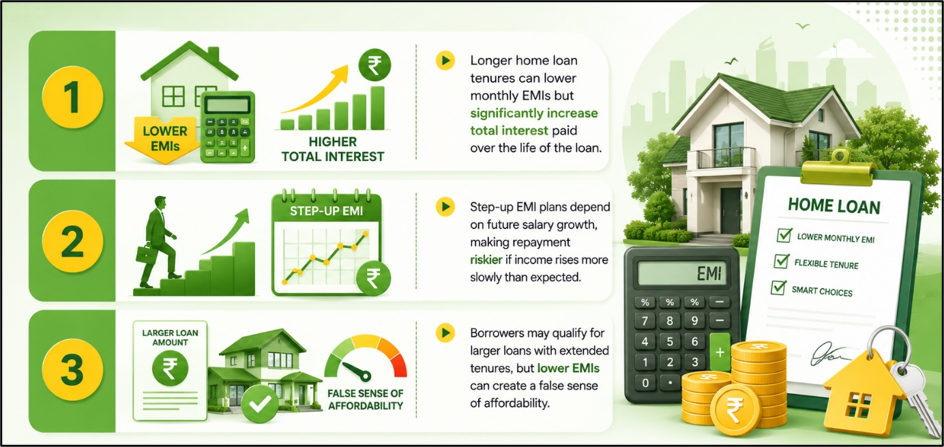
When the repayment period is extended, interest is charged for a much longer duration. Even though the monthly payment decreases, the cumulative interest paid over the life of the loan can increase significantly. In some scenarios, a relatively small reduction in EMI can result in a substantial rise in total borrowing costs.
Many borrowers focus on the monthly EMI because it directly affects their cash flow. However, the total repayment amount over the entire tenure often receives less attention during the decision-making process.
Understanding Step-Up EMI Plans
In addition to longer tenures, lenders increasingly offer step-up EMI structures.
Under these plans, borrowers start with lower EMIs that gradually increase over time. The concept is based on the assumption that income levels will rise during the loan period, allowing borrowers to accommodate larger repayments in later years.
This structure may help younger professionals qualify for larger home loans while maintaining manageable repayments initially. However, the strategy depends heavily on future earnings growth.
What Happens If Income Growth Falls Short?
A key risk associated with step-up EMI plans is uncertainty regarding future income.
Career progression does not always follow expected paths. Salary increases may be lower than anticipated, while job changes, economic slowdowns, layoffs or career breaks can affect repayment capacity. If income growth does not materialise as expected, borrowers may find it difficult to manage higher EMIs later in the loan tenure.
This risk becomes more significant when borrowers use lower initial EMIs to purchase properties that stretch their financial capacity beyond comfortable levels.
Why Loan Tenure Matters More Than Many Borrowers Realise
A home loan EMI consists of both principal and interest components. During the initial years of a long-term loan, a larger portion of each EMI goes toward interest payments, while only a small amount reduces the principal balance. As the loan progresses, the principal repayment portion gradually increases.
This means borrowers may spend several years servicing interest while reducing the outstanding loan amount relatively slowly. The effect becomes more pronounced in very long-tenure loans extending over multiple decades.
Who May Benefit From Long-Tenure Loans?
Longer tenures are not necessarily unsuitable for every borrower.
They may work for individuals with stable employment, predictable income growth and a clear strategy for future prepayments. Some borrowers use longer tenures to improve cash flow initially while planning to reduce the loan balance through bonuses, salary increases or other financial gains.
However, affordability should be assessed using both EMI comfort and total repayment cost rather than focusing exclusively on monthly obligations.
Strategies to Reduce Long-Term Borrowing Costs
Borrowers can consider several approaches to manage borrowing costs more effectively.
Making periodic part-prepayments, increasing EMI amounts after salary hikes and reducing tenure instead of lowering EMIs after prepayments can significantly reduce total interest costs. Early prepayments generally provide the greatest benefit because they reduce the outstanding principal sooner.
Regularly reviewing loan terms and repayment progress can also help borrowers stay aligned with long-term financial goals.
Key Risks
- Longer tenures substantially increase total interest payments.
- Future salary growth may not match expectations.
- Lower EMIs can create a false sense of affordability.
- Delayed principal reduction extends debt obligations.
Summary
Long-tenure home loans and step-up EMI structures can make homeownership more accessible by reducing initial monthly repayments. However, lower EMIs often come at the cost of significantly higher total interest payments over the life of the loan. Borrowers should carefully evaluate repayment capacity, future income assumptions and overall borrowing costs before choosing extended loan tenures. A balance between affordability and long-term financial efficiency is essential when selecting a home loan structure.
FAQs
Q: Why do longer home loan tenures reduce EMIs?
A: The repayment amount is spread across more years, lowering monthly instalments but increasing total interest costs.
Q: Are step-up EMI plans suitable for all borrowers?
A: No, they work best for borrowers expecting stable income growth and capable of handling future repayment increases.
Q: How can borrowers reduce interest costs on long-tenure loans?
A: Early prepayments, tenure reduction and higher EMIs after income growth can lower overall borrowing expenses.