

Highlights
- Some large-cap funds increased allocations to mid- and small-cap stocks within regulatory limits.
- Higher exposure to smaller companies contributed to stronger returns during the market rally.
- The strategy also carries higher volatility and downside risk during market corrections.
Large-cap mutual funds are primarily designed to invest in established companies with relatively stable business models and market leadership positions. Under market regulations, these schemes are required to invest at least 80 percent of their assets in large-cap stocks. However, fund managers have flexibility with the remaining portion of the portfolio, allowing them to invest in mid-cap and small-cap companies.
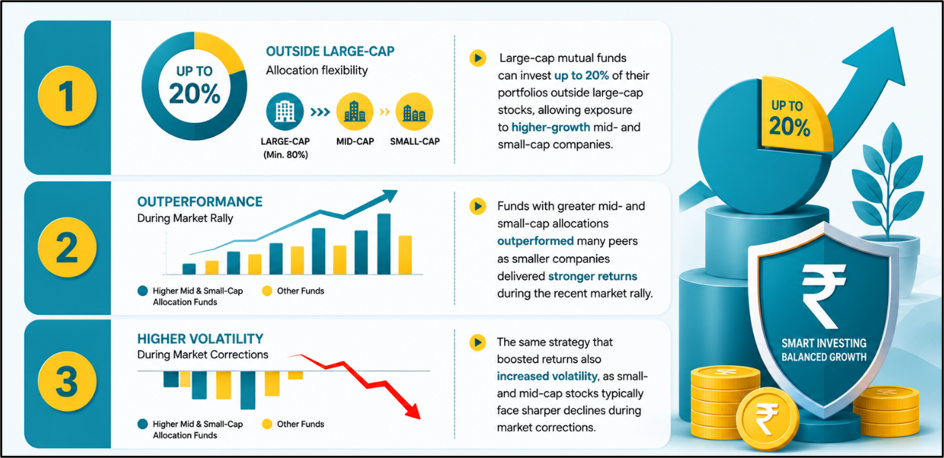
In recent years, several large-cap funds used this flexibility to increase exposure to mid- and small-cap stocks. As broader markets delivered strong gains, these allocations helped some schemes outperform peers that remained heavily concentrated in large-cap companies.
Source: Analysis by Kalkine
How Large-Cap Funds Use Portfolio Flexibility
Large-cap mutual funds must maintain a minimum 80 percent allocation to large-cap stocks. The remaining 20 percent can be invested across other segments, including mid-cap stocks, small-cap stocks, cash holdings and debt instruments.
Some fund managers have chosen to use a significant portion of this allocation for mid- and small-cap opportunities. The objective is to enhance returns by participating in the growth potential of emerging companies while retaining the stability associated with a large-cap core portfolio.
This approach creates a blend of stability and growth, although it also introduces additional risk compared with portfolios focused entirely on large-cap stocks.
Why Mid- and Small-Cap Exposure Boosted Returns
The Indian equity market witnessed a strong rally in mid-cap and small-cap segments over the past few years. Many companies in these categories delivered returns that exceeded those generated by large-cap stocks.
Funds that allocated part of their portfolios to these segments benefited from the market trend. As smaller companies recorded higher earnings growth and attracted increased investor interest, the value of these investments rose, contributing positively to overall fund performance.
Consequently, several large-cap funds with higher allocations to mid- and small-cap stocks generated returns above category averages during the period.
The Trade-Off Between Growth and Stability
While additional exposure to smaller companies can improve returns during favourable market conditions, it also increases portfolio volatility. Mid-cap and small-cap stocks generally experience larger price fluctuations than large-cap companies.
During market corrections, these segments often witness sharper declines, which can affect fund performance. As a result, investors should recognise that outperformance during strong markets may be accompanied by greater downside risk when market sentiment weakens.
Portfolio Construction Matters
Fund performance is not determined solely by the percentage allocated to mid- and small-cap stocks. Stock selection, sector allocation and portfolio management decisions also play important roles. A fund with a moderate allocation to smaller companies may outperform another with a larger allocation if the underlying stock selection proves more effective.
Therefore, investors should evaluate the overall investment strategy rather than focusing exclusively on exposure percentages. Long-term consistency, risk-adjusted returns and portfolio quality remain important factors when assessing mutual fund performance.
What Investors Should Consider
Investors often choose large-cap funds because they seek relatively lower volatility compared with pure mid-cap or small-cap schemes. However, funds with higher exposure to smaller companies may behave differently during market cycles.
Before investing, it is important to review the scheme's portfolio composition, risk profile and investment objective. Investors should ensure that the fund's strategy aligns with their risk tolerance and financial goals.
Those seeking a more conservative large-cap allocation may prefer funds with minimal exposure to smaller companies, while investors comfortable with higher volatility may find diversified allocations more suitable.
Market Cycles Can Influence Outcomes
The success of higher mid-cap and small-cap exposure depends significantly on market conditions. When smaller companies outperform, funds with greater allocations to these segments may generate superior returns.
However, if market leadership shifts back to large-cap stocks, the performance advantage may narrow or disappear. Because market cycles change over time, past outperformance does not guarantee similar results in the future.
Balancing Return Potential and Risk
Large-cap funds that incorporate mid- and small-cap investments offer an example of how portfolio flexibility can influence returns. The strategy can improve growth potential during favourable market environments while maintaining a large-cap foundation.
However, investors should evaluate both return opportunities and associated risks before making investment decisions. Understanding portfolio composition remains as important as reviewing historical performance figures.
Key Risks
- Higher small-cap exposure can increase portfolio volatility.
- Market corrections may impact smaller companies more severely.
- Past outperformance may not continue in future cycles.
- Sector concentration can amplify investment risks.
Summary
Large-cap mutual funds are required to maintain most assets in large-cap stocks but can invest a portion in mid- and small-cap companies. Funds that used this flexibility benefited from strong performance in smaller-company segments, helping some schemes outperform peers.
While the strategy can enhance returns, it also introduces additional volatility and downside risk. Investors should assess portfolio composition, risk levels and long-term objectives before selecting a fund.
FAQs
Q: Can large-cap mutual funds invest in small-cap stocks?
A: Yes, regulations allow a portion of assets to be invested outside large-cap stocks, including small-cap companies.
Q: Why did some large-cap funds outperform recently?
A: Higher exposure to mid-cap and small-cap stocks benefited from strong performance in those market segments.
Q: Are large-cap funds with small-cap exposure riskier?
A: Yes, additional exposure to smaller companies can increase volatility and downside risk during market declines.