

New SIF Strategy Targets Growth Beyond India's Top 100 Companies
360 ONE Mutual Fund has introduced the DynaSIF Equity Ex-Top 100 Long-Short Fund, a new offering under its Specialized Investment Fund (SIF) platform. The strategy is designed to generate long-term capital appreciation by investing primarily in mid-cap and small-cap companies while utilizing a long-short investment approach for enhanced risk management.
The fund seeks to identify opportunities across structural, cyclical, and tactical market themes, focusing on companies outside India's top 100 listed firms by market capitalization. This approach allows investors to gain exposure to potentially high-growth segments of the equity market that are often underrepresented in traditional large-cap portfolios.
Long-Short Strategy Aims to Balance Risk and Return
Unlike conventional equity funds that primarily take long positions, the DynaSIF Equity Ex-Top 100 Long-Short Fund has the flexibility to take limited short exposure through derivative instruments. The strategy can benefit from both rising and falling market trends while seeking to reduce overall portfolio volatility.
By combining long-term investment themes with tactical positioning, the fund aims to create a more balanced return profile across different market cycles.
Focus on Mid and Small-Cap Universe
The fund's investment universe excludes the top 100 companies by market capitalization, directing attention toward emerging businesses with higher growth potential. Mid-cap and small-cap stocks often offer opportunities for alpha generation, though they may also carry higher volatility compared to large-cap equities.
The investment strategy is designed for investors seeking exposure to the broader equity market beyond blue-chip stocks while benefiting from active portfolio management and risk-control mechanisms.
NFO Details
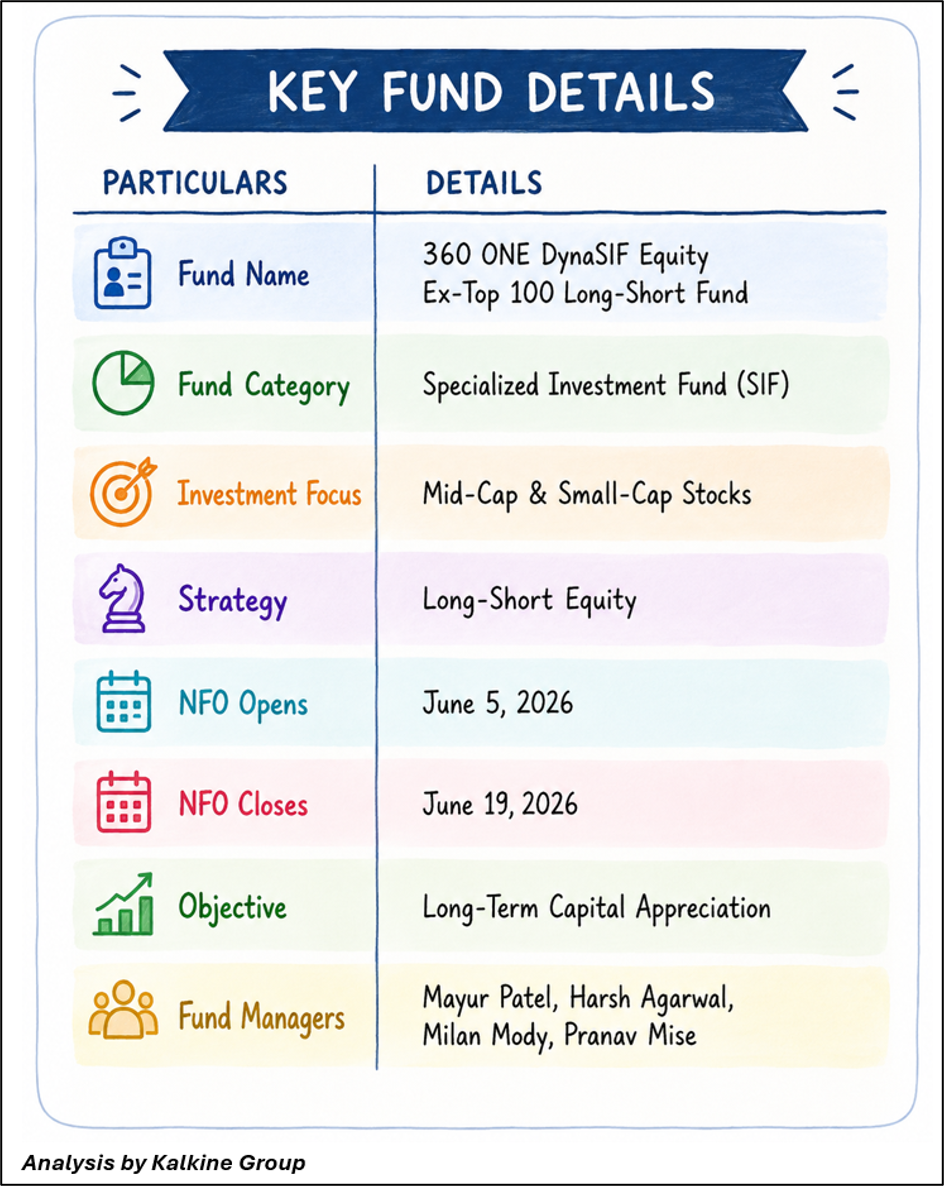
The New Fund Offer (NFO) opened on June 5, 2026, and is scheduled to close on June 19, 2026. The fund will be managed by an experienced investment team comprising Mayur Patel, Harsh Agarwal, Milan Mody, and Pranav Mise.
Key Fund Details
Growing Interest in Specialized Investment Funds
The launch reflects the growing adoption of Specialized Investment Funds in India, which provide investors with access to more sophisticated investment strategies than traditional mutual fund products. Long-short strategies have gained popularity globally due to their ability to navigate volatile market environments and generate risk-adjusted returns.
As investors increasingly seek differentiated investment opportunities, specialized products focused on active risk management and broader market participation are expected to gain traction in the coming years.
Investment Outlook
With valuations in certain large-cap segments remaining elevated, many market participants are exploring opportunities in the broader market. The DynaSIF Equity Ex-Top 100 Long-Short Fund aims to capitalize on this trend by targeting promising mid-sized and emerging companies while maintaining flexibility to manage downside risks through selective hedging strategies.
FAQs
- What is the 360 ONE DynaSIF Equity Ex-Top 100 Long-Short Fund?
It is a Specialized Investment Fund (SIF) that seeks long-term capital appreciation by investing primarily in mid-cap and small-cap stocks while using a long-short investment strategy.
- What is a long-short investment strategy?
A long-short strategy takes long positions in stocks expected to rise and limited short positions in stocks expected to underperform, helping manage portfolio risk.
- When is the NFO open for subscription?
The NFO opened on June 5, 2026, and closes on June 19, 2026.
- Which stocks will the fund invest in?
The fund will primarily invest in companies outside India's top 100 listed firms by market capitalization, focusing on mid-cap and small-cap opportunities.
- Who should consider investing in this fund?
The fund may suit investors seeking exposure to mid- and small-cap growth opportunities and who are comfortable with higher equity-market risk and a specialized investment strategy.