

Free-Float Advantage Propels ICICI Bank Ahead of India's Most Valuable Company in Benchmark Index
In a significant shift within India's benchmark equity index, ICICI Bank has surpassed Reliance Industries (RIL) to become the second-largest constituent of the Nifty 50 by weightage. The development highlights the growing importance of free-float market capitalization in determining index composition and underscores the increasing dominance of private sector banks in India's equity markets.
While Reliance Industries continues to hold the distinction of being India's largest listed company by total market capitalization, ICICI Bank now commands a larger share in the Nifty 50 due to its substantially higher free-float market capitalization.
Why ICICI Bank Has Overtaken Reliance in Nifty Weightage
The Nifty 50 follows a free-float market capitalization methodology rather than total market capitalization. This means only shares available for public trading are considered while calculating a company's weight in the index.
Reliance Industries currently has a total market capitalization of approximately ₹17.14 lakh crore, making it India's largest listed company. However, after excluding promoter and strategic holdings, its free-float market capitalization stands at around ₹8.52 lakh crore.
In contrast, ICICI Bank's total market capitalization exceeds ₹9.09 lakh crore, while its free-float market capitalization remains nearly identical at ₹9.05 lakh crore due to its widely dispersed shareholding structure.
As a result, ICICI Bank now holds a weight of 8.78% in the Nifty 50, surpassing Reliance Industries' 8.27% allocation.
HDFC Bank Continues to Lead the Nifty 50
Despite the reshuffling among the top constituents, HDFC Bank remains the largest stock in the benchmark index by weightage.
The private sector banking giant carries a weight of 10.56% in the Nifty 50, supported by a total market capitalization of approximately ₹11.33 lakh crore and a free-float market capitalization of around ₹11.24 lakh crore.
The development further reinforces the growing influence of India's banking sector within benchmark indices.
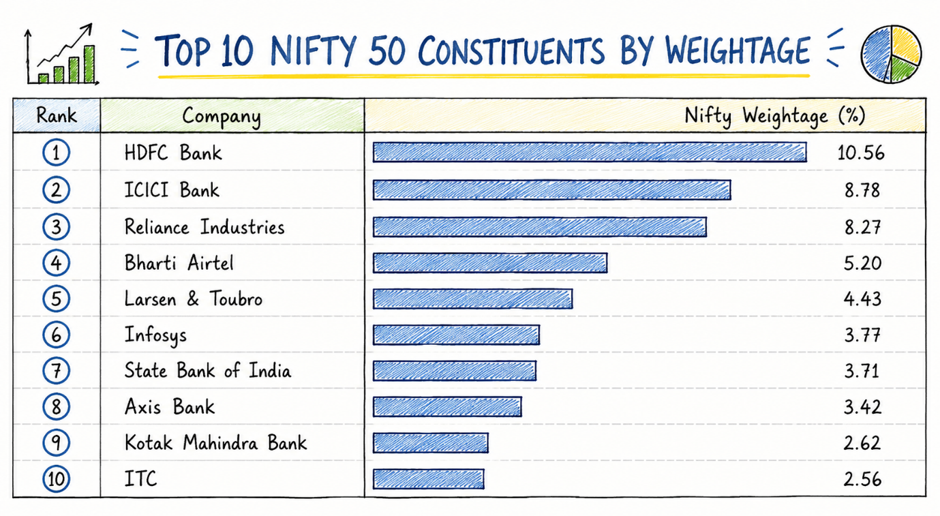
Notably, four banking stocks feature among the top ten constituents, reflecting the sector's growing role in India's market capitalization and economic expansion.
Understanding Free-Float Market Capitalization
Market capitalization can be measured in two different ways:
Full Market Capitalization
Full market capitalization represents the total value of all outstanding shares of a company. It includes promoter holdings, government stakes, strategic investments, and shares that may not be actively traded in the market.
Free-Float Market Capitalization
Free-float market capitalization only considers shares available for trading by public investors. Shares held by promoters, founders, governments, and strategic investors are excluded.
Because free-float capitalization better reflects actual market liquidity and investable opportunities, it is widely used by major global index providers, including NSE, BSE, MSCI, FTSE Russell, and S&P Dow Jones Indices.
Why the Change Matters for Investors
Changes in index weightage can influence fund flows, especially from passive investment vehicles such as index funds and exchange-traded funds (ETFs) that replicate benchmark indices.
As ICICI Bank's weight increases, passive funds tracking the Nifty 50 may allocate relatively more capital to the stock, while Reliance Industries could witness a marginal reduction in passive inflows due to its lower index representation.
The shift also reflects a broader trend where financial services companies continue to gain prominence in Indian equity benchmarks amid strong earnings growth, expanding credit demand, and increasing investor participation in the banking sector.
Banking Sector's Rising Influence
The latest rankings demonstrate the growing dominance of financial institutions in India's stock market ecosystem. Together, HDFC Bank, ICICI Bank, State Bank of India, Axis Bank, and Kotak Mahindra Bank account for nearly 29% of the Nifty 50 index.
This concentration highlights the critical role banks play in driving economic growth, credit expansion, and corporate profitability across the country.
Outlook
While Reliance Industries remains India's largest company by overall valuation, ICICI Bank's ascent to the second-largest position in the Nifty 50 underscores the importance of free-float market capitalization in modern index construction.
As passive investing continues to gain traction and benchmark-linked assets grow, free-float dynamics are likely to play an increasingly important role in shaping fund flows and market leadership within Indian equities.
FAQs
- Why did ICICI Bank overtake Reliance Industries in the Nifty 50?
ICICI Bank surpassed Reliance Industries because it has a higher free-float market capitalization, which is the basis for calculating Nifty 50 weightages.
- What is ICICI Bank's current weight in the Nifty 50?
ICICI Bank currently holds an 8.78% weight in the Nifty 50 index.
- What is Reliance Industries' weight in the Nifty 50?
Reliance Industries currently accounts for 8.27% of the Nifty 50 index despite being India's largest company by total market capitalization.
- Which stock has the highest weight in the Nifty 50?
HDFC Bank remains the largest constituent of the Nifty 50 with a weight of 10.56%.
- What is free-float market capitalization?
Free-float market capitalization represents the value of shares available for public trading after excluding promoter, government, and strategic holdings.
- Why is free-float market capitalization used in indices?
It provides a more accurate representation of investable market value and liquidity, making index construction more relevant for investors and fund managers.