

AI-Fuelled Rallies in Taiwan and South Korea Have Reshaped Global Rankings, But India's Broader Market Base Remains Intact
India's recent drop behind Taiwan and South Korea in global stock market capitalization rankings has sparked concerns among investors. However, market experts argue that the shift is less about weakening fundamentals in India and more about the extraordinary artificial intelligence (AI)-driven rally that has propelled semiconductor-heavy markets higher.
Taiwan and South Korea have benefited significantly from investor enthusiasm surrounding AI infrastructure, memory chips, and semiconductor manufacturing. Companies such as Taiwan Semiconductor Manufacturing Company (TSMC), Samsung Electronics, and SK Hynix have witnessed massive value creation, lifting the overall market capitalization of their respective markets.
Despite the ranking shift, India's long-term investment case remains supported by a diversified corporate landscape, broad sector representation, and strong domestic economic fundamentals.
AI Boom Has Distorted Global Market-Cap Rankings
The recent surge in AI-related stocks has created significant concentration in several global markets. Taiwan's equity market is heavily influenced by TSMC, while South Korea's rally has been largely driven by semiconductor giants Samsung Electronics and SK Hynix. These companies have become direct beneficiaries of the global AI investment cycle.
India, by contrast, lacks large listed semiconductor manufacturers and AI hardware companies, making it less exposed to the ongoing AI hardware boom. This relative absence has contributed to India's market-cap ranking decline despite continued economic growth.
Diversification Could Be India's Competitive Advantage
According to market analysts, India's market structure differs significantly from many Asian peers because it is less dependent on a handful of dominant companies or a single sector.
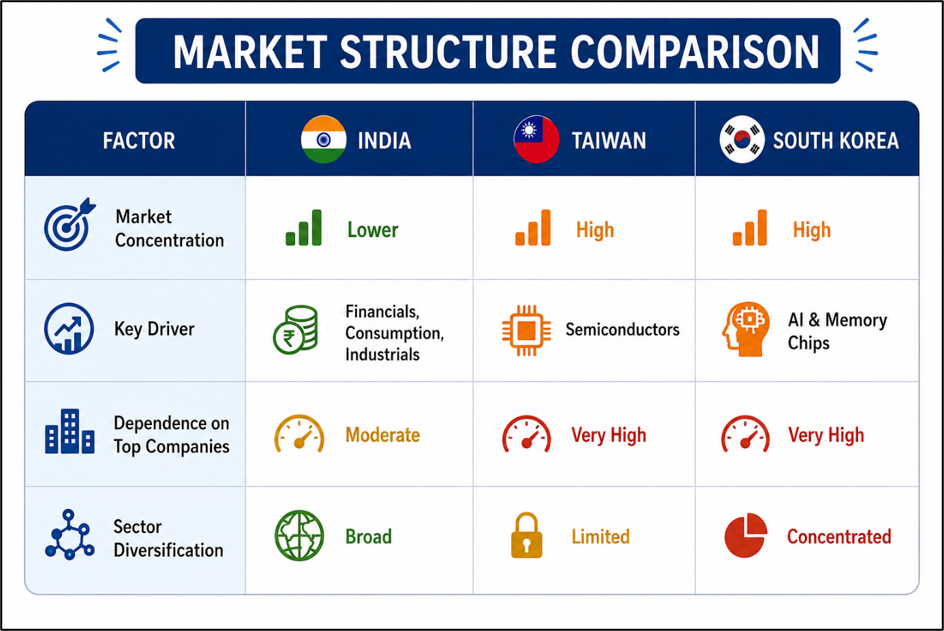
A diversified market structure offers investors exposure to multiple growth drivers including banking, consumption, manufacturing, healthcare, infrastructure, energy, and digital services.
This broader earnings base may help reduce concentration risk and cushion the market against sector-specific downturns.
Foreign Flows and Earnings Pressures Influenced Rankings
Apart from the AI-driven rally elsewhere, India has faced several short-term challenges in 2026.
These include:
- Foreign institutional investor outflows
- Moderating corporate earnings growth
- Weak performance in the IT sector
- Higher crude oil prices
- Global geopolitical uncertainty
These factors have contributed to underperformance relative to AI-focused markets. Foreign investors have withdrawn significant capital from Indian equities this year, affecting overall market capitalization and index representation.
India's Structural Growth Story Remains Intact
Despite near-term pressures, India's macroeconomic outlook remains among the strongest within emerging markets.
Several long-term growth drivers continue to support the investment case:
Key Structural Strengths
- Fast-growing domestic consumption
- Expanding manufacturing ecosystem
- Infrastructure investment push
- Financialization of household savings
- Strong SIP and mutual fund inflows
- Digital economy expansion
- Government-led capital expenditure
Unlike markets heavily dependent on semiconductor cycles, India's growth is distributed across multiple sectors of the economy.
MSCI Composition Highlights India's Breadth
Analysis of the MSCI India Index suggests that India's equity market is characterized by wider sector representation and lower stock concentration compared to Taiwan and South Korea.
While semiconductor companies dominate benchmark indices in those markets, India's benchmark composition includes financial services, energy, telecommunications, consumer goods, industrials, healthcare, and information technology.
This diversified structure can potentially provide greater earnings stability across market cycles.
Why Investors Should Look Beyond Rankings
Market capitalization rankings often fluctuate due to sector-specific trends and global investment themes.
The recent AI-driven surge has temporarily favored markets with substantial semiconductor exposure. However, rankings alone do not necessarily reflect the long-term health or growth potential of an economy.
Historically, leadership among global equity markets has shifted repeatedly as investment themes evolve. Today's AI beneficiaries may eventually be joined by markets benefiting from infrastructure, consumption, manufacturing, or digital transformation trends.
Outlook
India's temporary slide behind Taiwan and South Korea appears to be more closely linked to the global AI investment frenzy than to any meaningful deterioration in domestic fundamentals. While semiconductor-led markets have captured investor attention, India's broader and more diversified market structure continues to offer exposure to multiple long-term growth themes.
For investors, the key takeaway is that market-cap rankings may fluctuate, but diversified earnings growth, strong domestic demand, and structural economic reforms remain central to India's long-term equity market story.
FAQs
- Why did India fall behind Taiwan and South Korea in market capitalization rankings?
India was overtaken primarily because Taiwan and South Korea benefited from a strong AI and semiconductor-driven rally led by companies such as TSMC, Samsung Electronics, and SK Hynix.
- Does India's ranking decline indicate economic weakness?
Not necessarily. Analysts believe the shift reflects AI-related market concentration in other countries rather than a deterioration in India's long-term economic fundamentals.
- What is India's key advantage compared to Taiwan and South Korea?
India has a more diversified market structure with exposure to financials, consumption, infrastructure, healthcare, telecom, and manufacturing sectors rather than reliance on a few technology stocks.
- What factors have pressured Indian equities in 2026?
Foreign investor outflows, weaker earnings growth, IT sector underperformance, higher oil prices, and global uncertainties have affected Indian markets.
- Can India regain its global market-cap ranking?
Many analysts believe India can regain lost ground as earnings growth improves, foreign inflows return, and long-term structural growth drivers continue to strengthen.