

Tata Teleservices (Maharashtra) Limited (NSE:TTML) has continued to attract attention among market participants as investors reassess the company’s prospects against a backdrop of regulatory developments, enterprise-service expansion, and sector-wide telecom policy changes. The small-cap telecom counter remains closely watched due to its distinctive positioning and exposure to regulatory outcomes, particularly related to adjusted gross revenue (AGR) obligations.
TTML’s Business Transition Toward Enterprise Services
Tata Teleservices (Maharashtra) Limited was originally established to deliver telecommunication services in the Maharashtra and Mumbai service circles. Over time, the broader Tata Tele group repositioned its strategy by moving away from consumer mobility operations and focusing more heavily on enterprise-driven services.
Currently, TTML’s relevance is largely tied to enterprise telecom offerings such as connectivity, voice solutions, managed services, and data-driven communication systems tailored for business clients. This enterprise-led transformation reflects a broader trend in India where businesses are increasingly investing in digital infrastructure, cloud connectivity, and integrated communication solutions.
The growing demand for services such as SD-WAN, managed security, and unified communication platforms has helped shape the opportunity landscape for enterprise telecom operators. Investors continue to track whether this pivot translates into measurable operational improvement within TTML’s financial performance.
AGR Liabilities Continue to Influence Market Sentiment
One of the most critical drivers shaping TTML’s long-term outlook remains the AGR liability situation. The telecom sector has been navigating regulatory requirements following court rulings related to adjusted gross revenue dues, which have imposed significant financial obligations on operators.
For TTML, AGR-related liabilities remain a central element influencing investor perception and trading sentiment. Updates related to payment structures, government policy communications, or legal clarifications tend to trigger notable stock movements. The magnitude of these obligations relative to the company’s financial structure means regulatory clarity remains one of the most important factors shaping its future trajectory.
Investors continue to monitor policy announcements closely, as even incremental changes in regulatory frameworks can materially impact the company’s outlook.
Small-Cap Telecom Dynamics and Trading Behaviour
TTML’s stock profile is widely characterised by strong retail participation, resulting in periodic volatility. Trading activity often intensifies during news-driven periods, particularly when sector updates or regulatory developments emerge.
As one of the relatively limited small-cap exposures within India’s telecom ecosystem, TTML tends to experience amplified price reactions during broader telecom sector movements. Changes in investor sentiment, institutional flows, and risk appetite within small-cap segments frequently influence its performance.
Sector rotation patterns and telecom-related policy announcements can also contribute to fluctuations, making the stock sensitive to both company-specific developments and industry-wide narratives.
The Indian Telecom Landscape and Competitive Environment
India’s telecom sector remains dominated by major private operators, including Bharti Airtel, Reliance Jio, and Vodafone Idea. These companies drive tariff adjustments, network investments, and competitive strategies that shape the overall telecom environment.
While TTML primarily operates within enterprise telecom services rather than consumer mobility, sector-wide developments such as tariff changes, spectrum policies, and infrastructure investment cycles continue to influence its operating context.
The industry is also undergoing transformation driven by digital adoption, fibre expansion, and the monetisation of next-generation technologies such as 5G. Government initiatives aimed at strengthening digital infrastructure further contribute to the long-term demand outlook for enterprise connectivity services.
Bull and Bear Perspectives on TTML- Market views surrounding TTML often revolve around contrasting narratives of turnaround potential and structural constraints.
Bull Case Perspective- Optimistic investors highlight the long-term potential of enterprise telecom services as businesses continue to digitise operations. The Tata group’s brand strength and enterprise positioning provide strategic support, while any favourable regulatory developments related to AGR obligations could improve investor sentiment and unlock valuation re-rating potential.
Bear Case Perspective- Sceptical participants point to the scale of legacy liabilities relative to operational earnings. The presence of large competitors and the possibility of equity dilution in future resolution scenarios remain key concerns. Structural challenges associated with scaling enterprise services in a highly competitive environment are also cited as limiting factors.
Key Risks Investors Should Monitor
Several risks remain relevant to TTML’s long-term investment outlook:
- AGR Resolution Risk: Timing and structure of liability settlement remain uncertain.
- Dilution Risk: Potential equity issuance under settlement frameworks could affect shareholder value.
- Regulatory Risk: Telecom policy changes and licensing requirements may impact operations.
- Competitive Pressure: Large-cap telecom operators dominate industry dynamics.
- Operational Execution Risk: Success of enterprise-focused strategy depends on sustained customer adoption.
Understanding these risks is essential for evaluating the company’s long-term positioning within India’s evolving telecom landscape.
Forward Catalysts That Could Shape Future Performance
Over the coming quarters, several developments may influence TTML’s trajectory:
- Regulatory or judicial updates related to AGR dues
- Quarterly financial results reflecting enterprise segment growth
- Policy announcements related to telecom reforms
- Group-level strategic decisions within the Tata Tele structure
- Sector-wide investment cycles in digital infrastructure
These catalysts remain critical indicators that investors are likely to monitor closely in assessing both risk and opportunity dynamics.
Technical Summary
Tata Teleservices (Maharashtra) shows recovery after a prolonged downtrend, with price moving above the 50-day SMA and forming higher lows. RSI remains above the midline, indicating improving momentum. Immediate resistance is seen near 46–48 levels, while key support is placed around 40–41, followed by stronger support near 36.
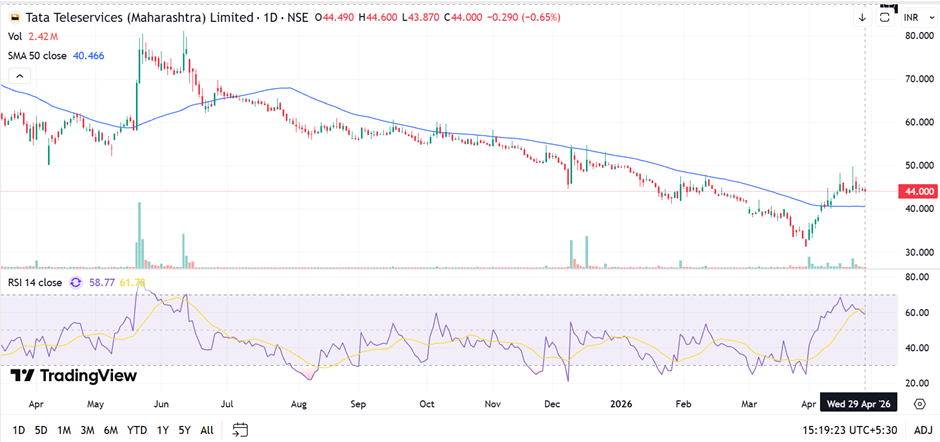
Chart by TradingView
Outlook: Balancing Legacy Challenges With Strategic Opportunity
Tata Teleservices (Maharashtra) Limited continues to represent a unique case within India’s telecom ecosystem. The combination of legacy financial obligations, evolving enterprise strategy, and regulatory uncertainty creates a complex but closely tracked investment narrative.
While structural challenges remain significant, the long-term direction of enterprise digitalisation and telecom infrastructure development provides a supportive thematic backdrop. The company’s performance in navigating regulatory obligations and scaling enterprise operations will likely determine its future trajectory within India’s telecom sector.
FAQs
- What is the main reason Tata Teleservices (Maharashtra) stock remains in focus?
The stock remains in focus mainly due to AGR liabilities, regulatory updates, and investor expectations surrounding enterprise telecom service growth potential. - How does the enterprise services segment support TTML’s long-term outlook?
Enterprise services support growth by offering connectivity, cloud, and managed communication solutions to businesses increasingly adopting digital infrastructure technologies. - What are the major risks associated with investing in TTML shares?
Key risks include AGR liability uncertainty, potential dilution, regulatory changes, intense competition, and execution challenges in enterprise telecom operations.