

Trident Limited (NSE:TRIDENT) continues to remain a closely monitored stock within India’s home-textile and integrated manufacturing space, as investors assess global demand recovery, cotton-price movements, and evolving trade policies. The company’s diversified operations across home textiles, yarn, and paper provide a balanced business profile, while export exposure keeps the stock sensitive to global macroeconomic developments.
Stock Reaction and Market Positioning
Shares of Trident Limited have demonstrated range-bound trading behaviour in recent months, reflecting cautious investor sentiment amid fluctuating export demand and volatile raw-material costs. The stock has witnessed intermittent spikes in trading activity, particularly around global tariff developments and sector-specific updates related to textile exports.
Market participants have remained attentive to evolving trade conditions, especially in the United States, which remains a key destination for home-textile exports. The stock’s movement has largely mirrored broader mid-cap textile sector sentiment, with investor positioning often shifting in response to cotton-price cycles and export demand trends.
Strategic Impact: Export Demand, Cotton Prices and Business Diversification
Trident’s positioning as a vertically integrated textile manufacturer allows it to capture value across the production chain—from spinning yarn to manufacturing finished textile products. This integration offers operational flexibility and enhances the company’s ability to manage cost pressures during volatile cotton cycles.
Export demand trends continue to shape the company’s growth outlook, particularly as global retailers adjust inventory levels following prior demand fluctuations. Any improvement in international retail sentiment could potentially support higher order inflows and improved capacity utilisation.
In addition to textiles, the company’s paper division offers revenue diversification, helping reduce reliance on export-driven textile earnings. This multi-segment structure has historically supported earnings stability during cyclical downturns in the textile industry.
Latest Quarterly Financial Performance
Recent quarterly performance trends highlight the continued impact of input-cost volatility and demand fluctuations across export markets. Operating performance has remained influenced by cotton-price movements, which directly affect yarn realisations and finished product margins.
Working capital management continues to remain a critical operational focus, given the export-oriented nature of the business and extended receivable cycles from global customers. Margin recovery trends remain dependent on the company’s ability to manage raw material costs efficiently while maintaining stable order inflows.
Despite short-term fluctuations, long-term financial prospects remain linked to global demand recovery and improved pricing power within the textile value chain.
Sector Context and Competitive Landscape
The Indian home-textile sector remains highly competitive, with manufacturers competing across cost efficiency, product quality, and sustainability compliance. Export-oriented companies like Trident operate within a dynamic global supply chain environment, where shifts in tariff policies or currency movements can influence profitability.
Domestically, structural initiatives such as textile park development and policy support for manufacturing expansion provide long-term growth potential. However, near-term sector performance remains closely tied to global demand cycles and commodity cost movements.
Technical Summary
Trident trades slightly above its 50-day moving average, indicating gradual recovery from recent lows. RSI near mid-to-upper levels suggests improving momentum without strong overbought signals. Immediate resistance is seen near 27.20–28.00 levels, while key support lies around 24.80–25.00 zone, with stronger downside support near 23.50 levels.
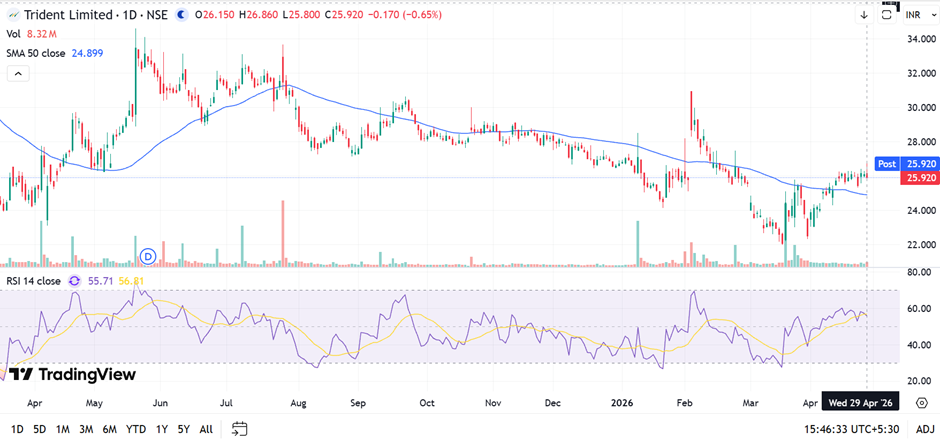
Chart by TradingView
Conclusion
Trident Limited remains positioned within a cyclical yet structurally supported textile industry environment. Export demand recovery, stable cotton prices, and improved operational efficiency could support medium-term growth. However, global trade developments, input-cost volatility, and currency fluctuations remain critical variables that could influence near-term profitability and investor sentiment.
FAQs
- What are the primary growth drivers for Trident Limited?
Key drivers include export demand recovery, stable cotton prices, improved capacity utilisation, and diversification through the company’s domestic paper segment operations. - How do cotton prices impact Trident’s profitability?
Cotton prices influence yarn costs and finished-product margins, making raw material cost management critical for sustaining profitability during volatile cycles. - What risks should investors monitor for Trident stock?
Investors should track export demand trends, cotton-price volatility, currency fluctuations, and global trade policy changes affecting textile supply chains.