

Shares of Reliance Industries Limited (NSE:RELIANCE) traded higher in recent sessions, rising around 1.6% to ₹1,349, as investors reacted positively to the company’s FY26 earnings performance and continued growth across its consumer-focused businesses. The stock movement reflects confidence in the company’s diversified earnings profile despite ongoing global energy volatility.
The results highlighted strong revenue expansion, steady operating performance, and strategic progress across digital, retail, and new energy initiatives, reinforcing Reliance’s position as India’s largest conglomerate.
FY26 Earnings Showcase Strong Revenue and Profit Growth
Reliance Industries delivered a solid full-year performance for FY26, supported by growth across its Oil-to-Chemicals (O2C), digital services, and retail businesses.
For FY26, the company reported:
- Revenue: ₹11,75,919 crore (+9.8% YoY)
- EBITDA: ₹2,07,911 crore (+13.4% YoY)
- Profit After Tax (PAT): ₹95,754 crore (+17.8% YoY)
The growth was largely driven by consumer-facing businesses such as telecom and retail, which together contributed over 55% of consolidated EBITDA, highlighting the company’s strategic shift toward high-margin consumer segments.
Reliance’s diversified operating structure continues to provide resilience, especially amid rising global energy prices and macroeconomic disruptions.
Q4FY26 Performance Reflects Stable Operating Trends
In the fourth quarter of FY26, Reliance reported continued revenue growth, although profitability was impacted by higher depreciation and financing costs associated with ongoing investments.
For Q4FY26, key metrics included:
- Revenue: ₹3,25,290 crore (+12.9% YoY)
- EBITDA: ₹48,588 crore (stable YoY)
- Profit Before Tax: ₹27,195 crore (−6.6% YoY)
- Profit After Tax: ₹20,589 crore (−8.9% YoY)
The decline in quarterly profit was primarily attributed to increased depreciation linked to the operationalization of 5G infrastructure and rising finance costs.
Despite these pressures, the company maintained stable EBITDA levels, supported by strong domestic consumer businesses.
Segment Performance Highlights Digital and Retail Strength
Reliance’s segment-wise performance underscores the growing importance of its consumer ecosystem.
Digital services remained a key growth engine, with robust subscriber additions and rising data consumption contributing to strong profitability. Retail operations also delivered steady expansion, supported by hyperlocal commerce initiatives and continued store network growth.
Meanwhile, the Oil-to-Chemicals segment faced headwinds from rising crude premiums and logistics costs, although strong fuel crack spreads partially offset margin pressures.
These diversified revenue streams continue to reduce Reliance’s dependence on traditional energy operations.
Strategic Investments Strengthen Long-Term Outlook
Reliance Industries continued to expand its strategic investments during FY26, particularly in digital infrastructure, retail expansion, and emerging energy technologies.
According to the operating context outlined in the results presentation, global macroeconomic disruptions—including elevated energy prices and currency volatility—created additional challenges. However, India’s strong domestic consumption environment supported continued growth across the company’s consumer businesses.
The company’s long-term strategy remains focused on strengthening its consumer ecosystem while building future capabilities in renewable energy and advanced digital infrastructure.
These initiatives are expected to enhance earnings visibility and improve profitability over the medium term.
Technical Summary
Reliance Industries is consolidating below its 50-day SMA near 1,384, indicating a weak short-term structure despite recent recovery attempts. Price is trading around 1,350, while RSI near 48 reflects neutral to slightly weak momentum. Immediate resistance is placed at 1,380–1,400, with support seen around the 1,310–1,325 zone.
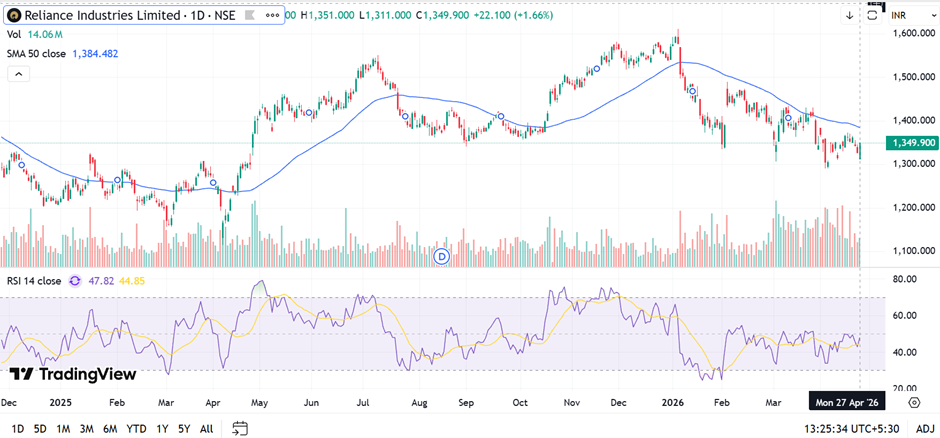
Chart by TradingView
Market Reaction Reflects Confidence in Diversified Business Model
The stock’s positive movement following the results indicates investor confidence in Reliance’s diversified business model and long-term growth prospects.
While quarterly profitability saw pressure due to elevated capex-related costs, the company’s strong revenue growth and stable EBITDA profile suggest resilience across business cycles.
Looking ahead, continued expansion in telecom, retail, and new energy segments is likely to remain key drivers of value creation for shareholders.
FAQs
- What drove Reliance Industries’ revenue growth in FY26?
Revenue growth was primarily driven by strong performance in digital services, retail operations, and steady recovery in O2C business segments. - Why did Reliance’s Q4FY26 profit decline despite revenue growth?
Profit declined mainly due to higher depreciation costs and increased finance expenses related to ongoing 5G infrastructure investments. - What are Reliance Industries’ key growth drivers going forward?
Future growth drivers include digital expansion, retail scale-up, new energy investments, and increasing contribution from consumer-focused businesses.