

South Indian Bank Ltd (NSE:SOUTHBANK) is one of India’s oldest private sector banks, with a strong regional presence and a century-long operating history. Established in 1929 and headquartered in Thrissur, Kerala, the bank has transitioned from a corporate-heavy lending model to a more retail-focused strategy in recent years. This shift has significantly improved its financial stability, asset quality, and profitability outlook.
The bank operates nearly 950 branches across India, with a strong concentration in southern states, particularly Kerala. Its customer base includes retail borrowers, small businesses, and non-resident Indians (NRIs), which together form the foundation of its deposit and lending franchise. The presence of a large NRI customer segment provides stable funding support, although it also exposes the bank to global remittance trends.
Recent financial improvements highlight the bank’s steady recovery following stress experienced between FY19 and FY21. The gross non-performing asset (NPA) ratio has reduced from peak levels near 8% to approximately 4% in FY25, indicating meaningful progress in credit quality. Return on Assets (RoA) has also recovered to the range of 0.8%–1.0%, reflecting improved operational efficiency and better loan portfolio management. These developments demonstrate the effectiveness of the bank’s transformation strategy and stronger risk management practices.
Retail-Focused Lending Driving Business Stability
One of the most important changes in South Indian Bank Ltd (NSE:SOUTHBANK) has been the gradual transition toward retail lending. Currently, more than half of its loan book consists of retail loans, including gold loans, housing finance, vehicle loans, and personal loans. Retail lending typically carries lower risk compared to large corporate lending, which historically caused asset quality stress.
Gold loans remain a major contributor to the bank’s lending portfolio. These loans are generally considered secure due to collateral backing, making them a stable revenue source. Additionally, housing and vehicle loans have witnessed steady demand across southern India, supporting loan growth and income expansion.
The bank also continues to serve micro, small, and medium enterprises (MSMEs), which represent a significant share of its lending operations. As MSME activity expands across regional markets, this segment is expected to contribute to future growth.
Financial Performance Reflects Strong Turnaround Momentum
South Indian Bank Ltd (NSE:SOUTHBANK) has shown consistent improvement in financial performance over the past few years. Net interest income has grown steadily, supported by improved loan growth and better interest margins. Profit after tax has also witnessed significant recovery compared to earlier years when asset quality challenges affected profitability.
Return on Equity (RoE) is currently estimated in the range of 13%–15%, indicating improved shareholder returns. Meanwhile, the bank maintains a stable capital adequacy ratio above regulatory requirements, ensuring sufficient buffers to support future lending growth.
Operating efficiency has improved, although the cost-to-income ratio remains slightly higher than leading private banks. Continued investment in digital platforms and operational upgrades is expected to support long-term efficiency gains.
Strong Regional Franchise and NRI Deposit Base
South Indian Bank Ltd (NSE:SOUTHBANK) benefits from a strong regional franchise in Kerala and surrounding southern states. More than 40% of its branches are located in Kerala, making it one of the region’s established financial institutions.
A notable strength of the bank is its NRI deposit base, which accounts for approximately 28%–30% of total deposits. This segment provides stable liquidity and supports consistent funding availability. However, reliance on NRI deposits also creates exposure to fluctuations in global employment trends, particularly in Gulf countries.
The bank has also enhanced its digital capabilities through mobile banking platforms and improved customer service systems. These initiatives are helping expand its customer reach while maintaining operational efficiency.
Industry Position and Competitive Landscape
Within India’s private banking sector, South Indian Bank Ltd (NSE:SOUTHBANK) is classified among old-generation private banks. These institutions typically maintain strong regional networks but operate on smaller scales compared to larger national private banks.
Competition in the southern banking market remains intense, with several major private banks expanding aggressively. Despite this, South Indian Bank retains customer loyalty through its regional familiarity, personalized service, and strong NRI relationships.
Industry trends also suggest possible consolidation within smaller private banks over the long term. While not certain, merger or acquisition opportunities could emerge as potential catalysts for growth and valuation improvement.
Growth Drivers Supporting Future Expansion
Several key factors are expected to support future growth for South Indian Bank Ltd (NSE:SOUTHBANK). Continued expansion of the retail loan portfolio is likely to remain a major growth engine, particularly in gold and housing finance segments.
Fee-based income is another area of opportunity. The bank is gradually increasing revenue from wealth management services, insurance distribution, and foreign exchange transactions. As these businesses scale, non-interest income could become a more significant contributor to profitability.
Additionally, digital transformation initiatives and operational improvements are expected to enhance productivity and reduce long-term costs. These developments may strengthen the bank’s ability to compete with larger financial institutions.
Risks Investors Should Monitor
Despite the positive outlook, certain risks remain. A significant portion of the bank’s operations is concentrated in Kerala, making it sensitive to regional economic conditions. Changes in employment patterns, remittance flows, or local business activity could affect deposit growth and loan demand.
Another potential risk relates to competition from larger private banks, which have greater financial resources and technology investments. Maintaining customer loyalty and market share will remain a key challenge.
Asset quality also requires ongoing monitoring, particularly in MSME and unsecured lending categories, which tend to be sensitive to economic cycles.
Technical Summary
South Indian Bank is showing gradual recovery, trading near its 50-day SMA around 39, indicating improving short-term sentiment. RSI near 58 suggests strengthening momentum without overbought conditions. Price is forming higher lows after recent decline, with resistance seen near 41–42 and immediate support positioned around 38–39 levels in near term.
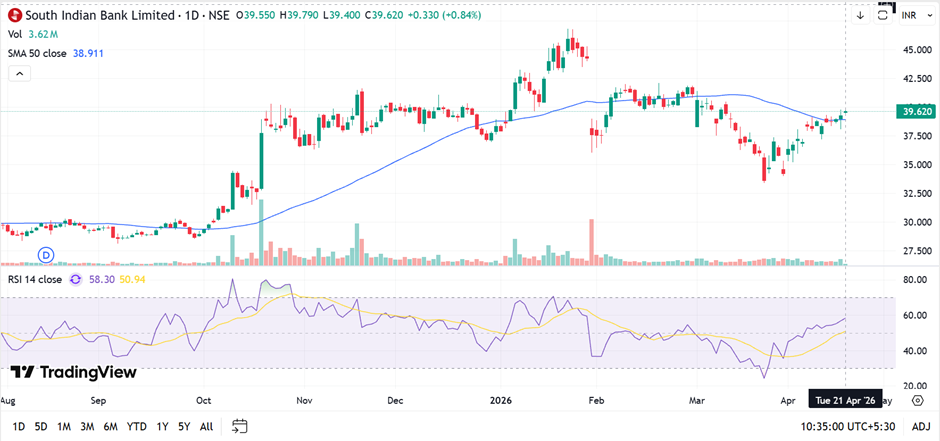
Chart by TradingView
Investment Outlook and Valuation Perspective
South Indian Bank Ltd (NSE:SOUTHBANK) trades at valuation multiples that reflect moderate growth expectations. The bank’s improving profitability metrics and stable capital position provide a foundation for steady long-term performance.
However, the investment case remains gradual rather than high-growth in nature. Investors typically view the bank as a stable regional player with improving fundamentals rather than a rapid expansion story.
Overall, the bank’s improving asset quality, retail lending strategy, and regional strengths support a balanced outlook. Continued execution of growth strategies and operational improvements will remain critical in determining its long-term performance trajectory.
FAQs
- What are the key strengths of South Indian Bank Ltd (NSE:SOUTHBANK)?
South Indian Bank benefits from strong regional presence, stable NRI deposits, improving asset quality, and consistent growth in retail lending segments. - What are the major risks associated with South Indian Bank Ltd (NSE:SOUTHBANK)?
Key risks include regional concentration, competitive pressure from larger banks, dependence on NRI deposits, and potential MSME credit cycle fluctuations. - What drives future growth for South Indian Bank Ltd (NSE:SOUTHBANK)?
Future growth is expected from retail loan expansion, fee income growth, digital transformation, and operational efficiency improvements across its banking network.