

Highlights
- Retail loan assets increased 16% YoY, reaching ₹ 86,946 crore.
- Gross NPA declined below 1%, improving to 0.93% in Q4 FY26.
- Net profit for FY26 rose 18% YoY to ₹ 2,291 crore.
PNB Housing Finance Limited (NSE:PNBHOUSING) reported continued expansion in its retail portfolio for the quarter ended March 31, 2026. Retail loan assets rose 16% year-on-year to ₹ 86,946 crore, supported by higher disbursements across affordable, emerging markets, and prime segments. Total retail disbursements for FY26 stood at ₹ 26,213 crore, reflecting a 19% annual increase.
Affordable and emerging markets segments contributed significantly, accounting for 47% of retail disbursements and 40% of the total retail portfolio. The company also expanded its distribution network, adding 35 branches during the year, taking the total to 393 locations.
Margins and Borrowing Costs Show Mixed Trends
The company reported a net interest margin (NIM) of 3.69% in Q4 FY26, compared to 3.63% in the previous quarter. However, spreads narrowed to 2.12% from 2.22% sequentially. Yield on assets moderated to 9.47%, while the cost of borrowing declined to 7.35%, indicating some easing in funding costs.
On a full-year basis, NIM remained relatively stable at 3.68%, while return on assets (ROA) improved to 2.66% from 2.55% in FY25.
Asset Quality Improves Below Key Threshold
Asset quality indicators showed improvement during the quarter. Gross non-performing assets (GNPA) declined to 0.93% as of March 31, 2026, compared to 1.04% in the previous quarter and 1.09% a year earlier. Net NPA also improved to 0.57%.
Recoveries from written-off accounts contributed to this trend, with ₹ 332 crore recovered during FY26. Credit cost remained negative in recent quarters due to these recoveries.
Profitability Supported by Higher Income
Total income for FY26 increased to ₹ 3,505 crore, up 12% year-on-year. Net interest income rose 13% to ₹ 3,110 crore.
Net profit after tax for FY26 stood at ₹ 2,291 crore, reflecting an 18% increase compared to the previous year. Quarterly profit for Q4 FY26 was ₹ 656 crore, up 19% YoY.
Operating expenses increased across employee costs and other expenses, but overall profitability remained supported by higher income and recoveries.
Segment Performance Highlights
The prime segment remained the largest contributor with loan assets of ₹ 51,953 crore, growing 9% YoY. Emerging markets grew 21% YoY to ₹ 26,820 crore, while the affordable segment expanded 61% YoY to ₹ 8,153 crore.
Incremental yields declined across segments, indicating moderation in lending rates or competitive pressures.
Technical Summary
PNB Housing Finance Limited (NSE:PNBHOUSING) is trading near ₹997.40, up around 10.00% as on 21 April 2026, and continues to remain above the 51-day SMA near ₹827.00, while the 14-day RSI near 73.13 points. Immediate support is placed in the ₹840.00–820.00 zone, while resistance is seen near the ₹1,050.00–1,100.00 range.
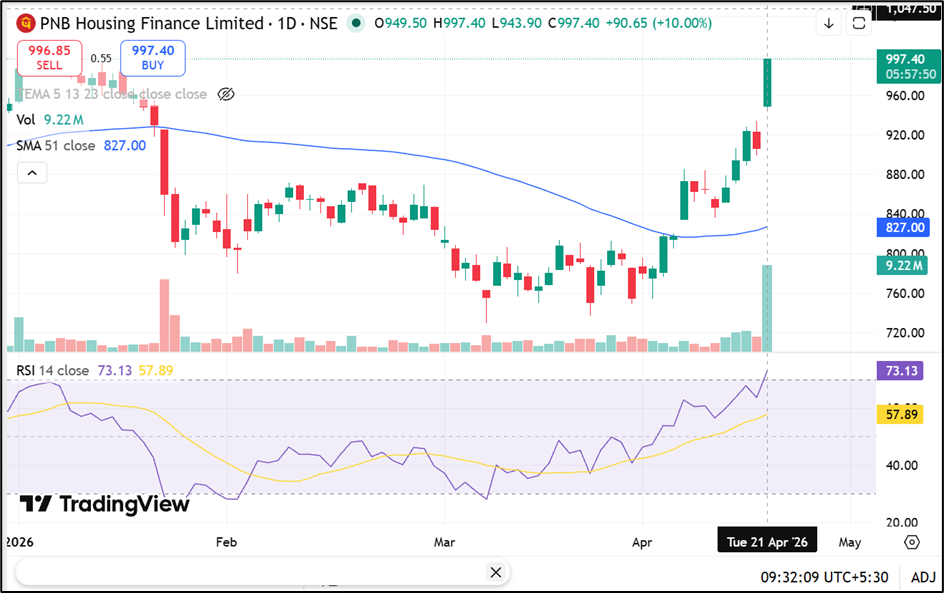
Source: TradingView
Key Risks
- Declining spreads may affect profitability if borrowing costs rise.
- Asset quality could weaken if economic conditions deteriorate.
- Dependence on retail segment exposes portfolio to borrower income risks.
- Yield moderation may impact interest income growth in coming quarters.
Summary
PNB Housing Finance Limited reported growth in retail assets and disbursements for FY26, supported by expansion in affordable and emerging markets segments. Asset quality improved with GNPA falling below 1%, while profitability increased on higher income and recoveries. However, margin compression and declining yields indicate evolving lending conditions that may influence future financial performance.
FAQs
- What was the GNPA level in Q4 FY26?
GNPA declined to 0.93% in Q4 FY26, improving from previous quarters and falling below the 1% level. - How did the company perform in FY26?
Net profit rose 18% YoY to ₹ 2,291 crore, supported by higher income and recoveries from written-off accounts. - Which segment contributed most to growth?
The emerging markets and affordable segments showed higher growth rates, contributing significantly to retail disbursements and loan assets.