

About KPR Mill
KPR Mill is one of India’s largest vertically integrated apparel manufacturing companies, producing yarn, fabrics, garments, and other textile products.
The company also operates in related segments such as sugar and green energy.
Possible Reasons Behind the Decline
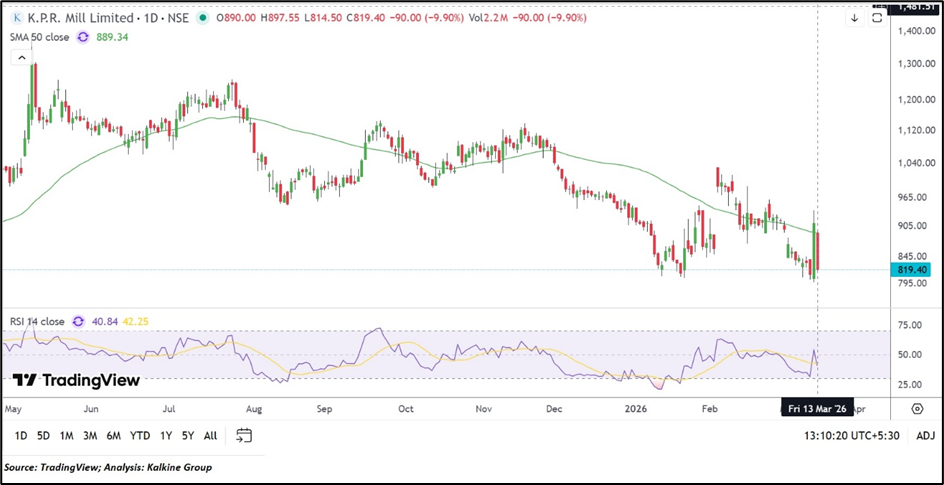
K.P.R. Mill Limited declined sharply, trading around INR 819.40 with a drop of about 9.90% on March 13, 2026, reflecting weakness in recent price action on the daily chart. The stock is currently below its 50-day Simple Moving Average near INR 889.34, indicating that the short-term trend remains under pressure. The 14-day RSI near 40.84 suggests moderating momentum following the recent decline. The movement may be associated with concerns over global textile demand, profit booking after earlier rallies, and changing market sentiment toward export-oriented companies amid currency and global economic trends. In the near term, support is placed around INR 760.00–INR 700.00, while resistance is seen near INR 870.00–INR 950.00.
Management Outlook
KPR Mill’s strategy focuses on:
- strengthening vertically integrated manufacturing
- expanding garment exports
- improving operational efficiency
The company has been investing in capacity expansion and technology upgrades to support long-term growth.
Industry Outlook
India’s textile industry benefits from:
- growing global apparel demand
- government manufacturing incentives
- rising domestic consumption
Companies with strong export capabilities and integrated manufacturing models may benefit from these trends.
Risks
Key risks include:
- cotton price volatility
- export demand fluctuations
- global economic slowdown
Outlook
Despite the short-term decline, KPR Mill’s vertically integrated business model and strong manufacturing base could support long-term growth if global textile demand improves.
FAQs
Q1. What does KPR Mill produce?
The company manufactures yarn, fabrics, garments, and other textile products.
Q2. Why did the stock fall today?
The decline may be due to profit booking or concerns about global textile demand.