

India Revises Export Duties Amid Global Oil Volatility
India has revised export duties on key petroleum products, reducing levies on diesel and aviation turbine fuel (ATF) while leaving domestic fuel taxes unchanged, according to a government notification.
Under the revised structure effective May 1, diesel export duty has been lowered to ₹23 per litre from ₹55.5, while ATF export duty has been cut to ₹33 per litre from ₹42. Export duty on petrol continues to remain nil, and domestic fuel taxation remains unchanged.
The move comes at a time when global crude prices remain volatile amid geopolitical tensions and supply disruptions. Policymakers continue to use export duties as a tool to manage domestic fuel supply while balancing refinery profitability.
Why the Government Adjusted Export Duties
India periodically reviews export duties on petroleum products to balance refinery profitability with domestic fuel availability.
The earlier sharp increase in export duties was aimed at curbing exports and ensuring sufficient domestic supply during periods of elevated global prices. The latest reduction signals partial normalization but still maintains restrictions on excessive exports.
Key policy objectives include:
- Ensuring adequate domestic fuel supply
- Stabilizing fuel availability amid global disruptions
- Protecting domestic consumers from price volatility
- Managing refinery windfall gains
Petrol and diesel prices for domestic consumers remain unchanged, reinforcing the government's focus on shielding domestic users from global energy shocks.
Impact on Refinery and Oil Marketing Stocks
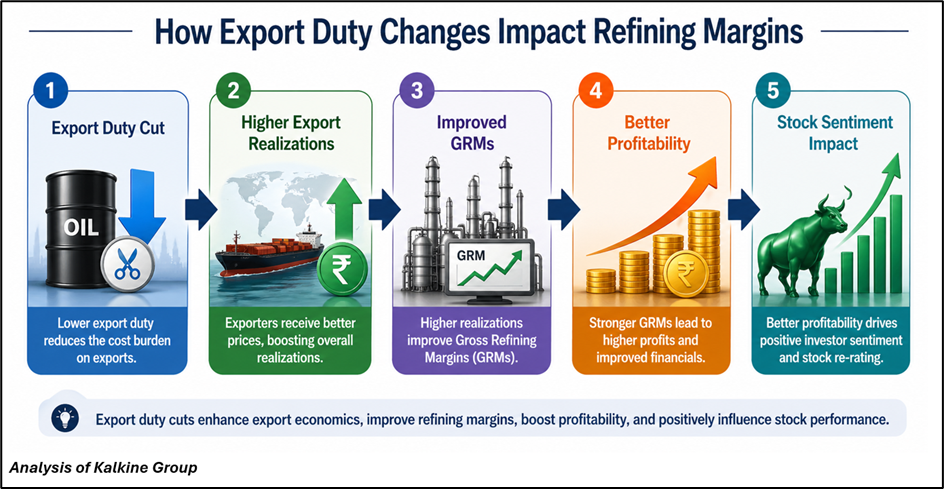
The revision in export duties is likely to have direct implications for refining margins, particularly for companies with large export exposure.
- Likely Beneficiaries
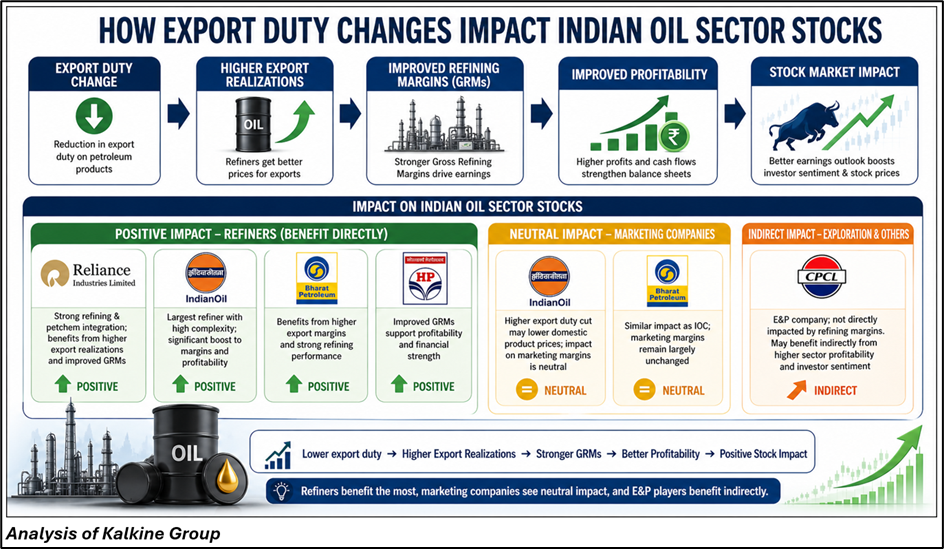
- Reliance Industries Limited (NSE:RELIANCE)- India’s largest private refiner with significant export exposure is likely to benefit from lower export duties. Improved refining economics could support better export realizations and potentially enhance margins.
- Chennai Petroleum Corporation Limited (NSE:CHENNPETRO)- The company’s export-linked refining operations make it sensitive to export duty revisions. Lower levies may improve profitability outlook and operational efficiency.
- Neutral to Mixed Impact
- Indian Oil Corporation Limited (NSE:IOC)
- Bharat Petroleum Corporation Limited (NSE:BPCL)
- Hindustan Petroleum Corporation Limited (NSE:HPCL)
These public sector oil marketing companies primarily serve domestic markets. Since domestic fuel duties remain unchanged, the near-term impact may remain largely neutral, although export-linked refining segments may see incremental benefits.
Aviation Sector Implications
Lower export duty on ATF could indirectly support the aviation ecosystem by stabilizing broader jet fuel pricing dynamics.
Aviation turbine fuel accounts for a significant portion of airline operating costs, making fuel price stability critical for airline profitability.
Stocks that may see indirect benefits include:
- InterGlobe Aviation Limited (NSE:INDIGO)
- SpiceJet Limited (NSE:SPICEJET)
However, the direct impact on airlines is expected to remain limited as domestic ATF pricing structures remain largely unchanged.
Refining Margins and GRM Outlook
Gross Refining Margins (GRMs) remain highly sensitive to global crude oil price trends.
Lower export duties may improve export realizations and support refining throughput, potentially enhancing operational profitability for export-oriented refiners.
However, sustained high crude prices could offset some margin gains, making global oil price movement a key variable for sector outlook.
Market Sentiment and Near-Term Stock Outlook
From an equity market perspective, the policy change appears mildly positive for export-oriented refiners while remaining neutral for domestic-focused oil marketing companies.
- Short-Term Sentiment Drivers
- Global crude oil trajectory
- Refining margin trends
- Export demand patterns
- Currency movement
- Policy stability
- Stocks likely to remain in investor focus include:
- Reliance Industries Limited
- Indian Oil Corporation Limited
- Bharat Petroleum Corporation Limited
- Hindustan Petroleum Corporation Limited
- Chennai Petroleum Corporation Limited
Strategic Sector View: Oil & Gas Remains Policy-Sensitive
The Indian oil and gas sector continues to remain highly sensitive to regulatory changes, particularly export taxes and windfall levies.
Frequent revisions to export duties highlight a dynamic policy environment where government intervention plays a critical role in balancing consumer protection and corporate profitability.
For investors, tracking policy developments alongside crude price trends remains essential to understanding sector direction.
Conclusion
India’s revision of diesel and ATF export duties reflects a calibrated response to evolving global energy conditions. While domestic fuel taxation remains unchanged, reduced export duties may support refining profitability, particularly for export-heavy companies. In the near term, refinery stocks could witness improved sentiment, although global crude price trends will remain the dominant driver of sector performance.
FAQs
- Why did India revise export duties on diesel and ATF?
To balance domestic fuel availability, stabilize fuel supply, and manage refinery profitability amid volatile global crude prices. - Which stocks are most impacted by this policy change?
Export-oriented refiners like Reliance Industries and Chennai Petroleum are expected to see relatively stronger operational impact. - Will domestic petrol and diesel prices change after this revision?
No, domestic fuel duties remain unchanged, so retail fuel prices are unlikely to be directly affected.