

Highlights
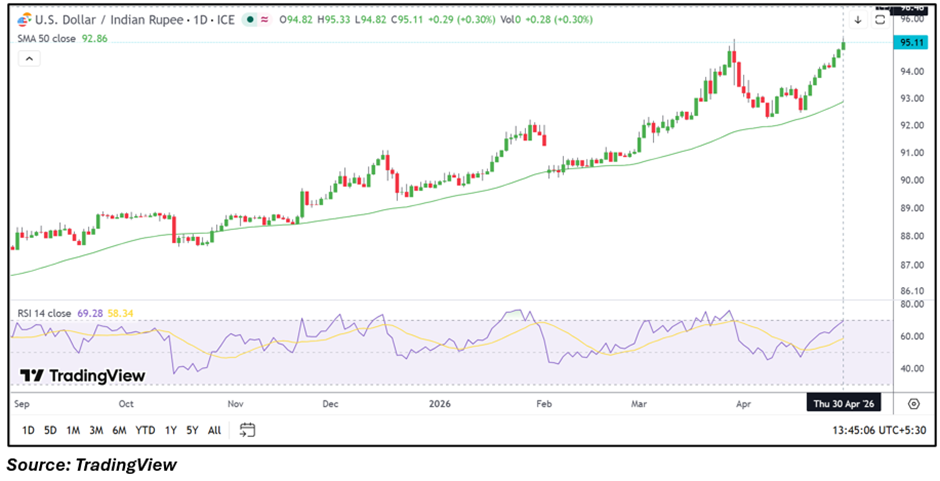
- USD/INR trades near 95.11 after hitting a record high of 95.33.
• Surging oil prices driven by the Iran conflict are pressuring the rupee.
• The Federal Reserve’s cautious stance is strengthening the US dollar.
• Foreign outflows and rising import costs are adding to currency weakness.
• RSI near 69.28 indicates strong momentum but nearing stretched levels.
• Price remains above its 50-day SMA near 92.86, maintaining an uptrend.
Overview
USD/INR is currently trading near 95.11 after touching a record high of 95.33, reflecting persistent weakness in the Indian rupee. The sharp move comes amid rising geopolitical tensions, higher crude oil prices, and a cautious global monetary backdrop.
The currency pair has been trending higher, indicating sustained pressure on the rupee as external risks continue to build.
Why the Rupee Is Falling?
The rupee’s decline is being driven primarily by the surge in crude oil prices linked to escalating tensions in the Middle East. Oil prices have climbed to multi-year highs amid supply disruptions and uncertainty surrounding the Iran conflict.
For India, a major oil importer, higher crude prices significantly increase the import bill and widen the current account deficit. This creates strong demand for the US dollar, weakening the rupee.
At the same time, the ongoing geopolitical tensions have triggered risk aversion in global markets. Investors are shifting toward safer assets, leading to reduced capital inflows into emerging markets like India.
Fed Outlook Adds to Pressure
The Federal Reserve has added another layer of pressure on the rupee. While rates were kept unchanged, policymakers highlighted persistent inflation risks and delivered a more cautious outlook.
The Fed’s stance has strengthened the US dollar globally, making it harder for emerging market currencies to stabilise. Expectations of delayed rate cuts and tighter financial conditions have further weighed on the rupee.
A stronger dollar combined with rising oil prices creates a double impact—both increasing external payments and reducing capital inflows.
External Pressures and Capital Flows
The rupee has also been affected by sustained foreign outflows. Investors have pulled significant capital from Indian equity and debt markets in recent weeks, intensifying pressure on the currency.
At the same time, the combination of high oil prices and geopolitical risks is raising fears of inflation and slower economic growth.
This environment creates a negative feedback loop—currency weakness increases import costs, which in turn pushes inflation higher and affects investor sentiment.
Can RBI Stabilize the Rupee?
With the rupee at record lows, attention is now shifting toward potential action from the Reserve Bank of India.
Possible measures could include intervention in the forex market, tightening liquidity conditions, or steps to manage dollar demand from oil imports. There may also be policy adjustments aimed at stabilising inflation and supporting capital flows.
However, the effectiveness of these measures will depend largely on global factors such as oil price trends and geopolitical developments.
Technical View
USD/INR is currently trading at 95.11, well above its 50-day Simple Moving Average near 92.86, indicating a strong upward trend.
The price structure shows a clear pattern of higher highs and higher lows, reflecting sustained momentum in the currency pair.
The 14-day RSI is at 69.28, approaching overbought territory. This suggests that while the trend remains strong, the pair may see some consolidation or short-term pullback.
The immediate support zone is placed near 91.00–89.00. On the upside, resistance is seen near 98.00–100.00. A sustained move above 95.50 could extend the current trend further.
Latest News
The rupee has come under sustained pressure as oil prices surged amid geopolitical tensions linked to the Iran conflict. The sharp move to record lows reflects growing concerns around inflation, external balances, and capital flows.
At the same time, the Federal Reserve’s cautious stance and focus on inflation risks have strengthened the US dollar, adding further pressure on emerging market currencies.
Key Risks
- Continued rise in oil prices may further weaken the rupee.
• Escalation in geopolitical tensions could increase volatility.
• Persistent capital outflows may pressure currency stability.
• A move above 95.50 could extend downside for the rupee.
Summary
The Indian rupee has fallen to a record low due to a combination of rising oil prices, geopolitical tensions, and a stronger US dollar. The current trend reflects a challenging macro environment with multiple external pressures.
The technical setup remains strong for USD/INR, although momentum is approaching stretched levels. The next move will depend on global developments, particularly oil prices and central bank policy responses.
FAQs
Why is the rupee falling to record lows?
The rupee is weakening due to rising oil prices, geopolitical tensions, and a stronger US dollar.
How does the Fed impact the rupee?
A cautious Fed outlook strengthens the US dollar, putting pressure on emerging market currencies like the rupee.
What are the key levels to watch for USD/INR?
Support is near 91.00–89.00, while resistance is seen near 98.00–100.00.