

Key Highlights
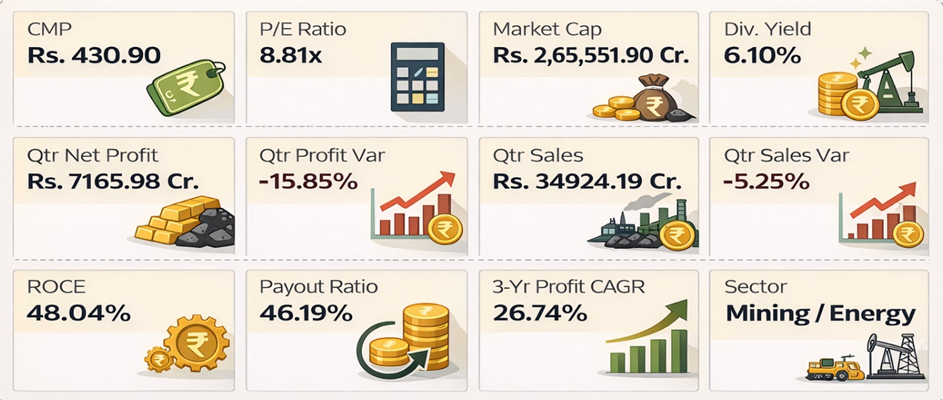
- Dividend yield of 6.10% — one of India's highest-yielding large-cap PSU stocks
- World's largest coal producer by volume — accounting for over 80% of India's domestic coal production
- Maharatna PSU — Government of India holds ~63% equity, providing structural dividend reliability
- ROCE of 48.04% — extraordinary capital efficiency driven by largely depreciated legacy mining assets
- Market cap of Rs. 2,65,551.90 Cr. — one of India's 10 largest listed companies
- 3-year profit CAGR of 26.74% — reflecting strong post-COVID recovery and high coal prices in 2022-24
- Payout ratio of 46.19% — moderate, leaving room for special dividends in high-profit years
- P/E of just 8.81x — significant discount to the broader market reflects long-term energy transition concerns
Company Overview
Coal India Limited (NSE: COALINDIA) was established in 1975 as a government-owned entity to centralize India's fragmented coal mining operations. Today it produces over 700 million tonnes of coal annually and supplies the vast majority of fuel consumed by India's thermal power generation sector — a captive relationship that provides extraordinary revenue stability and pricing power.
CIL operates through eight subsidiary companies across coal-bearing states including Jharkhand, Odisha, Chhattisgarh, West Bengal, Madhya Pradesh, and Assam. The Government of India holds approximately 63% of CIL's equity — a holding that creates a structural incentive to maintain generous dividends as a source of government fiscal revenue.
Stock Performance and Valuation
Company Strategy
Coal India's strategic agenda for 2025–2030 is built around three priorities: volume growth, diversification into clean energy, and operational efficiency. On volume, CIL is targeting 1 billion tonnes of annual production by 2026-27 — an ambitious ramp-up that requires accelerated mine opening, faster environment clearances, and significant evacuation infrastructure investment.
On clean energy, CIL has announced a strategic pivot toward solar energy, surface coal gasification, and coal-to-chemical projects. The company has been allocated large tracts of non-forest land for solar power development — an initiative that could, over time, provide a meaningful non-coal revenue stream and partially reposition the company in the context of India's energy transition narrative.
On operational efficiency, CIL is deploying first-mile connectivity projects (rail sidings and conveyor systems) to reduce road transport dependency, lower logistics costs, and reduce its environmental footprint. These investments will improve profitability per tonne over the medium term.
Financial Analysis
Net profit of Rs. 7,165.98 crore on revenue of Rs. 34,924.19 crore yields a ~20.5% net margin — remarkable for any mining company. The recent quarterly decline reflects pricing pressure and monsoon disruptions to mining operations, but the absolute profit base remains very high. ROCE of 48.04% reflects the capital efficiency of largely depreciated legacy mining infrastructure combined with near-monopoly pricing.
Dividend Policy and History
Coal India's government-directed dividend policy has resulted in one of India's most reliable PSU dividend track records. The payout ratio of 46.19% is moderate, and special dividends in high-profit years have augmented the base dividend. The 6.10% yield at Rs. 430.90 represents an attractive income from a large-cap, government-backed entity.
Energy Transition Risk Assessment
India's renewable energy ambitions represent the primary long-term risk for CIL. However, India's power demand growth — projected at 5-7% annually — means coal-based generation will remain essential for at minimum the next 10-15 years. CIL's production targets and the government's energy security priority provide near-to-medium term demand certainty.
Q: Does the Indian government force Coal India to pay dividends?
A: Yes. As the majority shareholder, the Government of India regularly directs CIL to maintain substantial dividend payouts, as these are a significant source of government non-tax revenue.
Q: Why has quarterly profit declined despite CIL's scale?
A: The decline reflects lower coal realisations versus prior-year highs (when global coal prices peaked), higher operational costs, and seasonal mining disruptions from monsoon. Long-term production and demand fundamentals remain intact.
Q: What is CIL's production target?
A: CIL is targeting 1 billion tonnes of annual coal production by 2026-27, requiring accelerated mine opening and evacuation infrastructure development.
Q: Is Coal India investing in renewable energy?
A: Yes. CIL has announced solar power projects, coal gasification initiatives, and coal-to-chemical projects — a strategic diversification to partially hedge against long-term coal demand risk.
Q: How many employees does Coal India have?
A: Coal India is one of India's largest employers, with a workforce of approximately 230,000-250,000 employees across its subsidiary mining companies.