

Key Highlights
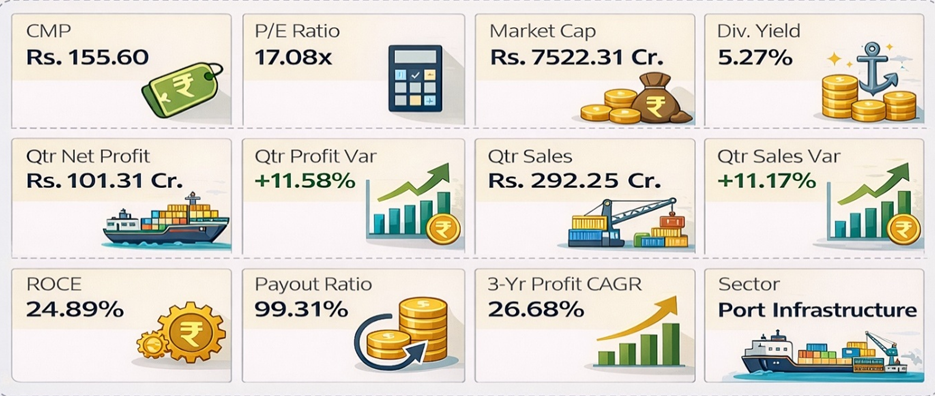
- Dividend yield of 5.27% — backed by near-100% payout of stable port revenues
- Payout ratio of 99.31% — one of India's highest, enabled by depreciated infrastructure and low capex needs
- P. Moller-Maersk as promoter — world-class operator, global shipping relationships, unmatched competitive moat
- ROCE of 24.89% — exceptional for regulated port infrastructure, well above sector average
- 30-year concession agreement with Gujarat Maritime Board — long-term operational certainty
- Quarterly revenue and profit growth of ~11% YoY — consistent, healthy volume and tariff growth
- 3-year profit CAGR of 26.68% — strong compounding from containerisation wave
- Strategic western coast location — serves landlocked markets of Rajasthan, MP, and North India
Company Overview
Gujarat Pipavav Port Limited (NSE: GPPL) is India's first private sector port, located at Pipavav in the Saurashtra region of Gujarat. Promoted by A.P. Moller-Maersk — the world's largest container shipping and terminal operator — GPPL provides a modern container, bulk, liquid, and Ro-Ro cargo handling facility strategically positioned to serve India's northwestern hinterland.
The port operates under a 30-year concession agreement with the Gujarat Maritime Board, providing long-term operational certainty that underpins investor confidence. Maersk's promoter role brings unparalleled advantages: access to Maersk's global container shipping network, world-class port operational expertise, and the credibility to attract the largest container vessels and shipping lines to Pipavav.
Stock Performance and Valuation
Company Strategy
GPPL's strategic priorities for the coming years are centred on three themes: capacity expansion to capture India's containerisation growth, customer base diversification beyond Maersk-affiliated lines, and logistics value-add services that complement the core port business.
On capacity, the port is evaluating berth additions and yard automation investments to increase throughput capacity. India's container port throughput is growing at 7-9% annually — and Pipavav's hinterland, encompassing the fast-growing economies of Rajasthan, Madhya Pradesh, and northwest India, is one of the highest-growth freight markets in the country.
Customer diversification is a key strategic priority: while Maersk's shipping lines provide a captive volume base, GPPL actively markets its facilities to MSC, CMA CGM, Hapag-Lloyd, and other major shipping lines. Attracting multiple major carriers increases the port's resilience to any single line's volume decisions.
On logistics, GPPL is developing warehousing and cold chain infrastructure in the port's vicinity to provide end-to-end supply chain solutions — capturing higher-value logistics revenue beyond pure port handling fees. This logistics adjacency strategy mirrors the approach of successful port operators globally.
India Containerisation Opportunity
India's container penetration rate — the share of total cargo moved in containers — remains well below global averages, providing structural growth opportunity as containerisation deepens. Government investments in dedicated freight corridors, port road and rail connectivity, and hinterland logistics parks all reduce the total cost of containerised trade, accelerating adoption.
Dividend Sustainability at 99.31% Payout
GPPL's near-100% payout is sustainable because the port's legacy infrastructure is largely depreciated — capital expenditure requirements are modest relative to earnings. The Maersk promoter's preference for high distributions from its Indian port holding reinforces the payout policy. At 5.27% yield with 11% profit growth, GPPL offers compelling income-plus-growth potential.
Q: Who owns Gujarat Pipavav Port?
A: A.P. Moller-Maersk, the world's largest container shipping and port operator, is the promoter and majority shareholder.
Q: What is GPPL's concession period?
A: GPPL operates under a 30-year concession agreement with the Gujarat Maritime Board, providing long-term operational certainty.
Q: Why is GPPL's payout ratio nearly 100%?
A: The port's legacy infrastructure is largely depreciated, resulting in low ongoing capex. The Maersk promoter prefers high cash distributions, and the business generates strong free cash flow above reported profits.
Q: What types of cargo does GPPL handle?
A: Containers (primary), bulk cargo, liquid cargo, and Ro-Ro (roll-on/roll-off) vehicles — making it a versatile multi-cargo facility.
Q: How does India's freight corridor infrastructure help GPPL?
A: Dedicated Freight Corridors connecting Pipavav to the hinterland significantly reduce transit times and logistics costs, making Pipavav more competitive and attracting higher container volumes.