

Key Highlights
- Dividend yield of 7.97% — well above Indian fixed-income alternatives for regulated infrastructure cash flows
- KKR-sponsored InvIT — institutional-grade governance and deal sourcing capability
- Power transmission assets under 35-year agreements with government counterparties — near-zero revenue risk
- CPI-linked rent/tariff escalators provide built-in inflation protection for distributions
- Market cap of Rs. 5,554.05 Cr — meaningful scale with growing asset base
- 3-year profit CAGR of 94.34% — driven by asset additions and portfolio growth
- SEBI-regulated: required to distribute minimum 90% of distributable cash flows to unitholders
- Availability-based tariff model — revenue earned regardless of actual power transmitted
Company Overview
India Infrastructure Trust is a SEBI-registered Infrastructure Investment Trust focused on power transmission assets across India. Sponsored by KKR — a leading global alternative asset manager — the trust provides unitholders with access to regulated, long-duration cash flows from inter-state transmission system (ISTS) lines operating under 35-year Transmission Service Agreements (TSAs) with the Central Transmission Utility (CTU) and state power utilities.
The InvIT structure requires distribution of at least 90% of distributable cash flows to unitholders — creating a high-yield, pass-through income vehicle comparable to REITs in structure and philosophy. The underlying transmission assets earn availability-based tariffs: revenues are earned based on the availability of the transmission line for service, not the actual quantum of power transmitted, creating one of the most revenue-certain business models in Indian infrastructure.
The trust's growing portfolio spans thousands of kilometres of high-voltage transmission lines across multiple Indian states, connecting power generation centres to load centres. Each asset added to the portfolio increases the distributable cash pool available to unitholders.
Stock Performance and Valuation
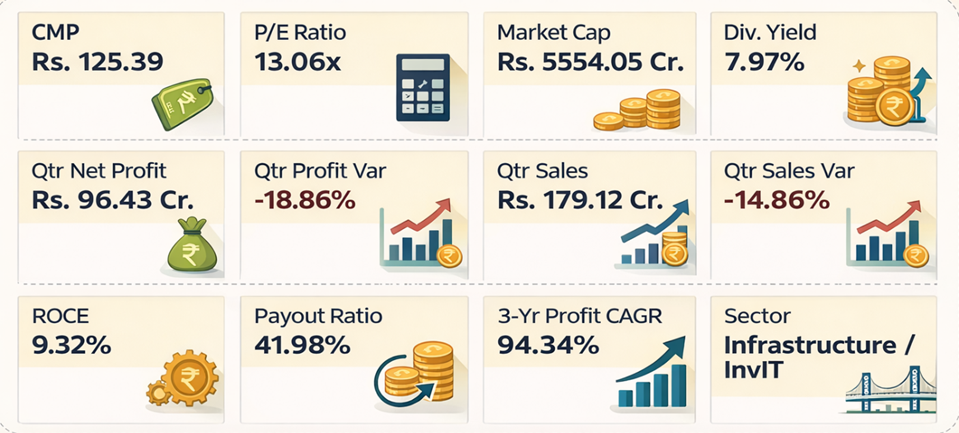
Quarterly revenue and profit declines should be evaluated in the context of InvIT accounting: depreciation charges, timing of distributions, and asset contribution accounting can create apparent volatility in reported profit even when underlying cash generation is stable. Investors in InvITs should focus on Distribution per Unit (DPU) trends rather than quarterly profit figures.
Company Strategy
India Infrastructure Trust's strategy is centred on three pillars: acquiring high-quality operational transmission assets with long-tenor regulated tariff streams, optimising the cost of capital to maximise distributable yields for unitholders, and leveraging KKR's global infrastructure relationships to access proprietary deal flow.
The trust is actively evaluating additional transmission assets for acquisition — India's massive power capacity addition programme (targeting 500 GW of renewable energy by 2030) requires commensurate transmission network expansion, creating a multi-year pipeline of potential acquisition targets for InvITs. Each new asset acquisition, if priced accretively, should grow the per-unit distribution.
The trust's debt financing strategy focuses on locking in long-term fixed-rate borrowings — insulating distributions from interest rate volatility. This asset-liability management approach is a critical differentiator from InvITs that rely on floating-rate debt.
Financial Performance Analysis
The ROCE of 9.32% is appropriate for regulated transmission infrastructure and compares favourably with bond yields. The 94.34% three-year profit CAGR reflects portfolio growth from asset acquisitions rather than organic earnings improvement within existing assets. Regulated transmission assets have stable, inflation-linked tariffs that provide predictable cash flows with minimal volume risk.
Dividend and Distribution Policy
As a SEBI-regulated InvIT, India Infrastructure Trust distributes a minimum of 90% of its distributable cash flows on a quarterly basis. The 7.97% yield is supported by regulated transmission revenues with government counterparties. The CPI-linkage in tariff escalation clauses provides a structural inflation hedge that fixed-income instruments cannot offer.
Management Outlook
KKR's infrastructure team has identified India's power sector as a priority investment theme, with the trust positioned as the primary vehicle for KKR's transmission asset acquisitions in India. Management expects to grow the portfolio through selective acquisitions, improving per-unit distributions as the asset base expands.
Q: What is an InvIT and how does it differ from a REIT?
A: An InvIT (Infrastructure Investment Trust) invests in operational infrastructure assets like power lines, roads, and pipelines — unlike REITs which invest in real estate. Both structures are regulated by SEBI and must distribute 90%+ of cash flows.
Q: Why is the quarterly revenue of the trust declining?
A: Quarterly fluctuations in InvIT revenues reflect timing of asset contributions, maintenance schedules, and accounting adjustments. Investors should evaluate trailing 12-month DPU trends rather than single-quarter revenues.
Q: Is the 7.97% yield safe?
A: The yield is backed by 35-year transmission tariff contracts with government counterparties — among the most creditworthy available in India. However, distributions can vary based on asset performance and acquisition activity.
Q: How are InvIT distributions taxed in India?
A: InvIT distributions are classified into interest income, dividend, and return of capital — each attracting different tax treatment. Investors should consult a tax advisor for their specific situation.
Q: Who sponsors India Infrastructure Trust?
A: KKR, the global alternative investment management firm, sponsors the trust and provides strategic direction, deal origination capability, and institutional governance.