

Key Highlights
- 35% dividend yield from India's largest E&P company — cornerstone of the Indian energy sector
- Maharatna PSU — Government holds majority stake; structural motivation for maintaining large dividends
- Produces ~70% of India's domestic crude oil and ~60% of domestic natural gas — critical energy security role
- 3,56,084 Cr market cap — one of India's 10 largest listed companies; Nifty 50 constituent
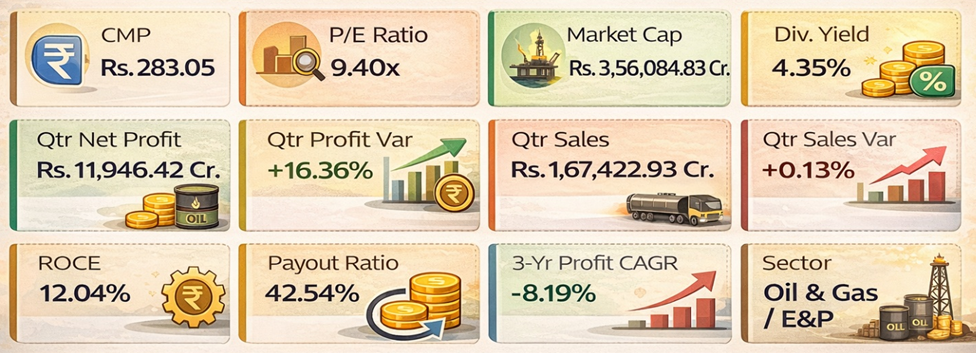
- Quarterly profit growth of 16.36% YoY — strong earnings recovery despite flat revenues
- Payout ratio of 42.54% — moderate; room for dividend growth as earnings recover
- Controlling stake in HPCL — downstream integration provides revenue diversification and refining margins
- International operations via ONGC Videsh in 30+ countries — global E&P diversification
Company Overview
Oil and Natural Gas Corporation Limited (NSE: ONGC) is India's largest and most strategically important energy company — a Maharatna PSU that has been the backbone of India's energy security since 1956. ONGC accounts for approximately 70% of India's domestic crude oil production and 60% of natural gas production, making it indispensable to India's economy and the energy security calculus of the Government of India.
The company operates across the full upstream E&P value chain in India — exploration, appraisal, development, and production — with assets concentrated in the Mumbai High offshore basin (India's largest oilfield), the eastern offshore KG Basin, and several onshore basins across Rajasthan, Gujarat, and Assam. ONGC also holds a controlling stake in Hindustan Petroleum Corporation Limited (HPCL) — providing downstream integration and refinery-to-retail revenue exposure.
Stock Performance and Valuation
Company Strategy
ONGC's strategic agenda is undergoing the most significant transformation in the company's history, driven by the twin imperatives of production renewal and energy transition preparedness. The strategy is organised around four pillars: domestic production growth, international portfolio management, new energy diversification, and operational efficiency.
Domestic production growth requires reversing the decline trajectory at aging Mumbai High fields through Enhanced Oil Recovery (EOR) technologies — including water flooding, polymer flooding, and CO2 injection. ONGC is also accelerating development of new discoveries in the KG Basin deepwater, which holds significant reserves potential but requires complex deepwater production technology.
ONGC Videsh — the international E&P subsidiary — manages assets in Russia, Brazil, Myanmar, Bangladesh, Mozambique, and other countries. These international assets contribute meaningfully to ONGC's production and earnings and provide geographic diversification from India-specific policy and regulatory risks.
New energy is ONGC's forward-looking strategic pillar. The company has announced targets to build 10 GW of renewable energy capacity by 2030 — a significant commitment for an upstream oil company. This includes solar, wind, and green hydrogen projects. ONGC's land holdings across India's energy-producing states provide a natural advantage for renewable energy development.
ONGC Green Limited — a dedicated renewable energy subsidiary — has been formed to execute the clean energy strategy. If successful, this could transform ONGC's corporate narrative from 'fossil fuel producer facing energy transition' to 'integrated energy company navigating energy transition' — a re-rating catalyst that the market is not yet pricing.
Financial Analysis and Dividend Sustainability
The 16.36% quarterly profit growth despite near-flat revenues reflects improved net realisations on domestic crude and gas — a positive margin signal. The negative 3-year profit CAGR reflects the COVID-19 demand destruction of 2020 and volatile crude prices since. ROCE of 12.04% is appropriate for a capital-intensive E&P business. The payout ratio of 42.54% provides room for dividend maintenance across commodity cycles.
Q: How much of India's oil does ONGC produce?
A: Approximately 70% of India's domestic crude oil production and 60% of domestic natural gas production — making ONGC irreplaceable in India's energy security infrastructure.
Q: What is ONGC's renewable energy target?
A: ONGC targets 10 GW of renewable energy capacity by 2030 through its dedicated subsidiary ONGC Green Limited — a major strategic pivot toward clean energy.
Q: What is ONGC's stake in HPCL?
A: ONGC holds a controlling stake (approximately 54.9%) in Hindustan Petroleum Corporation Limited, providing downstream integration and exposure to petroleum retailing revenues.
Q: Why is ONGC's 3-year profit CAGR negative?
A: The negative CAGR reflects COVID-19 demand destruction in 2020, volatile crude prices, and government subsidy obligations that ONGC absorbs in high-fuel-price periods. Current quarterly growth is positive at 16.36%.
Q: Does ONGC have international operations?
A: Yes — through ONGC Videsh, the company holds E&P assets in 30+ countries including Russia, Brazil, Myanmar, Bangladesh, Mozambique, and several African nations.