

Key Highlights
- India's largest power sector NBFC — standalone loan book exceeding Rs. 9 lakh crore
- Combined with subsidiary REC, manages India's largest power financing pool of Rs. 14+ lakh crore
- Navratna PSU under Ministry of Power — sovereign-linked AAA credit rating, lowest borrowing costs
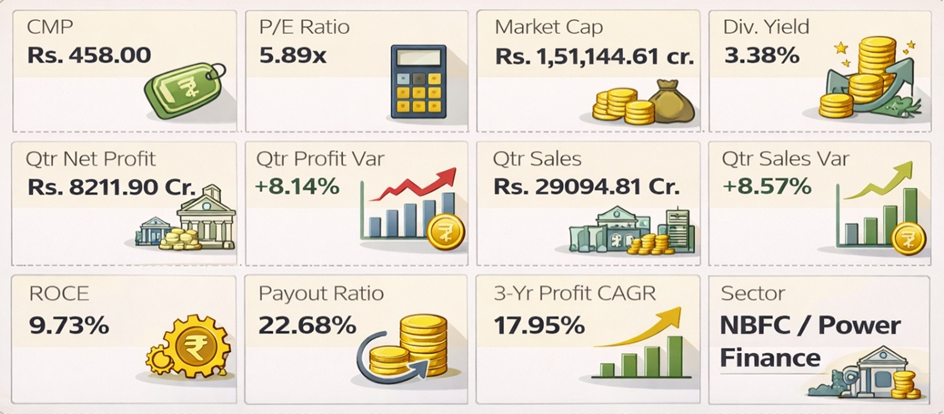
- P/E of 5.89x — one of the most undervalued large-cap PSU financials in India
- Quarterly profit growth of 8.14% and revenue growth of 8.57% — consistent, predictable expansion
- 3-year profit CAGR of 17.95% — sustained double-digit earnings compounding
- Payout ratio of only 22.68% — the most conservative in our coverage; highest dividend growth potential
- Renewable energy financing expanding as share of disbursements — improving credit quality profile
Company Overview
Power Finance Corporation Limited (NSE: PFC) is the cornerstone institution of India's power sector financing ecosystem. Established in 1986, PFC's sole mandate is to finance power sector projects — generation, transmission, distribution, and renewable energy — across India. With a standalone loan book exceeding Rs. 9 lakh crore and majority ownership of REC Limited, PFC is the single most impactful capital source for India's power sector transformation.
PFC's acquisition of a 52.63% controlling stake in REC Limited in 2019 — at a cost of approximately Rs. 14,500 crore — created a combined power financing entity of unrivalled scale and reach. The two companies operate independently under their respective brands but coordinate strategically on large infrastructure projects, avoiding duplication and maximising their combined impact on India's power sector.
Stock Performance and Valuation
Company Strategy
PFC's strategic framework for 2025-2030 encompasses five priorities: aggressive loan book growth in renewable energy, asset quality improvement in the legacy DISCOM portfolio, international financing expansion, green bond issuance, and digital transformation of credit processes.
The renewable energy lending push is PFC's most consequential strategic priority. India's 500 GW renewable target by 2030 — encompassing approximately 280 GW of solar, 140 GW of wind, and 60 GW of other renewable capacity — requires capital investment of Rs. 20-25 lakh crore. PFC and REC together are expected to finance 20-30% of this investment, implying an enormous growth opportunity for the combined entity's loan book.
Internationally, PFC is exploring opportunities to finance Indian infrastructure projects in South Asia and Africa — leveraging India's growing regional economic influence and the government's development financing agenda. This international expansion, while nascent, could provide significant long-term growth and geographic diversification.
On asset quality, the resolution of stressed thermal power plants — many of which were restructured under the government's SAMADHAN scheme — has improved PFC's legacy NPA position significantly. The RDSS scheme for DISCOM modernisation is further reducing systemic risk in PFC's largest borrower category.
Financial Analysis
PFC's 8.14% quarterly profit growth and 8.57% revenue growth are consistent and predictable — hallmarks of a well-run regulated financial intermediary. The ROCE of 9.73% is appropriate for a government-mandated lender that prioritises infrastructure impact alongside commercial returns. The 17.95% three-year profit CAGR reflects both organic loan book growth and the improving financial health of the power sector.
Dividend Growth Opportunity
PFC's 22.68% payout ratio is the most conservative in this report — representing the single largest opportunity for dividend growth among the 15 stocks analysed. As earnings grow at 17.95% CAGR and government dividend expectations increase, PFC's total shareholder return could significantly exceed its current 3.38% yield.
Q: How is PFC different from REC Limited?
A: PFC has a larger standalone loan book (Rs. 9+ lakh crore vs. REC's Rs. 5.5+ lakh crore) and owns a controlling stake in REC. Both are government power sector NBFCs serving overlapping customer bases, but operate independently under their own brands.
Q: What is PFC's combined loan book with REC?
A: Together, PFC and REC manage a combined power sector loan book of over Rs. 14 lakh crore — the largest infrastructure lending pool in India.
Q: Why is PFC's P/E so low at 5.89x?
A: The market applies a discount to PSU financials reflecting concerns about DISCOM asset quality and government pricing interference. Many analysts consider this discount excessive given PFC's earnings consistency and sovereign backing.
Q: What is the DISCOM risk for PFC?
A: State electricity distribution companies (DISCOMs) are among PFC's largest borrowers and have historically faced financial stress. Government schemes like RDSS are improving DISCOM health, but this remains a key risk to monitor.
Q: What is PFC's dividend growth potential?
A: With a payout ratio of just 22.68% and 3-year profit CAGR of 17.95%, PFC has the highest dividend growth potential in our India coverage — both from earnings growth and from increasing government dividend direction to PSUs.