

Reliance Industries Ltd. (RIL) shares recently rallied about 3% amid rising crude oil prices and improving refining economics, with brokerages suggesting that the recent selloff in the stock may have been overdone. The optimism is largely tied to the potential impact of Middle East tensions on global oil supply, which could boost refining margins—particularly diesel crack spreads—benefiting Reliance’s oil-to-chemicals (O2C) business.
As of early March 2026, Reliance shares were trading around ₹1,345–₹1,388, with a market capitalization exceeding ₹18 lakh crore, making it India’s most valuable listed company.
The rally reflects renewed investor confidence that improving global refining margins could translate into stronger earnings for the energy-to-telecom conglomerate.
Stock Performance and Recent Rally
Reliance shares had recently been under pressure due to broader market weakness and concerns over the energy segment. For instance, the stock closed at ₹1,345.55 on March 4, down slightly from the previous session, and remains about 16% below its 52-week high of ₹1,611.20 reached in January 2026.
Despite this correction, the recent 3% intraday rebound indicates that investors are reassessing the outlook for the company’s core refining business as crude markets tighten.
Over a longer horizon, the stock has still delivered solid returns, gaining nearly 17% over the past year, even as it faced short-term volatility linked to oil price swings and global economic concerns.
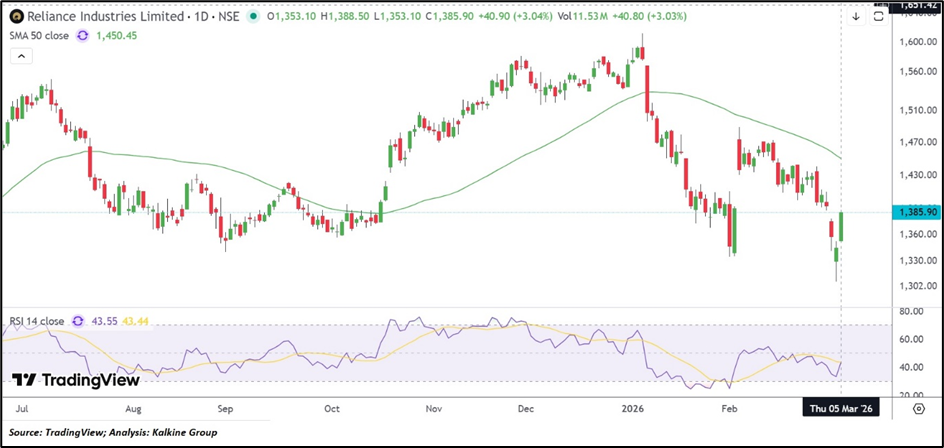
Technical Perspective: Reliance Industries Limited (NSE: RIL) is currently trading near ₹1,385.90, remaining below its 50-day Simple Moving Average around ₹1,450.45, which is acting as an immediate technical reference level. The recent price structure reflects a partial recovery following a corrective phase, with the stock currently moving within a consolidation range. The 14-day RSI near 43.55 indicates moderate momentum conditions without a clear directional tilt. On the downside, the ₹1,300.00–₹1,200.00 zone may serve as an important support range. Meanwhile, on the upside, the ₹1,700.00–₹1,800.00 band may act as a potential resistance area in the near term.
Rising Diesel Crack Spreads: Key Margin Driver
The biggest catalyst behind the renewed optimism is the surge in diesel crack spreads, which have reportedly jumped to around $35–$42 per barrel. Crack spreads represent the difference between the price of crude oil and the price of refined products such as diesel, gasoline, and jet fuel.
For refiners like Reliance, wider crack spreads translate directly into higher refining profitability.
Reliance operates the world’s largest refining complex at Jamnagar, with a combined capacity exceeding 1.4 million barrels per day, allowing it to process heavy and discounted crude grades while producing high-value fuels.
When diesel cracks move above $30 per barrel, refining margins tend to expand significantly for complex refiners. At the current $35–$42 range, analysts expect global refiners—especially export-oriented ones like Reliance—to see a notable boost in earnings.
How Crude Oil Prices Affect Reliance’s Margins
Crude oil prices influence Reliance’s margins through multiple channels.
- Refining Margins (GRM)
The company earns refining profits based on the gross refining margin (GRM), which reflects the spread between crude input costs and product prices.
If crude rises from, say, $80 to $90 per barrel, but diesel and gasoline prices rise faster due to supply disruptions, GRMs increase.
Reliance historically reports GRMs $2–$4 per barrel above global benchmarks, thanks to its complex refining configuration.
- Petrochemical Spreads
Reliance also produces petrochemicals such as polyethylene and polypropylene, derived from crude-based feedstocks. Rising crude can increase feedstock costs, potentially compressing margins if chemical prices do not rise proportionally.
However, improving global demand and supply disruptions can support polymer prices, partially offsetting higher feedstock costs.
- Inventory Gains
When crude prices rise rapidly, refiners may also record inventory gains, as previously purchased crude becomes more valuable relative to current market prices.
Export Advantage for Reliance
Reliance’s Jamnagar complex is largely export-oriented, supplying refined fuels to markets across Asia, Europe, and Africa. When global supply disruptions occur, export refiners often benefit more than domestic-focused players.
If Middle East tensions disrupt shipping routes or reduce regional supply, buyers may increasingly turn to Indian refiners. This could push export realizations higher and support refining margins.
India has already emerged as a major refining hub, and Reliance remains one of the largest exporters of refined petroleum products globally.
Broader Business Cushion
While the refining segment remains important, Reliance’s earnings are increasingly diversified.
Key growth drivers include:
- Reliance Jio, India’s largest telecom operator
- Reliance Retail, the country’s biggest retailer
- New investments in renewable energy, green hydrogen, and digital services
These segments provide relatively stable cash flows that help offset volatility in oil and petrochemical markets.
Risks to Watch
Despite the positive outlook, several risks remain.
- A sharp spike in crude without corresponding product price increases could compress refining margins.
- Slower global economic growth could weaken fuel demand.
- Petrochemical demand remains sensitive to industrial activity in China and Europe.
Additionally, geopolitical developments affecting energy markets can quickly alter refining economics.
Outlook
The recent 3% rally in Reliance Industries shares reflects growing confidence that rising crude prices and stronger diesel cracks could significantly boost refining profitability.
With consensus analyst targets ranging from ₹1,700 to ₹1,800, the stock still offers potential upside if refining margins remain elevated and the company’s telecom and retail businesses continue to expand.
In the near term, investors will closely watch global crude prices, crack spreads, and geopolitical developments in the Middle East to gauge whether the current momentum in Reliance shares can be sustained.