

Highlights
- Bitcoin slipped below the key $60,000 mark as selling pressure persisted.
- Spot Bitcoin ETF outflows extended into a seventh consecutive week.
- Higher U.S. inflation and expectations of elevated interest rates weighed on sentiment.
- Investors continued to rotate toward assets with stronger earnings visibility.
- Technical indicators suggest momentum remains subdued in the near term.
Introduction
Bitcoin remained under pressure after falling below the psychologically important $60,000 level, reflecting cautious market sentiment across the cryptocurrency space. Persistent outflows from spot Bitcoin exchange-traded funds (ETFs), expectations of higher U.S. interest rates, and sticky inflation data have reduced risk appetite. While Bitcoin attempted to stabilize around current levels, broader macroeconomic uncertainty continues to influence price action.
Why Are ETF Outflows Continuing to Pressure Bitcoin?
One of the biggest factors weighing on Bitcoin is the continued withdrawal of capital from spot Bitcoin ETFs. The market has now witnessed seven consecutive weeks of net outflows, indicating that institutional participation remains subdued. Investors have continued to reduce exposure to cryptocurrencies as uncertainty surrounding monetary policy and global markets persists, limiting fresh buying interest.
How Is the Federal Reserve Outlook Affecting Crypto Markets?
Recent U.S. inflation data reinforced expectations that the Federal Reserve may keep interest rates elevated for longer. Higher interest rates generally reduce the appeal of speculative assets such as cryptocurrencies because investors tend to shift toward income-generating investments. As a result, Bitcoin has remained under pressure while traders closely monitor upcoming economic data for further policy signals.
Why Is Investor Sentiment Remaining Cautious?
Apart from monetary policy concerns, capital rotation into sectors with stronger fundamental visibility has also affected cryptocurrency demand. Market participants have become increasingly selective, favouring assets backed by stable earnings expectations while reducing exposure to more volatile investments. This cautious approach has limited Bitcoin's ability to sustain any meaningful recovery despite occasional short-term rebounds.
Technical Outlook for Bitcoin
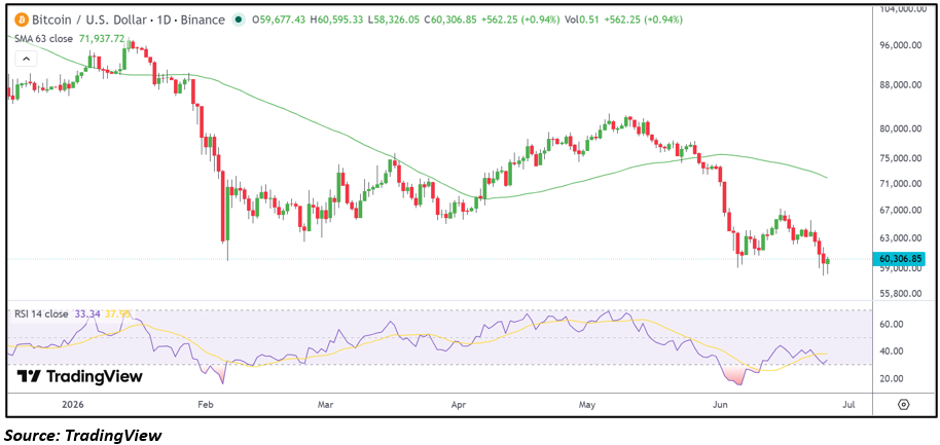
Bitcoin is currently trading near $60,306.85, while remaining below its 63-day Simple Moving Average of $71,937.72, indicating that the broader technical structure remains under pressure. The 14-day RSI is positioned near 33.34, suggesting weak momentum conditions. Immediate support is placed around $58,799.18 and $57,291.51, while resistance is seen near $61,814.52 and $63,322.19. A sustained move above resistance may improve near-term sentiment, while a break below support could expose Bitcoin to additional downside pressure.
Conclusion
Bitcoin continues to face headwinds as ETF outflows, elevated U.S. interest-rate expectations, and cautious investor positioning weigh on market sentiment. Until macroeconomic conditions improve and institutional inflows return, price action is likely to remain sensitive to economic data releases and broader risk sentiment across global financial markets.
FAQ
Q: Why did Bitcoin fall below $60,000?
A: Bitcoin declined due to continued ETF outflows, higher U.S. inflation, and expectations that interest rates could remain elevated for longer.
Q: How do higher interest rates affect Bitcoin?
A: Higher interest rates generally reduce demand for speculative assets such as cryptocurrencies as investors shift toward assets offering more predictable returns.
Q: What is putting pressure on investor sentiment?
A: Persistent ETF outflows, macroeconomic uncertainty, and cautious positioning across financial markets have weakened overall sentiment.
Q: What technical levels are important for Bitcoin?
A: Immediate support is located near $58,799.18 and $57,291.51, while resistance is placed around $61,814.52 and $63,322.19.