

Highlights
- Bitcoin slipped toward the $62,000 level as geopolitical tensions intensified.
- Renewed conflict in the Middle East reduced appetite for risk assets.
- Rising oil prices revived inflation concerns and expectations of tighter monetary policy.
- Institutional flows into Bitcoin ETFs remained subdued.
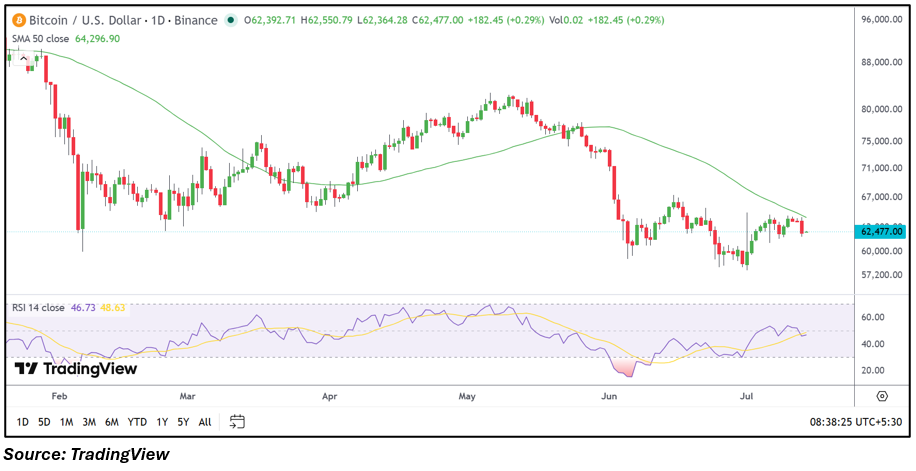
- Bitcoin traded near $62,477.00 during the session.
Geopolitical Risks Push Bitcoin Lower
Bitcoin remained under pressure as investors shifted away from risk-sensitive assets following renewed tensions in the Middle East. Escalating conflict and uncertainty surrounding shipping through the Strait of Hormuz lifted energy prices and increased market volatility, prompting traders to reduce exposure to cryptocurrencies despite Bitcoin attempting to stabilize above the $62,000 mark.
Risk-Off Sentiment Returns to Financial Markets
Renewed geopolitical uncertainty strengthened demand for traditional defensive assets while weighing on digital assets. Higher crude oil prices revived concerns about another inflation shock, leading markets to reassess the outlook for global interest rates. Expectations that borrowing costs could remain elevated for longer reduced demand for speculative assets such as cryptocurrencies.
Inflation Concerns Add to Market Pressure
The surge in energy prices has increased concerns that inflation could remain persistent in the coming months. If inflation accelerates, central banks may maintain tighter monetary policies for longer than previously anticipated. Higher interest rates generally reduce liquidity across financial markets and can limit investment flows into high-risk assets, including cryptocurrencies.
Institutional Participation Remains Cautious
Market participants also continued monitoring institutional activity, with exchange-traded fund flows remaining relatively subdued in recent weeks. Softer institutional demand has reduced one of the key sources of support that helped drive Bitcoin higher earlier in the year, leaving prices more sensitive to macroeconomic and geopolitical developments.
Technical Picture Reflects Ongoing Consolidation
Bitcoin traded around $62,477.00 while remaining below its 50-day Simple Moving Average near $64,296.90, indicating that the broader trend remains under pressure. The 14-day Relative Strength Index stood near 46.73, suggesting momentum remains neutral after recovering from oversold conditions. Price action shows Bitcoin consolidating as traders await greater clarity on geopolitical developments and macroeconomic signals.
Key Technical Levels to Watch
Immediate support is placed near $60,915.00, while the next important support is around $59,353.00. On the upside, immediate resistance is seen near $64,039.00, followed by the next resistance around $65,601.00. A decisive move beyond these levels could determine Bitcoin's next directional trend.
Macro Developments Remain the Primary Driver
Market participants will closely monitor developments in the Middle East, movements in crude oil prices, inflation expectations, central bank policy signals and institutional investment flows, as these factors are expected to remain the primary drivers of cryptocurrency market sentiment in the near term.
Frequently Asked Questions
Q: Why is Bitcoin falling today?
A: Bitcoin is under pressure as renewed Middle East tensions, higher oil prices and inflation concerns have reduced demand for risk-sensitive assets.
Q: How do oil prices affect Bitcoin?
A: Rising oil prices can increase inflation expectations, potentially leading to higher interest rates, which generally reduce investor appetite for speculative assets such as cryptocurrencies.
Q: What is the current technical outlook for Bitcoin?
A: Bitcoin is trading below its 50-day Simple Moving Average while the RSI remains near neutral levels, indicating consolidation after recent volatility.
Q: What are the important technical levels for Bitcoin?
A: Immediate support is around $60,915.00 and $59,353.00, while resistance is located near $64,039.00 and $65,601.00.