

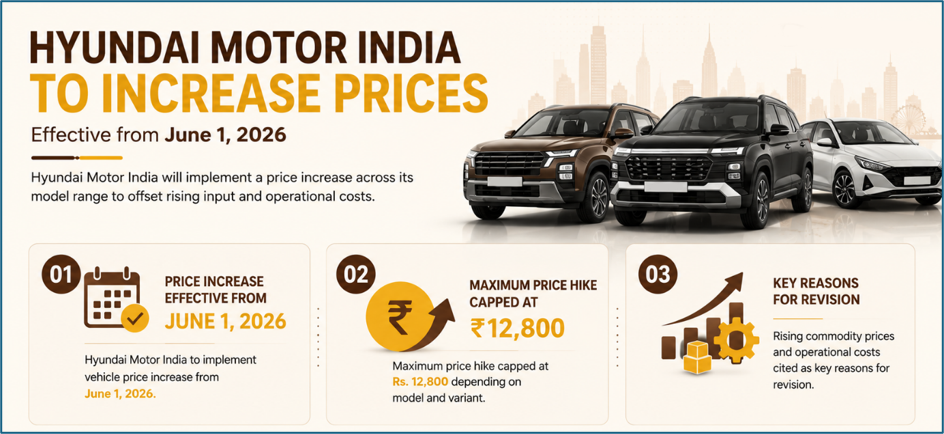
Hyundai Motor India Limited (NSE:HYUNDAI) informed stock exchanges that the company will implement revised vehicle prices effective June 1, 2026. The increase follows an earlier communication issued on April 8, 2026 regarding proposed pricing changes.
The automaker stated that the price increase would be up to a maximum of Rs. 12,800, varying across models and variants in its portfolio.
Reasons Behind Price Increase
According to the company, the revision has been necessitated due to rising input costs, higher commodity prices, and increased operational expenses. Hyundai Motor India noted that despite ongoing efforts to optimise costs internally, some portion of the cost escalation is being passed on to the market.
The company described the increase as nominal and indicated that it attempted to maintain a balanced approach toward customer interests while addressing cost pressures.
Source: Analysis by Kalkine
Industry Cost Pressures Continue
Automobile manufacturers in India have continued facing pressure from fluctuations in raw material prices, logistics costs, and supply chain expenses. Commodity-linked inputs including steel, aluminium, plastics, and electronics remain important cost components in vehicle manufacturing.
The sector has also been monitoring currency volatility and global economic developments that may influence production and operational costs.
Impact Across Models and Variants
Hyundai stated that the extent of the increase would differ based on vehicle model and variant configuration. The company did not disclose specific revised prices for individual models in the exchange filing.
The revised pricing structure is expected to apply across selected passenger vehicle offerings from June 2026 onward.
Company Positioning in Indian Market
Hyundai Motor India operates in the passenger vehicle segment with a portfolio spanning hatchbacks, sedans, SUVs, and electric vehicles. The company maintains manufacturing operations in Tamil Nadu and serves domestic as well as export markets.
Pricing adjustments remain a recurring industry practice when manufacturers face sustained increases in commodity and operating expenses.
Market and Sector Context
Automobile companies have periodically revised prices over the last few years in response to inflationary pressures and higher production costs. Vehicle manufacturers continue balancing demand conditions with profitability and operational sustainability.
Industry participants are also focusing on localisation strategies, production efficiencies, and supply chain management to offset input cost volatility.
Key Risks
- Higher vehicle prices may affect customer demand across price-sensitive segments.
- Commodity cost volatility may continue impacting automobile manufacturing margins.
- Competitive pricing pressure could influence future pricing flexibility in the sector.
- Supply chain disruptions may increase operational and logistics-related expenses.
Summary
Hyundai Motor India (NSE:HYUNDAI) announced a vehicle price increase effective June 1, 2026, with hikes of up to Rs. 12,800 depending on model and variant. The company cited rising input costs, commodity inflation, and operational expenses as key reasons. Hyundai stated it attempted to minimise customer impact while managing cost pressures. The revision follows broader pricing adjustments seen across India’s automobile industry.
FAQs
Q1: When will Hyundai’s revised vehicle prices become effective?
A: Hyundai Motor India will implement the revised prices from June 1, 2026.
Q2: What is the maximum announced price increase?
A: The maximum increase announced by the company is up to Rs. 12,800.
Q3: Why is Hyundai increasing vehicle prices?
A: The company cited rising input costs, commodity prices, and operational expenses for the revision.