

GST Collections Reach All-Time High in April 2026
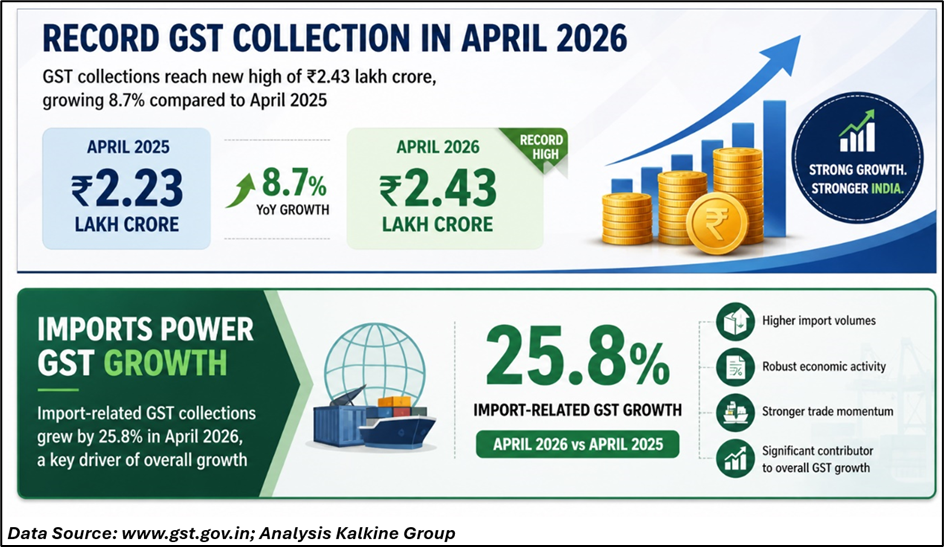
India recorded its highest-ever Goods and Services Tax (GST) collections of ₹2.43 lakh crore in April 2026, reflecting strong economic activity and improved tax compliance across sectors.
The latest GST collection figure represents a notable increase compared with ₹2.23 lakh crore recorded in April 2025, translating into a year-on-year growth of approximately 8.7 percent. The strong collections highlight sustained economic momentum despite global uncertainties and inflationary pressures.
April collections are traditionally strong due to year-end settlements and reconciliation payments from businesses, but the continued upward trajectory also signals resilience in India’s consumption-driven economy.
Import-Related GST Growth Signals Trade Strength
A key contributor to the record GST collections was strong growth in import-related GST revenues.
Import-related GST revenue recorded a 25.8 percent year-on-year increase, reflecting rising imports of goods and raw materials across sectors. This trend suggests strengthening industrial activity and improved demand for intermediate goods used in manufacturing and infrastructure projects.
However, domestic GST collections showed signs of moderation, indicating that while trade and industrial activity remain strong, consumption growth is stabilizing after a strong recovery phase in previous quarters.
Consumption Trends Reflect Mixed Momentum
Domestic consumption trends showed moderate growth during April, reflecting normalization after strong demand cycles observed earlier.
Consumer spending patterns remain stable but indicate selective demand across categories such as automobiles, FMCG, and discretionary goods. The moderation in domestic GST growth suggests that demand remains healthy but not overheated, supporting sustainable long-term economic expansion.
Strong GST collections also reflect continued improvements in compliance, digitalization of tax systems, and expanding formalization of the economy.
Sector-Wise Impact of Strong GST Collections
Higher GST collections typically signal broad-based economic strength and improved corporate earnings visibility across key sectors.
- Automobile Sector- Strong consumption trends typically support vehicle demand across passenger and commercial vehicle categories. Companies such as Maruti Suzuki India Limited (NSE:MARUTI), Mahindra & Mahindra Limited (NSE:M&M), and Tata Motors Passenger Vhcls Ltd (NSE:TMPV) are likely to benefit from improving retail sentiment and stable mobility demand.
- FMCG Sector- Stable consumption patterns strengthen demand outlook for consumer goods companies including Hindustan Unilever Limited (NSE:HINDUNILVR), ITC Limited (NSE:ITC), and Nestlé India Limited (NSE:NESTLEIND), particularly across rural and semi-urban markets.
- Infrastructure and Cement Sector- Higher GST inflows often correlate with rising construction activity and capital expenditure. Companies such as UltraTech Cement Limited (NSE:ULTRACEMCO), Shree Cement Limited (NSE:SHREECEM), and Larsen & Toubro Limited (NSE:LT) may benefit from increased infrastructure spending.
- Banking and Financial Sector- Improved economic activity supports credit growth and asset quality improvement across the banking sector. Major lenders including State Bank of India (NSE:SBIN), HDFC Bank Limited (NSE:HDFCBANK), and ICICI Bank Limited (NSE:ICICIBANK) could benefit from stronger credit demand and improving financial conditions.
Economic Outlook Strengthened by Fiscal Stability
Record GST collections strengthen India’s fiscal position and provide the government with improved revenue visibility.
Higher tax collections support public spending on infrastructure, welfare programs, and capital investment, which are critical drivers of long-term economic growth.
Improved fiscal health also enhances investor confidence and supports macroeconomic stability, particularly during periods of global economic volatility.
Continued policy focus on compliance enforcement and digital tax infrastructure is expected to sustain GST collection momentum over the coming quarters.
Market Implications for Equity Investors
Strong GST collections are often viewed as a leading indicator of economic health and corporate earnings growth.
Sustained growth in GST collections supports revenue visibility across sectors and strengthens investor sentiment toward cyclical industries such as automobiles, infrastructure, cement, and banking.
However, moderation in domestic consumption trends suggests that selective sectoral performance may continue, with companies linked to infrastructure and exports potentially outperforming consumption-heavy segments in the near term.
Conclusion
India’s record GST collection of ₹2.43 lakh crore in April 2026 highlights strong economic fundamentals and improved tax compliance. While import-driven growth remains robust, domestic consumption shows signs of normalization. Overall, the strong GST performance reinforces confidence in India’s growth trajectory and supports positive long-term market sentiment.
FAQs
- Why did GST collections rise sharply in April 2026?
Higher imports, improved compliance, and year-end reconciliation payments contributed to strong GST growth. - What does record GST collection indicate about the economy?
It reflects strong economic activity, improved formalization, and stable consumption patterns. - Which sectors benefit most from strong GST collections?
Automobiles, banking, infrastructure, FMCG, and cement sectors typically benefit from strong economic momentum.