

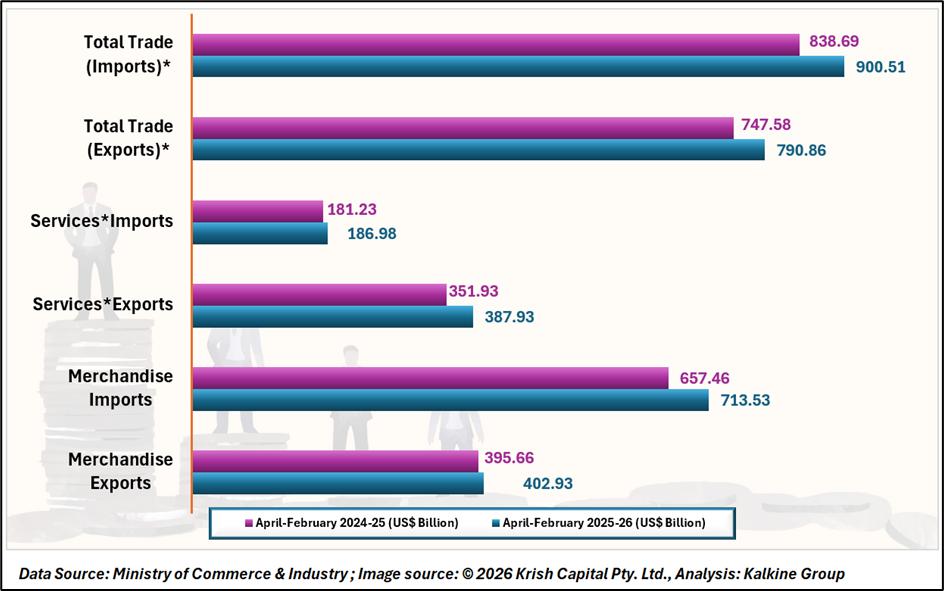
India’s external trade performance for April–February FY26 presents a picture of resilient growth supported by services exports, even as underlying imbalances begin to widen. Total exports (merchandise and services combined) rose to US$ 790.86 billion, marking a 5.79% increase over the previous year. This steady expansion reflects India’s growing integration with global markets, particularly in high-value services, which continue to anchor overall trade momentum.
Services Exports: The Silent Growth Engine
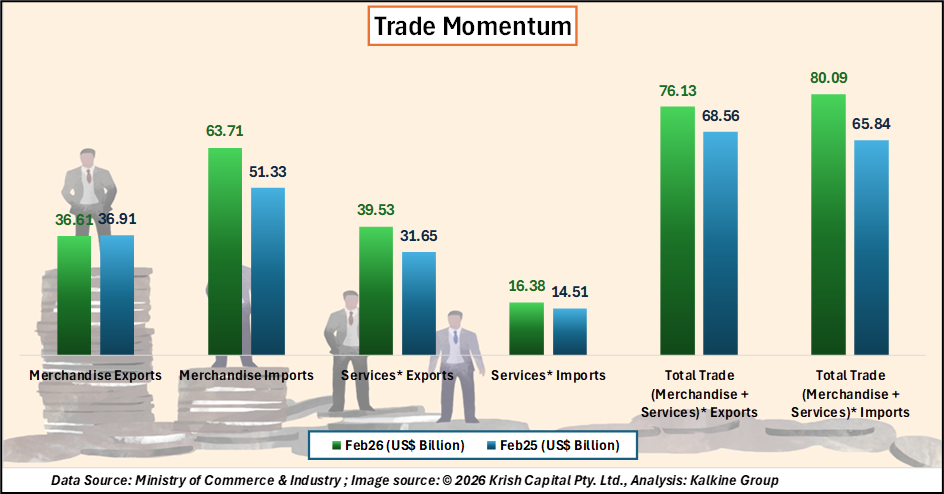
A major highlight of the current trade data is the robust performance of the services sector, with exports climbing to US$ 387.93 billion from US$ 351.93 billion last year. This strong growth underscores India’s global competitiveness in areas such as IT, consulting, and financial services. In February alone, services exports surged significantly, pushing total exports growth to 11.05% year-on-year, clearly indicating that services remain the key stabilizer in India’s trade mix amid global uncertainties.
Merchandise Exports: Slow Growth, Strong Pockets
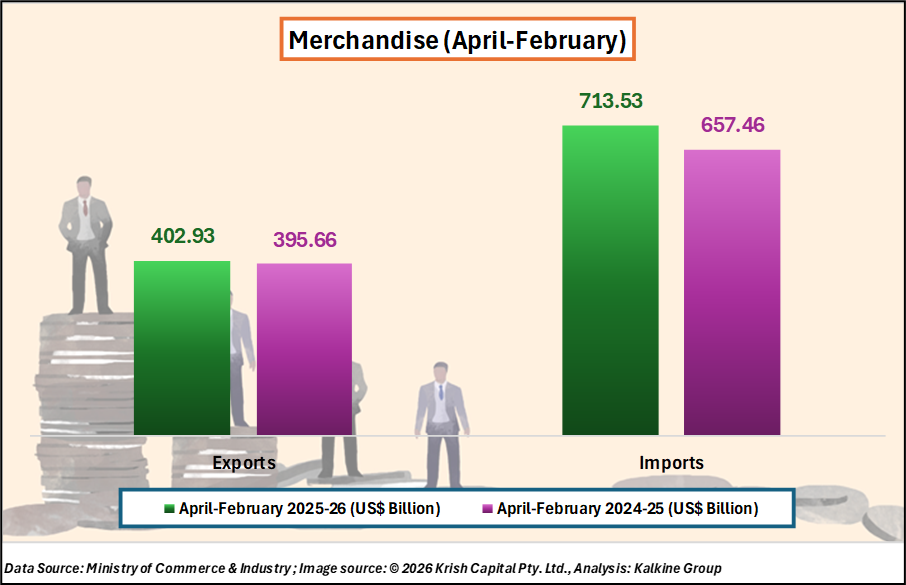
While overall merchandise exports growth remained modest at 1.84%, reaching US$ 402.93 billion, the underlying sectoral trends are encouraging. Key industries such as engineering goods, electronic goods, chemicals, gems & jewellery, and agri-based products recorded healthy growth in February. This suggests that India’s export basket is gradually shifting toward value-added and diversified segments, helping reduce reliance on traditional commodities and improving long-term resilience.
Diversification Gains Traction
The rise in non-petroleum exports, which grew by 5.03% to US$ 354.12 billion, highlights an important structural shift. Even more significant is the growth in non-petroleum, non-gems & jewellery exports, reflecting broad-based industrial strength rather than commodity-driven expansion. This trend points toward a more balanced and sustainable export profile, which is critical in navigating volatile global markets.
Imports Surge, Widening Trade Gap
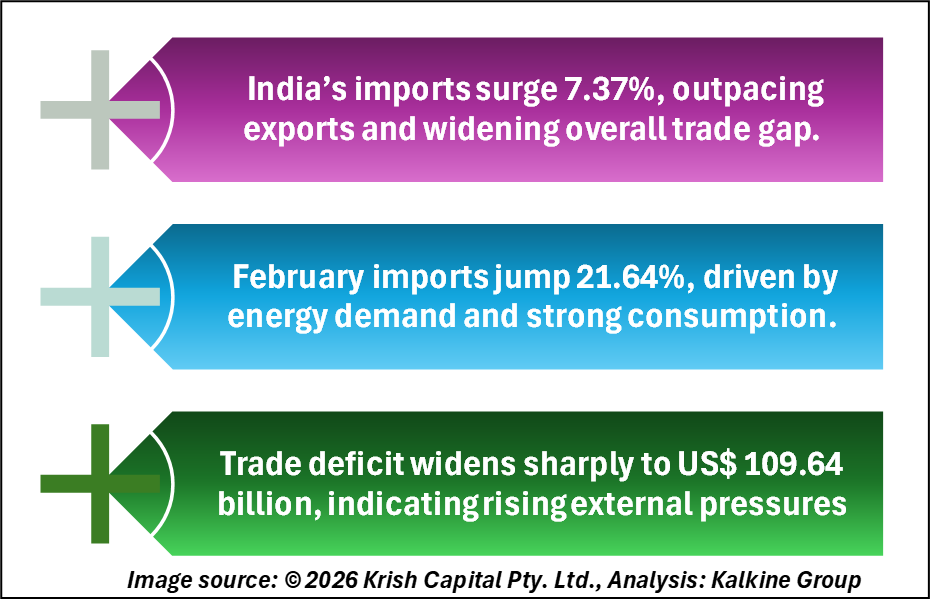
Despite steady export growth, India’s import bill has risen at a faster pace, increasing 7.37% to US$ 900.51 billion during the period. February saw an even sharper spike in imports, up 21.64% year-on-year, driven by strong domestic demand, energy needs, and higher purchases from major trading partners like China and the United States. As a result, the overall trade deficit widened to US$ 109.64 billion, while the merchandise trade deficit expanded significantly, highlighting growing external pressure.
Services Surplus: A Crucial Buffer
One of the most critical factors supporting India’s external stability is its services trade surplus, which stood at US$ 200.96 billion, up from US$ 170.69 billion last year. This surplus plays a vital role in offsetting the large merchandise trade deficit, effectively acting as a financial cushion for the economy. Without this strong services performance, India’s external balance would be considerably more vulnerable.
Outlook: Balanced Growth Needs Structural Push
Looking ahead, India’s trade outlook remains positive but cautiously optimistic. The continued strength in services exports and improving diversification in merchandise exports are strong positives. However, rising import dependence, especially on energy and critical inputs, along with a widening trade deficit, poses challenges.
Sustaining long-term growth will depend on enhancing manufacturing competitiveness, boosting exports of high-value goods, and reducing structural import reliance, ensuring a more balanced and resilient trade framework.