

Highlights
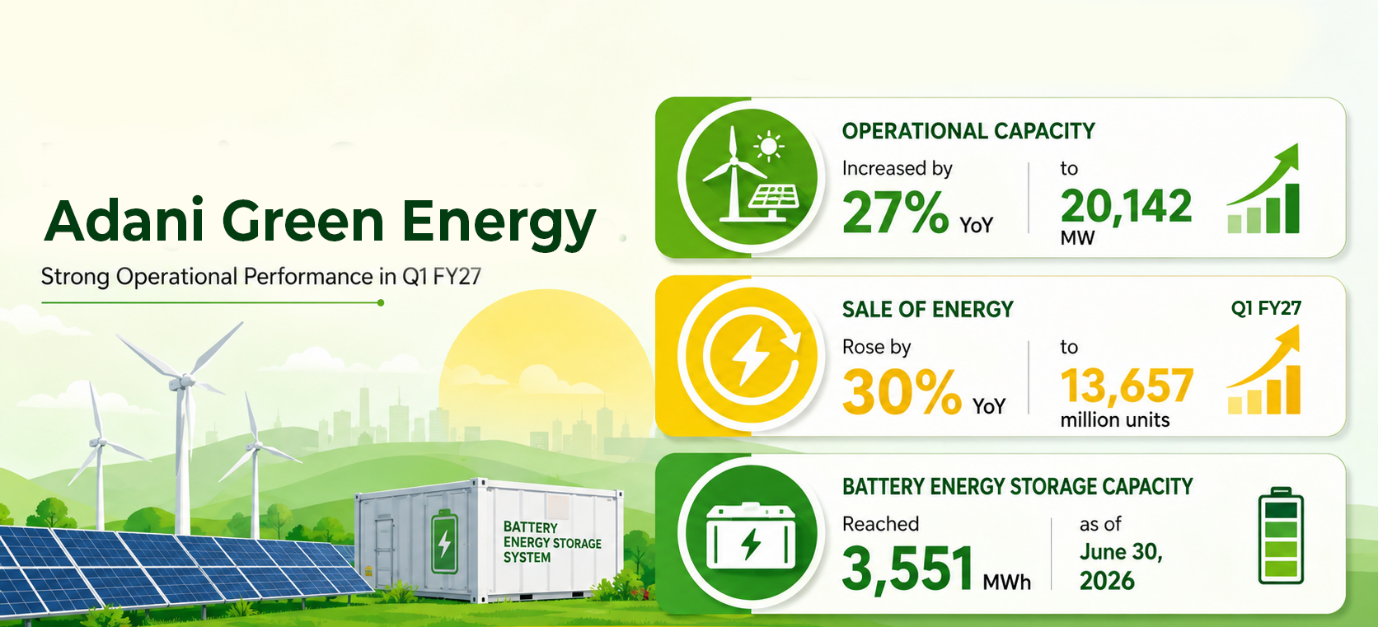
- Adani Green Energy increased operational capacity by 27% YoY to 20,142 MW.
- Sale of energy rose 30% YoY to 13,657 million units in Q1 FY27.
- Battery energy storage capacity reached 3,551 MWh as of June 30, 2026.
Adani Green Energy Limited (NSE:ADANIGREEN) reported a provisional operational update for the first quarter of FY27, highlighting growth in renewable energy capacity and electricity generation. The company said its operational renewable energy capacity increased 27% year-on-year to 20,142 MW, supported by greenfield additions of 4,327 MW. During the April–June quarter alone, AGEL added 848 MW of new operational capacity.
The operational portfolio comprises solar, wind and hybrid assets spread across multiple states. According to the company, the installed capacity is capable of supplying electricity to more than 9 million homes while avoiding around 37 million tonnes of CO2e emissions annually.
 Source: Analysis by Kalkine
Electricity Generation Rises on Capacity Addition
AGEL reported that sale of energy increased 30% year-on-year to 13,657 million units during Q1 FY27. The company attributed the increase to higher operational capacity following project additions during the year.
Operational capacity additions included 3,051 MW of solar projects, 684 MW of wind projects and 592 MW of hybrid projects. Among these, Khavda in Gujarat accounted for 2,662 MW of new solar capacity, 684 MW of wind capacity and the entire 592 MW of hybrid capacity added during the reported period. Rajasthan contributed an additional 389 MW of solar capacity.
Battery Storage Portfolio Continues to Grow
The company operationalised 1,972 MWh of Battery Energy Storage System (BESS) capacity at Khavda during Q1 FY27. This increased AGEL's total installed BESS capacity to 3,551 MWh as of June 30, 2026. The company described the deployment as one of the world's largest single-location battery storage installations.
Battery storage is designed to complement renewable energy generation by storing electricity for use when solar or wind output is lower, helping improve grid stability.
Operational Performance Metrics
AGEL reported a solar portfolio capacity utilisation factor (CUF) of 25.3%, supported by plant availability of 99.5%. The wind portfolio recorded a CUF of 44.4% with plant availability of 95.3%, while the hybrid portfolio delivered a CUF of 49.0% alongside plant availability of 98.8%.
The company stated that its Energy Network Operations Center monitors renewable assets across 12 states using predictive maintenance, machine learning and artificial intelligence tools to improve operational performance. It also noted that reported grid availability now incorporates grid curtailment beyond the national grid substation as part of its disclosure methodology.
Renewable Portfolio and Long-Term Target
As of June 30, 2026, AGEL's operational renewable energy portfolio stood at 20.1 GW. The company continues to target 50 GW of renewable energy capacity by 2030. The portfolio spans 12 resource-rich states and includes solar, wind, hybrid, pumped storage projects and battery energy storage systems.
The company said it has additional solar and wind sites in Khavda and Rajasthan as well as pumped storage project sites exceeding 5 GW for future development.
ESG and Operational Milestones
During the quarter, AGEL reported receiving an ESG Risk Rating score of 77 from ESG Risk Assessment & Insights Ltd. The company also retained the highest CRISIL ESG Score in the Indian power sector for the fifth consecutive year, improving its score from 66 to 69 in FY26.
In addition, AGEL said it maintained its Net Water Positive goal across its operational portfolio with a water balance index of 2.14 and received recognition including the Clean Power Generation Award at the Reuters Energy Industry Awards 2026 and the Golden Peacock Award 2026.
Key Risks
- Renewable generation depends on weather conditions affecting solar and wind output.
- Project execution may face construction and transmission infrastructure delays.
- Grid curtailment can affect electricity evacuation and reported availability.
- Renewable capacity expansion depends on regulatory and policy developments.
Summary
Adani Green Energy's provisional Q1 FY27 operational update showed a 27% year-on-year increase in operational capacity to 20,142 MW and a 30% rise in energy sales to 13,657 million units. The company expanded its battery storage portfolio, added renewable capacity across Gujarat and Rajasthan, and reported operational performance metrics alongside updates on ESG initiatives and long-term renewable energy expansion plans.
FAQs
Q: What was Adani Green Energy's operational capacity in Q1 FY27?
A: The company reported operational renewable energy capacity of 20,142 MW, representing a 27% year-on-year increase.
Q: How much did Adani Green Energy's electricity sales increase?
A: Sale of energy increased 30% year-on-year to 13,657 million units during the first quarter of FY27.
Q: What was AGEL's installed battery storage capacity at June 30, 2026?
A: The company reported total installed Battery Energy Storage System capacity of 3,551 MWh after adding 1,972 MWh during Q1 FY27.