

Key Highlights
- Indian Oil shares gained over 2% during Monday's session.
- Revenue from operations rose 27% year-on-year to ₹2.82 lakh crore.
- Consolidated net loss stood at ₹2,661 crore for Q1 FY27.
- Pipeline throughput reached a record 28.5 million metric tonnes.
- Panipat refinery expansion is 94% complete.
- The reported loss was lower than market expectations, supporting investor sentiment.
Why Did Indian Oil Shares Rise Despite Reporting a Quarterly Loss?
Indian Oil Corporation Limited (NSE: IOC), India's largest oil refining and fuel marketing company, remained in focus after announcing its Q1 FY27 results. Although the company reported a quarterly loss, the stock traded higher as investors looked beyond headline earnings and focused on resilient business operations. Better-than-expected financial performance relative to market estimates, coupled with record operational milestones and ongoing expansion projects, helped improve sentiment during the trading session.
Revenue Growth Stayed Strong Even as Crude Oil Prices Pressured Earnings
Indian Oil reported revenue from operations of ₹2.82 lakh crore during the June quarter, registering a healthy 27% year-on-year increase. However, the company posted a consolidated net loss of ₹2,661 crore compared with a profit of ₹6,808 crore in the corresponding quarter last year. Profitability came under pressure as higher international crude oil prices reduced retail fuel marketing margins, while LPG under-recoveries reached ₹665 per cylinder during the quarter. Even with these challenges, the reported loss was significantly lower than several market forecasts, which had anticipated a much deeper earnings decline.
Operational Milestones Continue to Strengthen Long-Term Growth Story
Despite weaker profitability, Indian Oil achieved record operational performance during the quarter. Pipeline throughput touched an all-time quarterly high of 28.5 million metric tonnes, reflecting steady fuel demand and efficient logistics operations. The company's Panipat refinery expansion has reached 94% completion, while the new PX-PTA petrochemical complex at Paradip is expected to be commissioned by the end of August 2026. Additionally, the proposed restructuring of senior management is aimed at improving operational efficiency and strengthening long-term execution capabilities.
Technical Setup Suggests Investors Are Watching Recovery Momentum
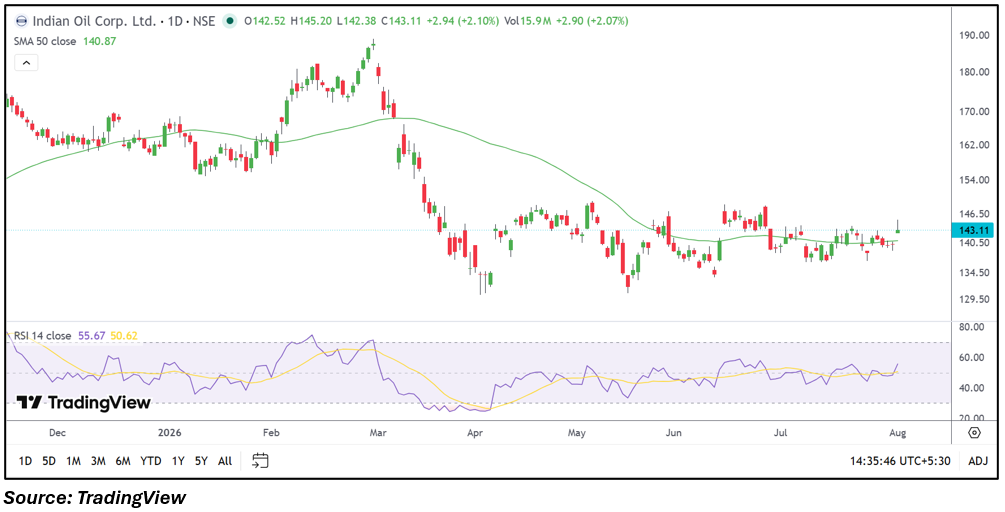
Indian Oil traded near ₹143.09 after opening at ₹142.52 and touching an intraday high of ₹145.20. The stock remained above its 50-day Simple Moving Average of ₹140.87, indicating that the medium-term trend continues to remain stable. The 14-day Relative Strength Index stood near 55.67, suggesting balanced momentum with scope for further movement depending on crude oil prices and upcoming quarterly developments.
Important Price Levels Traders Are Watching
Immediate support is placed near ₹140.90, followed by ₹138.20. On the upside, the first resistance is seen around ₹145.20. A sustained move above this level could strengthen the near-term trend and bring the ₹149.00 zone into focus.
Key Risks That Could Influence Future Performance
Indian Oil's earnings remain sensitive to fluctuations in global crude oil prices, refining margins, government fuel pricing policies and LPG subsidy-related under-recoveries. The pace of commissioning large refinery and petrochemical projects will also remain an important factor for long-term growth.
Market Takeaway
Indian Oil delivered a challenging earnings quarter, but the market focused on stronger-than-expected operational performance rather than the headline loss. Healthy revenue growth, record pipeline throughput and continued progress on strategic expansion projects helped support investor confidence, allowing the stock to trade higher despite near-term pressure on profitability.
Frequently Asked Questions
Q1. Why did Indian Oil shares rise despite a quarterly loss?
The stock gained because the reported loss was lower than market expectations, while operational performance and infrastructure expansion remained strong.
Q2. What revenue did Indian Oil report in Q1 FY27?
The company reported revenue from operations of ₹2.82 lakh crore, up 27% year-on-year.
Q3. Why did Indian Oil report a net loss?
Higher crude oil prices reduced fuel marketing margins, while elevated LPG under-recoveries also weighed on quarterly profitability.
Q4. What major expansion projects is Indian Oil currently undertaking?
The Panipat refinery expansion is 94% complete, and the Paradip PX-PTA petrochemical complex is expected to be commissioned by the end of August 2026.