

The excitement around artificial intelligence has drawn Indian retail investors toward AI penny stocks in India — low-priced shares of smaller companies claiming AI credentials listed on the NSE or BSE. While some of these companies have genuine AI-driven business models, others carry thin fundamentals dressed in AI marketing language. Separating real opportunity from speculative noise is the core challenge.
All prices mentioned in this article must be independently verified on NSE (nseindia.com) or BSE (bseindia.com) as share prices can change rapidly. This article is educational only and does not constitute investment advice.
Sector Overview
India's AI boom has not been confined to large-cap IT giants. A growing cohort of small-cap and micro-cap companies are building genuine AI capabilities in payments technology, cloud infrastructure, healthcare services, niche IT and data analytics. Many of these companies are listed on the NSE Emerge or BSE SME platforms, or as small-cap stocks on the main boards.
The government's IndiaAI Mission — a Rs 10,372-crore programme — and the broader push for domestic AI adoption have created real commercial opportunities for smaller companies. E2E Networks, for example, has positioned itself as an AI-focused cloud GPU provider, while AvenuesAI (formerly Infibeam Avenues) has repositioned itself as an AI-driven digital payments platform. However, the valuation reality of many such stocks reflects speculative excitement as much as underlying fundamentals.
Why AI Penny Stocks Matter in 2026
Several factors have pushed small-cap AI stocks into the spotlight in 2026.
- IndiaAI Mission spillover: Government AI spending is not limited to large enterprises — smaller infrastructure and software firms are eligible for contracts.
- Cloud GPU demand: India's rapid build-out of AI compute infrastructure is creating demand for domestic GPU cloud providers and hardware-adjacent companies.
- Low absolute price appeal: Retail investors are often drawn to low-priced stocks as they appear 'affordable' per share — though the share price alone does not determine value.
- Potential for outsized returns: Smaller companies can potentially grow faster in percentage terms from a low base, though this is matched by higher downside risk.
- Agentic AI adoption: Small companies with narrow AI niches — healthcare AI, payments AI, enterprise automation — may capture disproportionate market share in specific verticals.
Key AI Penny Stocks to Watch
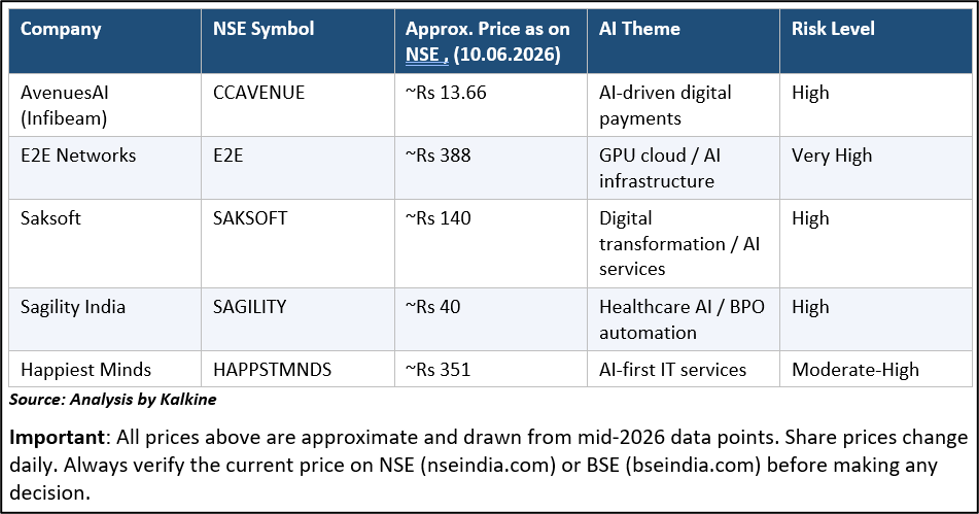
Company-by-Company Analysis
AvenuesAI (formerly Infibeam Avenues) (NSE:CCAVENUE)
Business: AvenuesAI rebranded from Infibeam Avenues in 2025, reflecting its evolution from an e-commerce platform to a full-stack AI-driven digital payments provider. It operates CCAvenue, one of India's largest payment gateways, alongside enterprise software and fintech infrastructure.
AI Exposure: The company has repositioned its entire stack around AI-driven payments processing, fraud detection and fintech automation. It describes itself as an 'agentic fintech' company focused on AI-powered payment solutions for enterprises in India and emerging markets.
Financial Trend: Net profit rose 61.67% to Rs 79.38 crore in Q4 FY26, while sales rose 114.52% to Rs 2,489.54 crore for the quarter. Full-year FY26 net profit grew 23.78% to Rs 279.04 crore and revenue more than doubled to Rs 8,115.85 crore. Market capitalisation as of June 2026 was approximately Rs 4,887 crore. The share was trading around Rs 13-14 with a P/E of approximately 17x — verify on NSE.
Risk: The stock was down around 41% from its 52-week high as of June 2026, illustrating the significant price volatility in this category. Competitive fintech landscape; risk that 'AI' rebrand does not translate into structural earnings improvement; regulatory risk in payments.
E2E Networks — (NSE:E2E)
Business: E2E Networks is a Delhi-based NSE-listed cloud platform offering GPU-as-a-service and AI/ML infrastructure. Its offerings include cloud GPU instances (H100, H200, A100, V100), the TIR AI/ML platform, AI Labs-as-a-Service, and sovereign cloud solutions.
AI Exposure: E2E is a direct pure-play on India's AI compute boom. As domestic AI training and inference workloads grow — driven by startups, enterprises and government AI projects — demand for affordable GPU cloud is increasing. The company has benefited from Nvidia's strong earnings cycle and rising AI infrastructure investment in India.
Financial Trend: Market capitalisation was approximately Rs 8,404 crore as of mid-2026. The company approved a 10-for-1 share split in 2026, making shares more accessible to retail investors. Verify current revenue and profit figures on NSE/BSE as the company is in a rapid growth phase.
Risk: On June 9, 2026, E2E Networks hit a lower circuit at Rs 408.8 with no buyers — illustrating the acute liquidity risk of small-cap AI infrastructure stocks. Hardware and cloud infrastructure businesses have high capex requirements; revenue concentration risk; competition from larger cloud providers; Nvidia GPU pricing dynamics can affect margins significantly.
Saksoft — (NSE:SAKSOFT)
Business: Saksoft is a Chennai-based IT services company founded in 1999 that has evolved into a digital transformation and data analytics specialist, serving enterprise clients globally. It is listed on NSE.
AI Exposure: Saksoft provides data engineering, cloud migration, and AI-augmented analytics services. It is a smaller-scale version of Persistent Systems — a digital-first IT firm leveraging AI tools to deliver faster, lower-cost enterprise transformation.
Financial Trend: Revenue grew approximately 15% over the past three years; EPS grew 13% annually. Q3 FY26 EPS was Rs 2.27 (up from Rs 2.12 a year earlier) and revenue was Rs 2.54 billion, up 12% YoY. The company has delivered one of the strongest 5-year stock returns among Indian small-cap IT names at approximately 408.5% over five years. Verify current price on NSE.
Sagility India — (NSE:SAGILITY)
Business: Sagility India (formerly listed as Sagility Limited from August 2025) is a Bengaluru-based healthcare IT and BPO company offering AI-powered revenue cycle management, document processing, contract automation and genAI solutions for the US healthcare sector.
AI Exposure: Healthcare is one of the most AI-intensive verticals globally, and Sagility's platforms are built around AI-driven automation of claims processing, prior authorisation, and clinical documentation. The genAI solutions segment addresses a large addressable market as US healthcare payers and providers seek cost reduction.
Financial Trend: The share was trading around Rs 40 as of mid-2026 per publicly available data — verify current price on NSE. The company was incorporated in 2021 and listed relatively recently, meaning its financial history is limited and track record is shorter than more established peers.
Risk: Heavy dependence on the US healthcare sector which faces regulatory and reimbursement uncertainty; limited operating history as a listed entity; healthcare AI is competitive with many well-funded US-based competitors; integration and execution risk.
Happiest Minds Technologies — (NSE:HAPPSTMNDS)
Business: Happiest Minds (NSE:HAPPSTMNDS) is a Bengaluru-based mid-small IT firm founded by Ashok Soota that has positioned itself as a pure-play digital and AI company since its IPO in 2020. It serves 280+ clients including 85+ billion-dollar corporations across global markets.
AI Exposure: In February 2026, Happiest Minds launched 'AI First' — its 11th Strategic Initiative — reorienting its entire operating model, service delivery and client engagement around AI-native software development and agentic AI solutions. The company generates annualised revenues exceeding USD 270 million with a 6,500-person workforce.
Financial Trend: The company has revised FY27 revenue growth guidance upward to 12.5%, with an aspiration for 15% growth in FY28. It has partnered with UnifyApps to accelerate enterprise AI-Native transformations. Verify current price and valuation on NSE before investing.
Risk: Smaller scale limits pricing power and deal size; revenue growth has been inconsistent; the 'AI First' strategy is still in early execution; dependence on North American clients creates geographic concentration risk.
Recent News & Market Triggers
- AvenuesAI Q4 FY26 revenue doubled YoY to Rs 2,489 crore; full-year profit grew 23.78% — demonstrating genuine business scale-up behind the AI rebrand.
- E2E Networks approved a 10-for-1 share split in 2026 to increase retail accessibility; stock hit a lower circuit on June 9 2026, highlighting liquidity risk.
- Happiest Minds launched its 'AI First' strategic initiative in February 2026 and partnered with UnifyApps for enterprise AI-Native transformation.
- Equitymaster identified Saksoft as one of three small-cap AI stocks with growth plans to watch ahead of India's AI Summit in early 2026.
- IndiaAI Mission onboarded 38,000+ GPUs at Rs 65/hour — directly benefiting cloud GPU providers like E2E Networks.
- Nifty IT index and broader small-cap tech indices saw selling pressure in early-mid 2026 amid global uncertainty, creating potential entry points for risk-tolerant investors.
- India AI Impact Summit 2026 focused on democratising AI access — supporting the demand environment for AI service companies across all sizes.
Growth Drivers
- Domestic AI demand: IndiaAI Mission and private sector AI adoption create a new revenue pool not dependent on US IT spending cycles.
- GPU cloud demand: India's AI startup ecosystem and enterprise AI adoption require affordable GPU compute — E2E Networks and similar players are direct beneficiaries.
- Healthcare AI boom: US healthcare digitalisation and AI-driven claims processing are structural tailwinds for Sagility and similar BPO-AI hybrids.
- Digital payments growth: India's fintech ecosystem continues to expand, supporting AvenuesAI's payment processing volumes.
- Agentic AI adoption in enterprises: Small specialist firms can win niche agentic AI contracts that larger IT firms may not prioritise.
- Government procurement: PPP-MII and Make in India preferences give domestic small-cap AI companies an advantage in government tenders.
Risks Investors Should Know
- Liquidity risk: Small-cap and penny stocks can see extreme price moves with very small order volumes; exiting a position quickly may be difficult or costly.
- Pump-and-dump risk: Low-priced stocks with AI branding are susceptible to speculative price runs disconnected from fundamentals.
- Business model fragility: Smaller companies have less financial cushion to weather a business downturn, losing a major client or a competitive challenge.
- AI rebrand risk: Some companies have adopted 'AI' labels without substantive capability changes — always examine revenue and profit trends, not just marketing.
- Regulatory risk: SEBI has increased scrutiny of speculative small-cap trading activity; regulatory actions can create sudden sharp price moves.
- Governance risk: Smaller listed companies may have weaker corporate governance than large caps — review promoter pledging, related-party transactions and audit qualifications.
Valuation Considerations
Valuing AI penny stocks requires particular care. Many small-cap AI companies trade at high P/E multiples when they are growing fast — but the revenue base is small enough that a single client loss or macro disruption can wipe out earnings for a quarter. Price-to-sales ratios are often more useful than P/E for pre-profit or early-stage growth companies.
AvenuesAI traded at approximately 17x P/E as of June 2026 — relatively modest compared to large-cap IT peers — but the recent revenue doubling includes a major business line expansion that may not sustain at the same rate. E2E Networks' market cap of Rs 8,404 crore relative to its revenue requires investors to price in significant future growth.
Always verify current valuations on NSE/BSE. Screener.in, Tickertape, and Trendlyne are useful free platforms for Indian retail investors to check fundamental data. However, these are tools, not substitutes for professional financial advice.
Long-Term Outlook
The long-term outlook for small-cap AI companies in India is genuinely exciting — but only for those that build sustainable, differentiated businesses. India's AI market growing at 30% CAGR to USD 35 billion by 2032 will create opportunities across the value chain, not just for large IT exporters. Domestic AI infrastructure, healthcare automation, fintech AI and government digital transformation will create new winners.
The risk for retail investors is that in the near term, many AI-branded small caps will underperform as valuations correct from speculative peaks. The winners — companies with real revenue growth, expanding margins and genuine AI capability — will be separated from the also-rans over the next 2-3 years. Position sizing is critical: AI penny stocks and small caps should represent only a small portion of a diversified portfolio for most retail investors.
Frequently Asked Questions
Q: What are AI penny stocks in India?
A: AI penny stocks in India are low-priced shares of small-cap or micro-cap companies listed on NSE or BSE that have some exposure to artificial intelligence — through AI-powered services, cloud AI infrastructure, or digital transformation. While some have genuine AI revenue, others have adopted AI branding without commensurate capability. Always research fundamentals carefully before investing.
Q: Is AvenuesAI (Infibeam) a genuine AI company?
A: AvenuesAI, which rebranded from Infibeam Avenues, operates CCAvenue — a major Indian payment gateway — and has built AI-driven fraud detection and fintech automation capabilities. Its revenue growth has been substantial, with FY26 sales of Rs 8,115 crore. However, payments processing infrastructure is the primary revenue driver, with AI being embedded across it. The company's AI credentials are real, though the business is primarily a payments technology firm.
Q: Is E2E Networks a good AI stock for retail investors?
A: E2E Networks is a genuine AI GPU cloud provider — it is not merely AI-branded but operates actual AI compute infrastructure. However, the stock exhibited extreme volatility in 2026, including hitting a lower circuit in June 2026. It is suited only to investors with high risk tolerance, a long horizon and the ability to withstand significant drawdowns. Verify current price and fundamentals on NSE before any decision.
Q: How much of my portfolio should I allocate to AI penny stocks?
A: This is a personal decision that depends on your overall financial position, risk appetite and investment goals. Most financial planners and SEBI-registered advisers suggest limiting high-risk speculative holdings — including penny stocks — to a small fraction of total investable assets (often cited as 5-10% maximum). Never invest money you cannot afford to lose entirely in this category.
Q: Where can I verify the current price of AI penny stocks in India?
A: Always verify prices on NSE (nseindia.com) or BSE (bseindia.com) directly. You can also use broker platforms, Screener.in, Tickertape, Moneycontrol or Trendlyne for fundamental data. Prices in any article — including this one — may be outdated by the time you read it.
Q: Are any AI penny stocks fundamentally strong in India?
A: Some smaller AI-linked companies do show genuine revenue growth and improving profitability — AvenuesAI's FY26 results and Saksoft's consistent earnings growth are examples. However, 'fundamentally strong' is relative; even the best-performing small caps carry risks that large caps do not. Due diligence on revenue concentration, promoter shareholding, debt levels and audit quality is essential.
Conclusion
AI penny stocks in India occupy a high-risk, high-potential corner of the Indian equity market. Companies like AvenuesAI, E2E Networks, Saksoft and Sagility India have genuine AI exposure and in some cases strong recent financial performance. But the risks — liquidity constraints, governance concerns, valuation volatility and the possibility of AI-branded companies without real capability — are equally real. Investors who choose to allocate to this category must do so with disciplined position sizing, thorough research and a willingness to accept the possibility of significant capital loss.