

India’s renewable energy sector continues to expand rapidly as the country accelerates its transition toward sustainable power generation. Adani Green Energy Limited (NSE:ADANIGREEN) remains one of the largest renewable energy developers in India, with a rapidly growing portfolio of solar, wind, and hybrid energy projects. The company’s large-scale capacity expansion and long-term power purchase agreements provide structural revenue visibility, positioning it as a major contributor to India’s clean energy roadmap.
Despite volatility linked to regulatory developments and capital structure concerns, Adani Green Energy Limited continues to demonstrate strong operational momentum supported by large-scale infrastructure deployment and growing energy demand. The company’s long-term capacity targets and project execution capabilities remain central to its growth narrative.
Large-Scale Renewable Portfolio Supporting Market Leadership
Adani Green Energy Limited has emerged as India’s largest listed renewable power producer, supported by aggressive capacity expansion across multiple renewable technologies. By the end of FY26, the company’s operational capacity crossed approximately 19 GW, reflecting one of the fastest renewable expansion programs globally.
A significant portion of this capacity growth has been driven by the Khavda Renewable Energy Park in Gujarat. This mega-project is expected to become one of the world’s largest renewable energy installations, combining solar, wind, and energy storage solutions. The project’s large scale enables cost efficiencies and supports improved long-term project economics.
The company continues to focus on utility-scale solar installations as its core generation segment. However, hybrid energy projects combining solar and wind generation are gaining traction, particularly in contracts requiring stable round-the-clock power supply.
Battery Energy Storage Systems (BESS) also represent a growing segment, supporting renewable integration and enhancing grid reliability.
Long-Term Power Purchase Agreements Provide Revenue Stability
Adani Green Energy Limited operates under long-duration power purchase agreements with government utilities and corporate customers. These contracts typically extend over 25 years, ensuring predictable revenue streams and reducing demand-related volatility.
Under this structure, tariffs are pre-determined through competitive bidding processes, enabling long-term planning and steady cash flow generation once projects are operational.
Revenue visibility remains one of the strongest features of the company’s business model. After commissioning, renewable energy projects generate consistent output with relatively low operating costs, resulting in strong EBITDA margins.
Such contract-driven revenue models help mitigate market risk while supporting large-scale infrastructure investments.
Industry Tailwinds Supporting Renewable Energy Expansion
India’s renewable energy capacity continues to grow rapidly as the government aims to significantly increase non-fossil fuel power generation. Policy initiatives supporting solar and wind power development remain key growth drivers across the sector.
Corporate demand for renewable energy has also increased, particularly among companies seeking to meet sustainability targets. Industrial and commercial users are increasingly entering long-term renewable contracts, expanding the addressable market for renewable energy developers.
Technological improvements in solar modules and battery storage systems continue to reduce production costs, improving the long-term economics of renewable projects.
Additionally, international partnerships and investments support financing and technology transfer, enabling faster project execution across large renewable clusters.
These structural tailwinds provide long-term growth opportunities for companies capable of executing large-scale infrastructure projects efficiently.
Financial Performance Reflects Strong Operational Growth
Adani Green Energy Limited has demonstrated consistent revenue growth supported by commissioning of new renewable projects. In recent reporting periods, the company recorded strong year-on-year increases in power supply revenue driven by capacity additions and rising energy output.
Energy sales volumes have expanded significantly as newly commissioned projects reached operational status. EBITDA margins remain strong across renewable operations due to relatively low operating costs after project completion.
However, profitability at the net level continues to be influenced by high interest costs and depreciation associated with large infrastructure investments. These factors remain typical for companies operating in capital-intensive sectors such as renewable power generation.
Over time, as commissioned assets generate stable cash flows, the company expects improved profitability metrics supported by operating leverage.
Growth Drivers Supporting Future Expansion
Adani Green Energy Limited’s long-term growth outlook is supported by several strategic expansion initiatives.
The Khavda Renewable Energy Park remains the most significant growth catalyst. As additional capacity is commissioned within the project, the company is expected to benefit from economies of scale and enhanced operational efficiency.
Expansion into hybrid renewable systems combining solar, wind, and storage technologies is another key driver. These integrated solutions provide consistent power delivery and support grid stability requirements.
Battery storage deployment is expected to become increasingly important as renewable penetration increases across India’s power grid.
The company’s long-term target of achieving approximately 50 GW of renewable capacity by 2030 highlights management’s commitment to aggressive expansion. Achieving this milestone would significantly strengthen its leadership position within the renewable energy sector.
Key Risks Investors Should Monitor
Despite strong operational growth, Adani Green Energy Limited carries several structural risks that investors should carefully evaluate.
High capital requirements and elevated debt levels remain key financial risks associated with rapid infrastructure expansion. Continued access to capital markets remains critical for funding ongoing projects.
Regulatory developments and legal proceedings represent another important risk factor. Such developments may influence investor sentiment and financing costs.
Payment delays from electricity distribution companies may also impact working capital cycles, particularly in regions with weaker financial health.
Policy changes affecting renewable tariffs or import duties on solar components could influence project economics.
Additionally, concentration of large projects in specific geographic locations may expose the company to localized operational risks.
Technical Summary
Adani Green Energy Limited shows strong bullish momentum after a sharp rally toward ₹1,220 levels, though recent profit booking has emerged. The stock remains well above the 50-day SMA near ₹960, indicating a strong uptrend. RSI near 71 suggests overbought conditions, with support at ₹1,120–₹1,140 and resistance around ₹1,220–₹1,240.
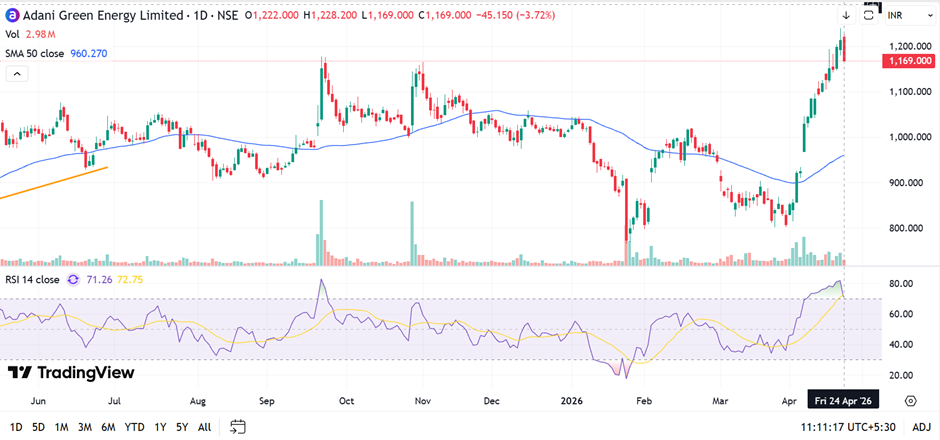
Chart by TradingView
Investment Outlook: High-Growth Renewable Platform with Structural Execution Risks
Adani Green Energy Limited represents one of the most prominent renewable energy developers in India’s evolving energy landscape. The company’s strong execution capabilities and large-scale project pipeline provide visibility into long-term revenue expansion.
The combination of large renewable installations, integrated storage capabilities, and long-term power contracts supports sustained operational growth potential.
However, elevated leverage levels and regulatory uncertainties require disciplined risk assessment before investment decisions. Investors should monitor financing trends, project execution milestones, and policy developments closely.
Overall, Adani Green Energy Limited offers exposure to India’s renewable transition but remains best suited for investors with a higher risk tolerance and long-term investment horizon.
FAQs
Q1. What drives long-term growth for Adani Green Energy Limited (NSE:ADANIGREEN)?
Growth is driven by renewable capacity expansion, Khavda mega project development, long-term power contracts, and increasing demand for clean energy.
Q2. Why is Adani Green Energy Limited considered a major renewable energy player?
Large operational capacity, integrated solar-wind projects, battery storage deployment, and strong project execution capabilities support its industry leadership.
Q3. What risks should investors consider before investing in Adani Green Energy Limited?
Key risks include high debt levels, regulatory uncertainty, legal developments, financing dependence, and operational concentration across large renewable projects.