

Highlights
- Fino Payments Bank Limited (NSE: FINOPB) climbed nearly 7% during Friday's session.
- The stock featured among the day's top gainers on the NSE.
- The company reported standalone net profit of ₹710.00 lakh in its latest reported quarter.
- The stock continued trading above its 50-day moving average, indicating an improving trend.
- RSI moved above 60, reflecting strengthening momentum.
- Investors will monitor whether the stock sustains gains after the recent breakout.
Overview
Fino Payments Bank Limited (NSE: FINOPB), a digital-focused payments bank offering banking and financial services through an extensive merchant network, witnessed strong buying momentum during Friday's trading session. The stock advanced nearly 7% to around ₹169.08 after touching an intraday high of ₹175.65. Although there was no fresh company-specific announcement, improved technical strength and increased market participation helped the stock emerge among the session's top gainers.
Fundamental View
Fino Payments Bank continues to strengthen its presence in India's digital banking ecosystem through merchant-led banking services, digital payments, remittance solutions, and financial inclusion initiatives. For the quarter ended March 2026, the company reported standalone total income of ₹33,998.00 lakh, profit before tax of ₹410.00 lakh, and net profit of ₹710.00 lakh. Earnings per share stood at ₹0.85. Going forward, business growth will depend on expanding customer acquisition, higher transaction volumes, digital banking adoption, and continued improvement in operating efficiency.
Technical View
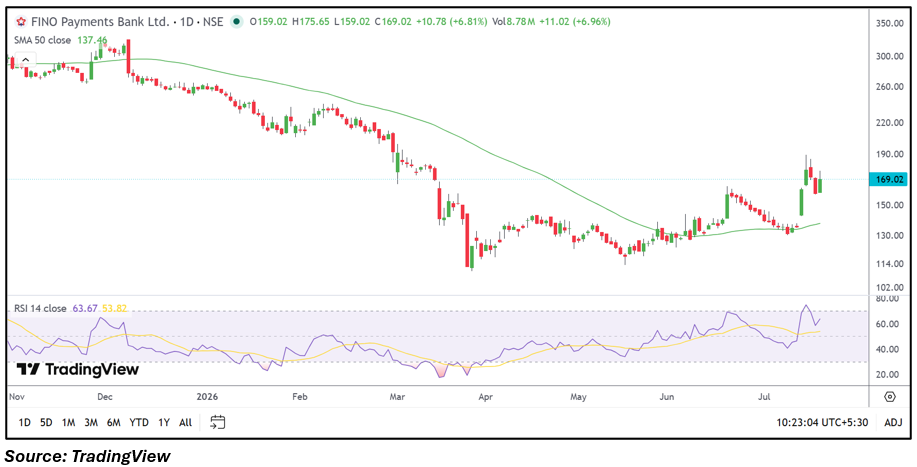
Fino Payments Bank Limited (NSE: FINOPB) has shown a notable improvement in its technical structure after breaking above recent consolidation levels. The stock is trading comfortably above its 50-day moving average of ₹137.46, reinforcing the medium-term uptrend. The 14-day RSI has climbed to 63.67, indicating strengthening momentum while remaining below extreme overbought territory. Rising trading volumes alongside the price breakout suggest improved market participation, although sustained follow-through will be important for maintaining the current trend.
Key Technical Levels
Immediate support is placed near ₹160.00, followed by the next support around ₹151.00. On the upside, immediate resistance is seen near ₹176.00, while the next resistance is positioned around ₹185.00. Price action around these levels may provide further clues regarding the stock's near-term direction.
Risks to Watch
- Slower growth in digital transaction volumes.
- Regulatory changes affecting the payments banking sector.
- Intense competition from banks and fintech companies.
- Margin pressure due to rising operating expenses.
- Broader market volatility impacting financial stocks.
Summary
Fino Payments Bank Limited (NSE: FINOPB) attracted strong market attention after delivering a sharp intraday rally backed by improving technical indicators and healthy trading activity. While the latest quarterly performance reflects stable profitability, investors are likely to monitor business growth, customer expansion, transaction volumes, and regulatory developments alongside the stock's ability to sustain its recent technical breakout.
FAQs
Q: Why did Fino Payments Bank shares rise today?
A: The stock gained on improving technical momentum, strong trading volumes, and renewed market participation despite the absence of any fresh corporate announcement.
Q: How did Fino Payments Bank perform in its latest quarterly results?
A: For the quarter ended March 2026, the company reported total income of ₹33,998.00 lakh and net profit of ₹710.00 lakh.
Q: What does the current technical setup indicate?
A: The stock is trading above its 50-day moving average with the RSI above 60, indicating improving momentum.
Q: What are the important technical levels to watch?
A: Immediate support is around ₹160.00, while resistance is placed near ₹176.00 and ₹185.00.
Q: What factors could influence Fino Payments Bank's future performance?
A: Key factors include digital transaction growth, customer acquisition, regulatory developments, operating efficiency, and overall market conditions.