
The Indian rupee (INR) fell to a record low of 95.40 per USD on May 5, declining 0.3% during the session and surpassing its previous low of 95.33. The fall comes amid escalating tensions between the United States and Iran, which have unsettled global markets and increased concerns for oil-importing economies like India.
The INR has declined 4.5% since the conflict began on February 28, tracking losses across other Asian currencies such as the Indonesian rupiah and Philippine peso. The depreciation reflects heightened investor caution and persistent pressure from elevated crude oil prices.

Oil Price Surge Deepens Economic Concerns
A sharp rise in Brent crude prices—from nearly $70 per barrel to around $115—has significantly impacted India’s macroeconomic outlook. Higher energy costs are expected to widen the current account deficit, increase inflationary pressures, and weigh on economic growth projections.
Economists have revised key indicators, including inflation forecasts and GDP growth estimates, while also factoring in a weaker currency outlook. The sensitivity of the INR to oil price movements remains a central concern given India’s reliance on energy imports.
Market Reaction and Bond Yield Movement
India’s benchmark Nifty 50 declined 0.3% during the session, reflecting cautious sentiment in equities. Meanwhile, the yield on the 10-year government bond rose by 3 basis points to 7.04%, indicating pressure in debt markets as investors adjust expectations.
Currency volatility has also influenced capital flows, with foreign investors remaining sensitive to global risk factors and domestic macroeconomic signals.
Policy Response and Central Bank Actions
The Reserve Bank of India is evaluating measures to increase dollar inflows and stabilize foreign exchange reserves. These include reviving schemes to attract deposits from non-resident Indians and removing withholding tax on overseas bond investments.
The central bank has actively intervened in both spot and forward FX markets. This intervention is reflected in declining FX reserves and a rise in short dollar forward positions, which have crossed $100 billion.
Traders reported dollar sales near the 95.40 level, likely conducted through state-run banks on behalf of the central bank to limit excessive volatility.
Global Central Banks Respond to Currency Pressure
Other central banks have also responded to currency pressures driven by high oil prices. The Bank of Japan has reportedly intervened to support the yen, while Indonesia’s central bank signaled continued actions to stabilize its currency after it hit record lows.
These coordinated responses highlight the broader impact of geopolitical tensions on global financial stability and currency markets.
Key Risks
- Sustained high oil prices may widen India’s current account deficit significantly.
- Continued INR depreciation could increase imported inflation and pressure consumers.
- Declining FX reserves may limit central bank intervention capacity.
- Global risk aversion could reduce foreign capital inflows into Indian markets.
Technical Summary
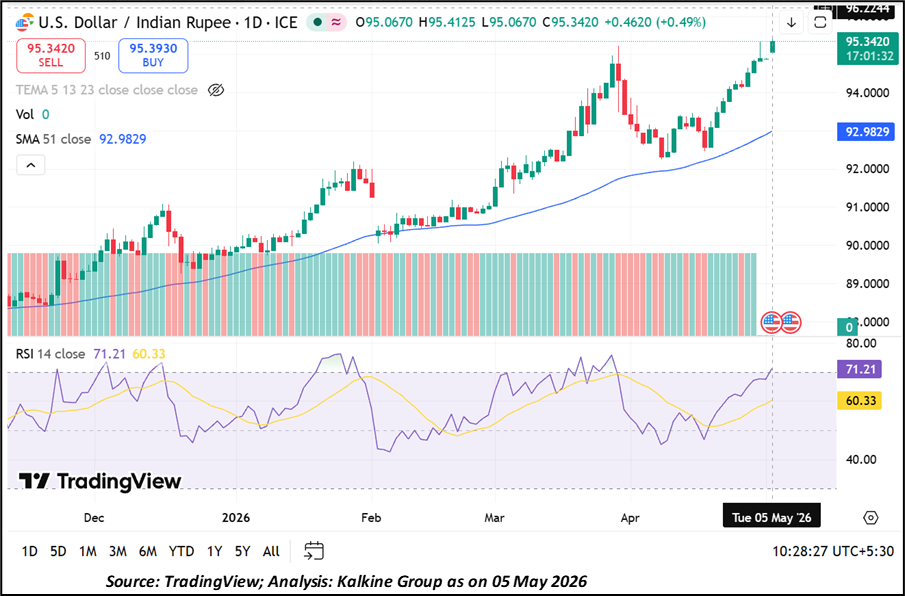
USD/INR is currently trading at 95.34, well above its 51-day Simple Moving Average near 92.98, indicating a strong upward trend.The price structure shows a clear pattern of higher highs and higher lows, reflecting sustained momentum in the currency pair.
The 14-day RSI is at 71.21, approaching overbought territory. This suggests that while the trend remains strong, the pair may see some consolidation or short-term pullback. The immediate support zone is placed near 91.00–89.00. On the upside, resistance is seen near 98.00–100.00. A sustained move above 95.50 could extend the current trend further.
Summary
The INR reached a record low of 95.40 per USD amid U.S.–Iran tensions and rising oil prices. The currency has fallen 4.5% since late February, reflecting pressure on India’s external balances. Policymakers are considering measures to attract capital inflows, while central bank interventions continue.
FAQs
Why did the Indian rupee hit a record low?
The INR weakened due to rising oil prices and global uncertainty triggered by escalating U.S.–Iran geopolitical tensions affecting markets.
How do oil prices impact the Indian rupee?
Higher oil prices increase import bills, widen deficits, and raise inflation, which puts downward pressure on the INR.
What actions is the RBI taking to stabilize the rupee?
The RBI is intervening in FX markets and considering steps to attract foreign capital and increase dollar inflows.