

Highlights
- Mirza International Limited (NSE: MIRZAINT) shares fell more than 5% during Monday's trading session.
- The decline followed a strong rally over the past few weeks, leading to profit booking.
- The company reported a consolidated net loss in the latest quarterly results.
- Trading volumes remained elevated during the correction.
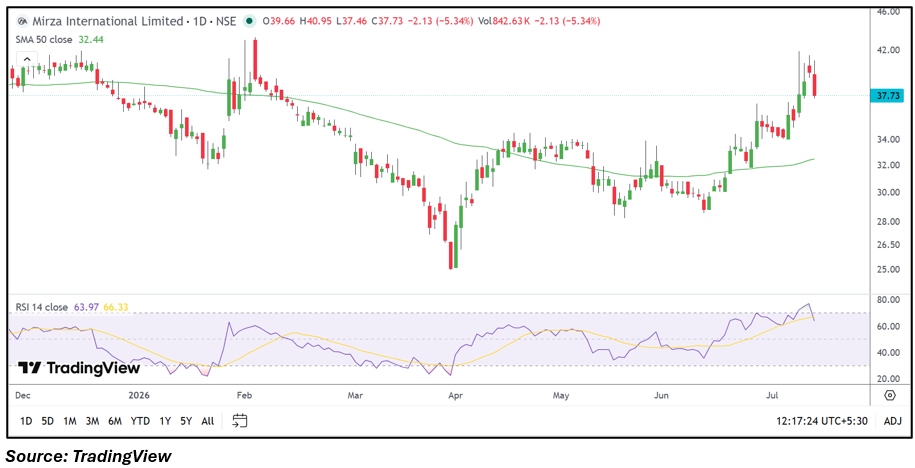
- The stock continues to trade above its 50-day moving average despite today's decline.
- Technical indicators suggest momentum has moderated after the recent upmove.
Overview
Mirza International Limited (NSE: MIRZAINT), a leading manufacturer of leather footwear and lifestyle products, witnessed sharp selling pressure during Monday's session as investors booked profits following the stock's recent rally. The stock opened at ₹39.66, touched an intraday high of ₹40.95, slipped to a low of ₹37.46, and traded around ₹37.79, down over 5%. There was no fresh corporate announcement behind the move, with the decline largely reflecting profit-taking after a strong run over the past month.
Fundamental View
Mirza International operates across leather footwear manufacturing, branded retail, and exports, supplying products to domestic as well as overseas markets. For the quarter ended 31 March 2026, the company reported consolidated total income of ₹10,344.82 lakh. However, profitability remained under pressure, with a loss before tax of ₹1,471.96 lakh and a consolidated net loss of ₹1,321.92 lakh. Earnings per share stood at -₹0.96 during the quarter. Going forward, investors are expected to track export demand, margin recovery, raw material costs, and the company's efforts to improve operational performance.
Technical View
After delivering a strong rally over recent weeks, the stock witnessed a healthy correction as traders booked gains near higher levels. Despite today's decline, the price remains above the 50-day moving average, indicating that the broader trend has not yet weakened significantly. The 14-day RSI remained around 64, suggesting that momentum has cooled from recent highs but continues to stay in positive territory. Higher trading volumes during the decline indicate active participation from market participants.
Key Technical Levels
Immediate support is placed near ₹36.80, followed by the next support around ₹35.00. On the upside, immediate resistance is seen near ₹40.95, while the next resistance is placed around ₹42.50. These levels are likely to remain important for the stock's near-term price movement.
Risks to Watch
- Weak demand in domestic and export markets.
- Rising leather and raw material costs.
- Currency fluctuations affecting export realizations.
- Margin pressure from higher operating expenses.
- Broader market volatility impacting investor sentiment.
Summary
Mirza International Limited (NSE: MIRZAINT) corrected sharply after a strong rally, with profit booking weighing on the stock during Monday's session. While the latest quarterly results reflected continued losses, the stock remains above important medium-term technical levels. Investors are likely to monitor future earnings, export demand, margin improvement, and whether the stock can stabilize following the recent correction.
FAQs
Q: Why did Mirza International Limited (NSE: MIRZAINT) stock fall over 5% today?
The decline was primarily driven by profit booking after the stock's recent rally, with no major company-specific announcement.
Q: What business does Mirza International Limited operate in?
The company manufactures leather footwear, leather products, and lifestyle brands while exporting to several international markets.
Q: How did Mirza International perform in its latest quarterly results?
For the March 2026 quarter, the company reported consolidated total income of ₹10,344.82 lakh and a consolidated net loss of ₹1,321.92 lakh.
Q: What does the current technical setup indicate?
The stock has corrected after a strong rally but continues to trade above its 50-day moving average, while RSI indicates momentum has moderated.
Q: What should investors monitor going forward?
Investors should watch upcoming quarterly earnings, export demand, raw material costs, margin trends, and overall market sentiment.