

Highlights
- Reliance Infrastructure (NSE: RELINFRA) declined 5.00% and hit the lower circuit during Monday's trading session.
- The weakness emerged despite the absence of any fresh company-specific announcement.
- The company reported a consolidated net profit of ₹1,64,015.00 lakh in its latest reported quarter.
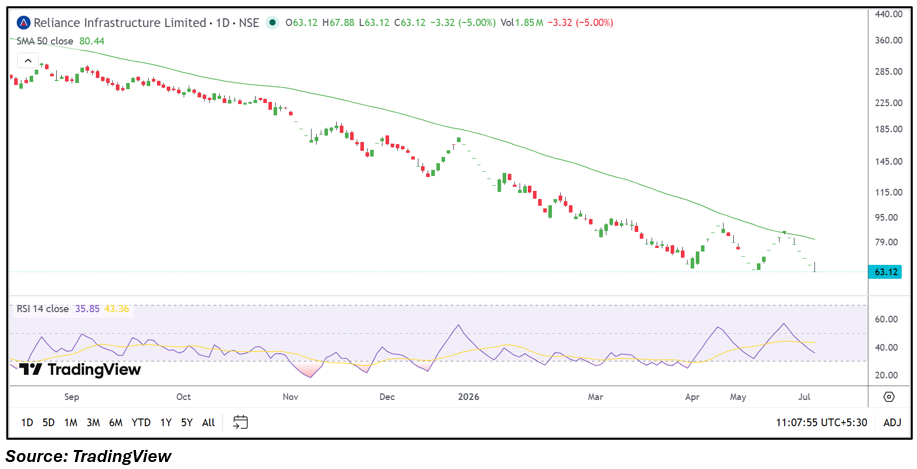
- The stock continues to trade below its 50-day moving average, reflecting a weak medium-term technical trend.
- RSI has slipped near the lower end of the neutral range, indicating fading momentum.
- Market participants are closely watching support levels and broader market sentiment for the next directional move.
Overview
Reliance Infrastructure Limited is engaged in infrastructure development, engineering, power distribution, transportation, and defence-related businesses. The company's shares came under heavy selling pressure on Monday, falling 5.00% to ₹63.12 and locking into the lower circuit. Since there was no fresh corporate announcement, the decline appears to reflect profit booking, weak technical sentiment, and cautious market participation after recent volatility.
Fundamental View
For the quarter ended 31 March 2026, Reliance Infrastructure reported consolidated total income of ₹4,15,434.00 lakh. The company posted a consolidated net profit of ₹1,64,015.00 lakh with earnings per share (EPS) of ₹22.47, despite reporting a loss before tax of ₹1,76,163.00 lakh due to exceptional accounting adjustments. The company continues to focus on infrastructure, EPC, defence, and energy businesses while executing ongoing projects. Investors are expected to monitor future order inflows, project execution, debt management, and cash-flow trends to assess the company's longer-term financial performance.
Technical View
Reliance Infrastructure remains technically weak as the stock trades below its 50-day simple moving average of ₹80.44, indicating that the broader trend continues to favour caution. Monday's sharp decline pushed the stock into the lower circuit, while the 14-day RSI eased to 35.85, reflecting weakening momentum after recent volatility. Elevated trading activity suggests increased participation during the decline, and the stock may remain sensitive to broader market sentiment until it stabilises above key resistance levels.
Key Technical Levels
Immediate support is placed near ₹60.00, while the next downside level is seen around ₹57.00 if weakness persists. On the upside, immediate resistance is located near ₹67.90, followed by the next resistance around ₹72.00, which could act as an important hurdle for any recovery.
Risks to Watch
- Delays in infrastructure and EPC project execution.
- High debt servicing and financing costs.
- Regulatory or legal developments.
- Weak order inflows.
- Broader market volatility.
- Liquidity-driven price fluctuations.
Summary
Reliance Infrastructure witnessed a sharp correction as selling pressure pushed the stock to its lower circuit despite the absence of fresh corporate developments. Although the company reported profitability in its latest quarterly results, the stock continues to trade below key technical averages, reflecting a weak market structure. Going forward, investors are likely to track project execution, financial performance, debt management, and overall market sentiment for further direction.
FAQs
Q: Why did Reliance Infrastructure shares hit the lower circuit?
A: The decline appears to be driven by technical weakness, profit booking, and cautious market sentiment rather than any fresh company-specific announcement.
Q: How did Reliance Infrastructure perform in its latest quarterly results?
A: The company reported consolidated total income of ₹4,15,434.00 lakh and net profit of ₹1,64,015.00 lakh for the quarter ended 31 March 2026.
Q: What does the current technical trend indicate?
A: The stock is trading below its 50-day moving average, indicating that the medium-term trend remains weak.
Q: Which technical levels are important to watch?
A: Immediate support is around ₹60.00, while resistance is placed near ₹67.90.
Q: What factors could influence the stock in the coming sessions?
A: Project execution, future financial performance, debt management, regulatory developments, and overall market sentiment are likely to remain the key factors.