

Highlights
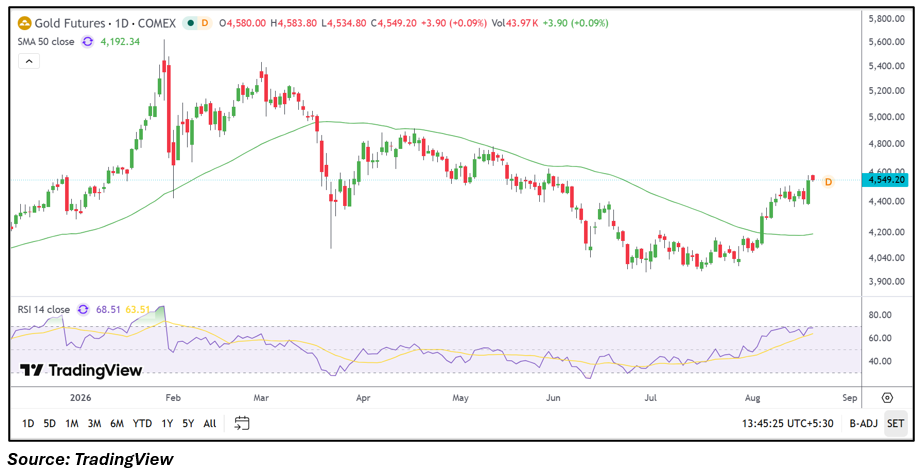
- Gold Futures traded near USD 4,549.20, gaining 0.09%.
- The contract opened at USD 4,580.00 and touched a high of USD 4,583.80.
- Expanded U.S. Treasury buybacks have pushed longer-term yields lower.
- A subdued U.S. dollar has provided additional support to dollar-denominated gold.
- Federal Reserve minutes highlighted persistent inflation concerns and the possibility of tighter policy.
- Gold remains above its 50-day SMA of USD 4,192.34, while RSI stands at 68.51.
Overview
Gold Futures remained near USD 4,549.20 as lower long-duration U.S. Treasury yields and a subdued dollar provided support to the precious metal. The contract opened at USD 4,580.00 and moved to an intraday high of USD 4,583.80 before easing toward the latest quoted level. The latest price action follows a sharp recovery in gold from its recent lows, with monetary policy expectations, U.S. government debt concerns and central-bank demand continuing to influence the market. At the same time, Federal Reserve officials remain focused on inflation risks, creating uncertainty around the future path of interest rates. This combination has kept gold elevated while limiting a straightforward directional move.
Treasury Buybacks Create a More Supportive Yield Environment
One of the key developments for Gold Futures has been the U.S. Treasury's expanded bond-buyback programme. Increased demand for longer-dated government securities has contributed to a decline in long-term Treasury yields, creating a more favourable environment for non-yielding assets such as gold.
Gold does not generate interest income, meaning its relative attractiveness can change significantly when bond yields move. Lower yields reduce the opportunity cost associated with holding bullion and can therefore provide additional support to prices. The latest move in Treasury yields has consequently become an important factor behind the metal's ability to remain close to elevated levels.
The broader U.S. fiscal backdrop is also receiving increased attention, with government debt exceeding USD 40 trillion. Concerns surrounding debt servicing costs, government spending and the longer-term fiscal position continue to contribute to uncertainty across financial markets.
Fed Minutes Keep Interest Rate Expectations Uncertain
While Treasury yields have recently provided support, the Federal Reserve remains an important source of uncertainty for Gold Futures. Minutes from the July Federal Open Market Committee meeting showed that inflation continues to be a significant consideration for policymakers.
Several officials indicated that interest rates could need to remain restrictive if inflation fails to move sustainably toward the Federal Reserve's 2% objective. Some policymakers also remained open to the possibility of higher rates if inflationary pressures persist.
For gold, the rate outlook is particularly important because higher interest rates can increase the relative attractiveness of interest-bearing assets. Conversely, expectations of easier monetary conditions can reduce that disadvantage. As a result, changes in Federal Reserve expectations are likely to remain a major influence on gold prices.
Softer Dollar Provides Additional Support
The U.S. dollar has remained subdued, offering another factor supporting Gold Futures. Since gold is priced in U.S. dollars, movements in the currency can influence its affordability for international buyers.
A weaker dollar can make dollar-denominated bullion comparatively less expensive for holders of other currencies, potentially supporting demand. The latest market environment has therefore combined softer currency conditions with lower Treasury yields, creating a relatively supportive backdrop for gold.
However, the currency remains sensitive to U.S. economic data and Federal Reserve expectations. Any sustained recovery in the dollar could alter the current environment and place renewed pressure on dollar-priced precious metals.
Central Bank Demand Strengthens the Longer-Term Picture
Central-bank purchases remain an important structural factor for the gold market. Demand from official institutions has increased the importance of gold as a reserve asset amid concerns surrounding inflation, geopolitical uncertainty and diversification away from traditional reserve holdings.
A World Gold Council survey indicated that a significant proportion of central banks intend to increase their gold reserves. Such demand provides a longer-term underpinning for the market even when short-term price movements are influenced by interest rates and currency fluctuations.
The combination of central-bank demand and fiscal uncertainty has helped gold maintain a relatively high valuation despite periods of pressure from elevated yields.
Geopolitical and Fiscal Risks Remain Relevant
Gold also continues to attract attention during periods of heightened economic and geopolitical uncertainty. Concerns over government finances, inflation, monetary policy and international tensions can all influence demand for precious metals.
The current market is particularly sensitive to the interaction between energy prices, inflation expectations and interest rates. Any renewed rise in energy costs could increase inflation concerns and potentially delay monetary easing, while a decline in inflationary pressure could improve expectations for lower rates.
This creates a two-way influence on gold, with safe-haven and reserve demand providing support while higher-rate expectations can limit the upside.
Technical Outlook Shows Elevated Price Momentum
Gold Futures traded near USD 4,549.20 after opening at USD 4,580.00 and touching an intraday high of USD 4,583.80 and a low of USD 4,534.80. The contract remains above its 50-day Simple Moving Average of USD 4,192.34, indicating that the broader price structure remains positioned above the medium-term average. The 14-day Relative Strength Index stood at 68.51, reflecting elevated momentum while remaining below the conventional 70 threshold.
Key Levels to Watch
On the downside, levels to watch are around USD 4,321.74 followed by USD 4,094.28. On the upside, resistance levels are seen around USD 4,776.66 and USD 5,004.12.
Summary
Gold Futures continue to trade near USD 4,549.20 as lower Treasury yields, a subdued U.S. dollar and sustained central-bank demand provide support to the precious metal. The expanded Treasury buyback programme has contributed to lower long-term yields, improving the relative environment for non-yielding bullion. However, Federal Reserve minutes highlighted persistent inflation concerns and kept the interest-rate outlook uncertain. Technically, Gold Futures remain above the 50-day SMA of USD 4,192.34, while the RSI of 68.51 points to elevated momentum. Treasury yields, dollar movements, Fed expectations and central-bank demand remain key factors to monitor.
FAQs
Q: Why are Gold Futures in focus?
A: Gold Futures are in focus as lower Treasury yields following expanded U.S. government bond buybacks and a subdued dollar provide support to bullion, while Federal Reserve inflation concerns limit the upside.
Q: What is supporting the Gold Futures price?
A: Lower long-term Treasury yields, a softer U.S. dollar, central-bank demand and continued economic and geopolitical uncertainty are supporting the gold market.
Q: How are Federal Reserve expectations affecting gold?
A: Persistent inflation concerns could keep interest rates elevated for longer, which can weigh on gold because higher-yielding assets become relatively more attractive. Expectations of easier policy can have the opposite effect.
Q: What should traders monitor in Gold Futures?
A: Traders should monitor Treasury yields, the U.S. dollar, Federal Reserve policy expectations, inflation data, central-bank purchases and geopolitical developments for potential changes in gold-market conditions.