

Overview
The Nifty 50 Index is India's benchmark equity index comprising the country's largest listed companies across banking, financial services, information technology, automobiles, pharmaceuticals, FMCG, energy and industrial sectors. The index serves as a key indicator of domestic market sentiment and institutional investment trends. During Wednesday's session, the benchmark erased its early gains and slipped towards the 24,500 marks as investors adopted a cautious approach ahead of the Reserve Bank of India's monetary policy announcement while geopolitical concerns added to market volatility.
RBI Policy Caution and Global Headlines Drive Market Lower
Indian equities witnessed broad-based profit booking after an optimistic opening, with investors preferring to reduce risk before the Reserve Bank of India's interest rate decision. Market participants are closely watching the central bank's policy stance, commentary on inflation, liquidity conditions and economic growth outlook, as these are expected to influence the direction of banking, financial and rate-sensitive sectors.
Adding to the cautious mood, geopolitical tensions resurfaced after U.S. President Donald Trump warned of a "very strong strike" if the Strait of Hormuz is not reopened, renewing concerns over global energy supplies and crude oil prices. Higher oil prices could increase inflationary pressures, making investors more cautious ahead of the RBI's policy outcome.
Apart from macro developments, the recent rally in benchmark indices also encouraged profit booking near higher levels, resulting in selling pressure across several heavyweight sectors.
Market Breadth Weakens as Investors Await Fresh Triggers
Selling pressure was visible across several frontline stocks, causing the Sensex to surrender nearly 700 points from its intraday high while the Nifty 50 moved back near the 24,500 mark. Investors largely refrained from taking aggressive positions ahead of the RBI announcement, preferring to wait for clarity on the future interest-rate trajectory and the central bank's economic assessment.
The policy statement, inflation projections and Governor's commentary are expected to remain the primary domestic catalysts for equities over the near term, particularly for banking, real estate, automobiles and NBFCs.
Technical View Suggests Consolidation Above Key Moving Average
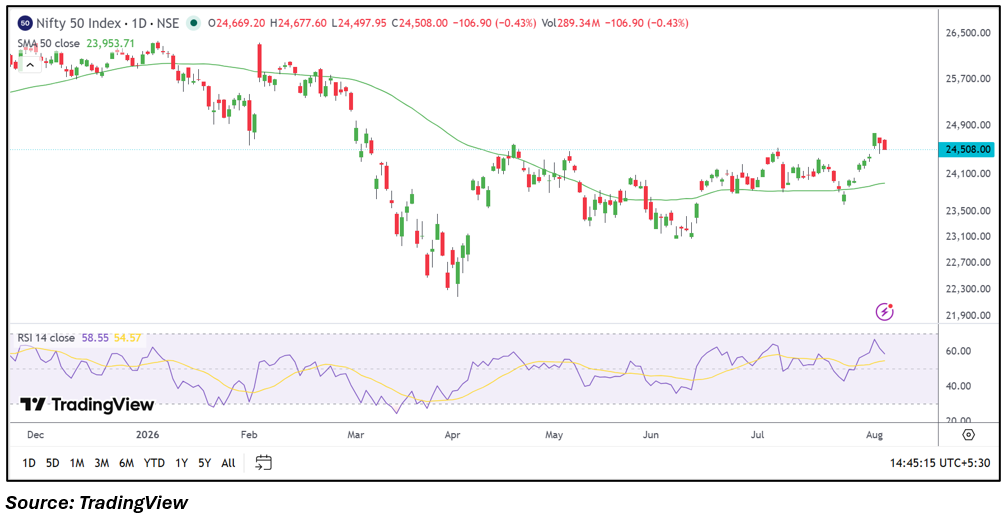
The Nifty 50 Index traded around 24,508.00 after opening at 24,669.20. The index touched an intraday high of 24,677.60 before declining to a low of 24,497.95. Despite the session's weakness, the benchmark continues to trade above its 50-day Simple Moving Average of 23,953.71, indicating that the medium-term trend remains constructive. The 14-day Relative Strength Index (RSI) stood near 58.55, suggesting momentum has eased from recent highs while remaining in positive territory.
Key Technical Levels
Immediate support is placed near 24,500.00, followed by 24,350.00. On the upside, immediate resistance is seen around 24,680.00, with the next hurdle near 24,850.00.
What Investors Should Watch Next
The RBI's policy decision, interest-rate guidance, inflation projections, liquidity measures, global crude oil prices, developments surrounding the Strait of Hormuz, foreign institutional investor activity and upcoming corporate earnings will remain the key drivers for market direction over the coming sessions.
Summary
The Nifty 50 retreated from early gains as investors turned cautious ahead of the RBI monetary policy announcement while renewed geopolitical tensions and profit booking weighed on sentiment. Although the broader medium-term structure remains intact above the 50-day moving average, markets are likely to remain sensitive to the RBI's commentary and global macro developments before establishing the next directional move.
Frequently Asked Questions
Q: Why did the Nifty 50 decline despite opening higher?
A: The index gave up early gains due to caution ahead of the RBI policy decision, profit booking at higher levels and renewed geopolitical concerns.
Q: Why is the RBI policy important for the stock market?
A: The RBI's interest-rate decision and economic outlook influence borrowing costs, liquidity and earnings expectations across multiple sectors.
Q: How did geopolitical developments affect market sentiment?
A: Concerns increased after renewed tensions surrounding the Strait of Hormuz raised worries about crude oil supplies and inflation.
Q: Which sectors are expected to react most to the RBI decision?
A: Banking, financial services, NBFCs, automobiles and real estate are likely to remain the most sensitive to the policy outcome.