

Highlights
- Gold prices declined as the U.S. dollar remained near a one-month high.
- Investors are awaiting the Federal Reserve's policy decision and Chair Kevin Warsh's comments.
- Markets continue to price in the possibility of another interest rate hike later this year.
- A pause in hostilities between the U.S. and Iran reduced safe-haven demand.
- Traders are also focused on upcoming U.S. GDP and inflation data.
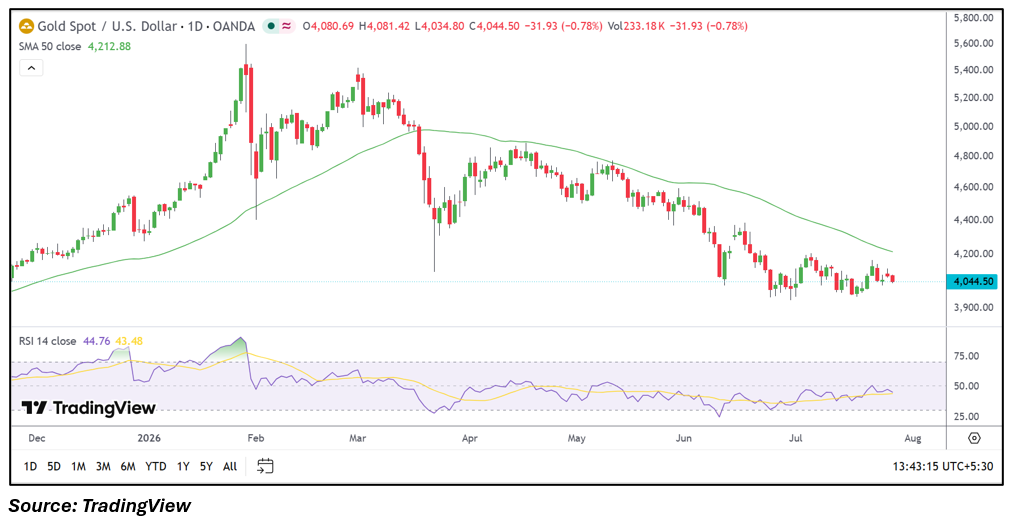
- Gold remains below its 50-day moving average despite holding above recent lows.
Overview
Gold prices moved lower on Tuesday as the U.S. dollar remained firm ahead of the Federal Reserve's policy announcement. Investors avoided taking aggressive positions before the central bank's decision, while expectations that interest rates could stay elevated for longer continued to weigh on sentiment. At the same time, easing geopolitical tensions reduced demand for traditional safe-haven assets.
Stronger Dollar Limits Gold Demand
The U.S. dollar hovered close to a one-month high, making gold more expensive for buyers using other currencies. Although the dollar showed little movement during the session, its elevated level continued to pressure bullion prices. A firm dollar typically reduces overseas demand for gold and remains one of the primary headwinds for the precious metal.
Fed Decision Takes Center Stage
Market participants are widely expecting the Federal Reserve to leave interest rates unchanged at its latest policy meeting. However, traders continue to anticipate the possibility of another rate increase later this year, with expectations supported by resilient U.S. economic data. Higher interest rates generally reduce the attractiveness of non-yielding assets such as gold, prompting investors to remain cautious ahead of the Fed's statement and Chair Kevin Warsh's press conference.
Economic Data Could Shape Market Expectations
Attention is also turning to upcoming U.S. economic releases, including second-quarter GDP figures and the Federal Reserve's preferred inflation gauge. These reports could influence expectations for future monetary policy. Stronger-than-expected economic data may reinforce the case for higher interest rates, while softer readings could improve sentiment toward precious metals.
Geopolitical Risks Ease but Remain in Focus
Safe-haven demand moderated after the United States and Iran maintained a pause in hostilities. President Donald Trump said discussions with Iran were progressing but warned that military action could resume if negotiations failed. Meanwhile, softer oil prices also eased concerns over energy-driven inflation, reducing one of the recent factors supporting gold prices.
Technical Outlook
Gold is trading near $4,044.50 while remaining below its 50-day simple moving average of $4,212.88, indicating that the medium-term trend remains under pressure. The 14-day RSI is around 44.76, suggesting neutral momentum as prices continue to consolidate within a broad trading range.
Key Levels to Watch Ahead
Immediate support is seen near $4,030.00, followed by $3,950.00. On the upside, immediate resistance is located around $4,120.00, with the next important resistance near the 50-day moving average at $4,213.00. A sustained move above this area could improve the broader technical picture.
Summary
Gold prices remain under pressure as a stronger U.S. dollar and expectations of higher interest rates continue to limit buying interest ahead of the Federal Reserve's policy decision. While geopolitical risks have eased following the pause in U.S.-Iran hostilities, investors are likely to remain focused on central bank guidance and upcoming U.S. economic data for the next major move in bullion prices.
FAQs
Q: Why are gold prices falling today?
A: Gold prices are weakening due to a stronger U.S. dollar, expectations of higher interest rates, and reduced safe-haven demand ahead of the Federal Reserve's policy decision.
Q: Why does the Federal Reserve influence gold prices?
A: Higher interest rates increase the opportunity cost of holding non-yielding assets like gold, which can weigh on prices.
Q: How does the U.S. dollar affect gold?
A: A stronger U.S. dollar makes gold more expensive for overseas buyers, which can reduce global demand.
Q: Are geopolitical tensions still supporting gold?
A: Support has moderated after the U.S. and Iran maintained a pause in hostilities, although geopolitical developments continue to influence market sentiment.
Q: What should investors watch next?
A: Investors will monitor the Federal Reserve's policy announcement, Chair Kevin Warsh's comments, U.S. GDP data, and inflation figures for further direction in gold prices.