

Highlights
- Oil prices extended losses as hopes for a potential US-Iran agreement improved market sentiment.
- President Donald Trump said talks with Iran were progressing but warned military action could resume if negotiations fail.
- Tanker flows through the Strait of Hormuz remain disrupted despite the pause in hostilities.
- Security risks continue in the Bab el-Mandeb Strait due to Houthi attacks.
- Russian Black Sea oil exports have resumed, improving global supply expectations.
- Traders continue to monitor geopolitical developments for the next major move in crude prices.
Overview
Oil prices moved lower as investors reduced the geopolitical risk premium following signs of continued diplomatic engagement between the United States and Iran. While hopes of a potential agreement have eased immediate concerns over supply disruptions, traders remain cautious because key Middle East shipping routes have yet to return to normal operations.
US-Iran Talks Reduce Risk Premium
The latest decline in crude prices follows comments from President Donald Trump that negotiations with Iran are progressing and that there is a reasonable chance of reaching an agreement. At the same time, he warned that military strikes could resume if diplomatic efforts fail. The easing of immediate conflict concerns encouraged traders to unwind part of the risk premium that had lifted oil prices during recent tensions.
Supply Routes Remain Under Pressure
Despite improving diplomatic signals, supply risks have not disappeared. Tanker traffic through the Strait of Hormuz has yet to show a meaningful recovery, indicating that energy markets continue to face logistical challenges. Market participants believe that a sustained decline in oil prices will likely require clearer evidence that shipping activity through the strategic waterway has normalized.
Red Sea Security Risks Continue
Concerns also remain around the Bab el-Mandeb Strait, where Houthi attacks continue to pose risks to commercial shipping and Saudi oil exports. Although vessel movements have slowed rather than stopped completely, the threat to regional energy infrastructure remains an important factor that could quickly influence crude prices if tensions escalate again.
Black Sea Exports Offer Additional Supply
Providing some relief to global supply expectations, oil loadings from Russia's Black Sea terminals have resumed after earlier disruptions. The restart of exports from the CPC terminal and the Sheskharis terminal has improved market confidence in near-term supply availability, adding further downward pressure on crude prices.
Technical Outlook
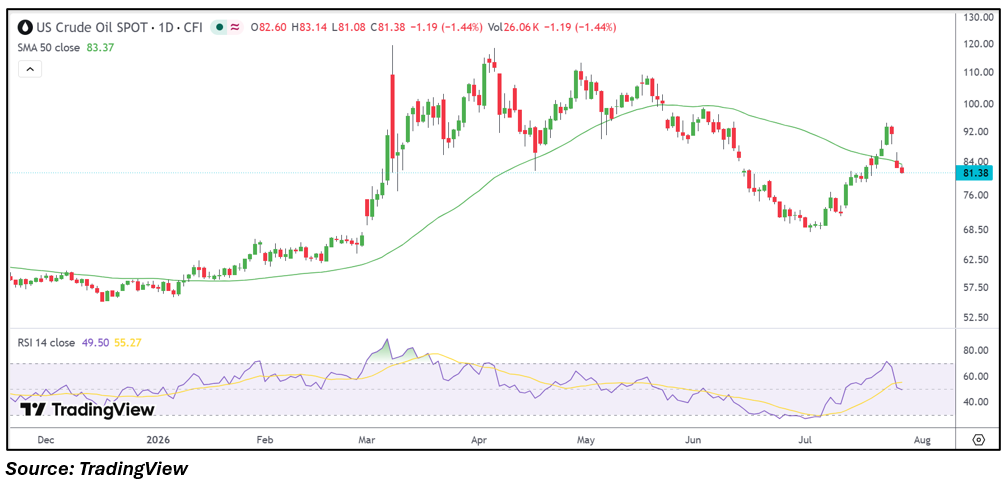
WTI crude oil is trading near $81.38 while remaining slightly below its 50-day simple moving average of $83.37, suggesting that the medium-term trend has weakened following the recent pullback. The 14-day RSI stands near 49.50, indicating balanced momentum as prices consolidate after recent volatility.
Key Levels to Watch Ahead
Immediate support is seen near $80.00, followed by $76.00 if selling pressure intensifies. On the upside, immediate resistance is located around $84.00, with the next major resistance near $87.00. A sustained move above these levels could improve the near-term technical outlook.
Summary
Oil prices remain under pressure as hopes of a potential US-Iran agreement reduce geopolitical risk premiums and renewed Black Sea exports improve supply expectations. However, unresolved disruptions in the Strait of Hormuz and continued security concerns in the Red Sea suggest that geopolitical developments will remain the key driver of crude prices in the coming sessions.
FAQs
Q: Why are oil prices falling today?
A: Oil prices are declining as optimism over a possible US-Iran agreement reduces geopolitical concerns and lowers the market's risk premium.
Q: Why is the Strait of Hormuz important for oil prices?
A: The Strait of Hormuz is one of the world's busiest oil shipping routes, and any disruption can significantly affect global crude supplies.
Q: How do US-Iran talks affect crude oil?
A: Progress in diplomatic negotiations reduces fears of supply disruptions, which can weigh on oil prices, while failed talks could quickly reverse sentiment.
Q: What role do the Houthis play in the oil market?
A: Houthi attacks on shipping and energy infrastructure in the Red Sea increase concerns about regional oil supply and transportation risks.
Q: What should traders watch next?
A: Investors will monitor developments in US-Iran negotiations, tanker movements through the Strait of Hormuz, Red Sea security, and global supply data for further direction in crude oil prices.