

Highlights
- GIFT Nifty traded 103.5 points (0.43%) higher before Thursday's trading session.
- The indication followed Wednesday's decline of more than 2% in the Sensex and Nifty.
- Asian markets traded higher, supported by gains in semiconductor stocks.
- Crude oil prices remained elevated amid geopolitical developments.
- FIIs and DIIs remained net buyers in Indian equities.
Indian equity markets remained in focus after GIFT Nifty indicated a positive opening ahead of Thursday's trading session. The indication followed a sharp decline in domestic benchmark indices during the previous session and came alongside a recovery across several Asian markets, even as investors continued to monitor geopolitical developments in the Middle East and elevated crude oil prices.
Although GIFT Nifty is widely followed as an early indicator of market sentiment, it reflects expectations before the opening bell and does not determine the actual direction of Indian markets during regular trading hours.
Technical Summary
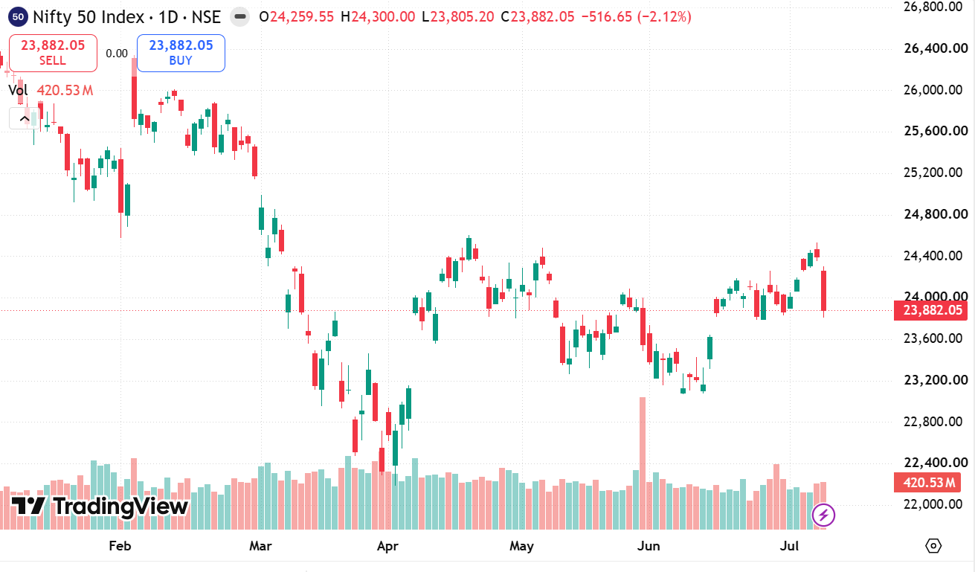
The NIFTY 50 chart illustrates how the benchmark index responded after the opening bell following a positive indication from GIFT Nifty. The previous session's decline of more than 2% provided the backdrop for the day's trading, while improving sentiment across Asian markets supported expectations of a recovery. At the same time, investors continued to monitor geopolitical developments and crude oil prices, both of which remained important factors influencing overall market sentiment. The chart represents the market's actual trading activity and should be viewed as a reflection of price movement rather than a prediction of future performance.
Source:TradingView
How Global Cues Influenced Sentiment
Ahead of Thursday's trading session, GIFT Nifty traded at 23,981.5, up 103.5 points (0.43%), after the Nifty 50 had closed at 23,882.05 in the previous session. The movement suggested improved sentiment before trading began, supported by gains across several Asian equity markets.
Japan's Nikkei rose about 2.3%, while South Korea's Kospi gained approximately 3.8%, helped in part by advances in semiconductor stocks following recent weakness in the sector. The improvement across regional markets contributed to a more positive risk environment before Indian markets opened.
Previous Session Set the Context
The positive indication from GIFT Nifty followed Wednesday's broad-based market decline. The Sensex closed at 76,503.60, down 1,677.12 points (2.15%), while the Nifty 50 fell 516.65 points (2.12%) to 23,882.05.
The decline occurred alongside renewed geopolitical developments involving the United States and Iran and a rise in international crude oil prices, both of which influenced investor sentiment across global markets.
Crude Oil and Institutional Flows Remained in Focus
Crude oil prices remained elevated during the period, with Brent crude trading above $79 per barrel and West Texas Intermediate (WTI) crude remaining near $75 per barrel. For India, movements in crude oil prices are closely monitored because they can influence inflation expectations and business costs.
Institutional investment activity also remained in focus. On July 8, Foreign Institutional Investors (FIIs) were net buyers of Indian equities worth approximately ₹1,962.80 crore, while Domestic Institutional Investors (DIIs) recorded net purchases of around ₹790.16 crore. Such investment flows are among the indicators market participants consider while assessing overall market sentiment.
What Investors Continue to Monitor
Beyond GIFT Nifty, investors continue to monitor global equity markets, geopolitical developments, crude oil prices, institutional investment activity and the ongoing corporate earnings season. Together, these factors provide additional context for understanding changes in market sentiment and trading activity.
Conclusion
GIFT Nifty's higher indication ahead of Thursday's session reflected improving market sentiment following the previous day's decline in Indian equities. However, market participants continued to monitor broader factors, including geopolitical developments, crude oil prices, global equity markets and institutional investment activity.
While GIFT Nifty is widely used as an early indicator of expected market direction, it represents only one aspect of the overall market picture. Actual market performance is influenced by a combination of domestic developments, global cues and investor participation throughout the trading session.
Frequently Asked Questions (FAQs)
Q: What is GIFT Nifty?
A: GIFT Nifty is a futures contract traded on the NSE International Exchange (NSE IX) at GIFT City. It is commonly used as an early indicator of market sentiment before Indian stock markets open.
Q: Why did GIFT Nifty trade higher before Thursday's session?
A: GIFT Nifty moved higher alongside a recovery in several Asian markets, despite continued geopolitical developments and elevated crude oil prices.
Q: Does GIFT Nifty predict the market's exact opening?
A: No. GIFT Nifty provides an indication of expected market sentiment before trading begins. Actual movements in the Sensex and Nifty can differ depending on domestic and global developments during market hours.
Q: Why are crude oil prices important for Indian markets?
A: India imports a significant share of its crude oil requirements. Changes in international crude oil prices can influence inflation expectations, input costs and overall market sentiment.
Q: Why do investors track FII and DII activity?
A: FII and DII investment flows are widely monitored because they provide insight into institutional participation in the equity market. However, they are only one of several factors that influence market performance.