

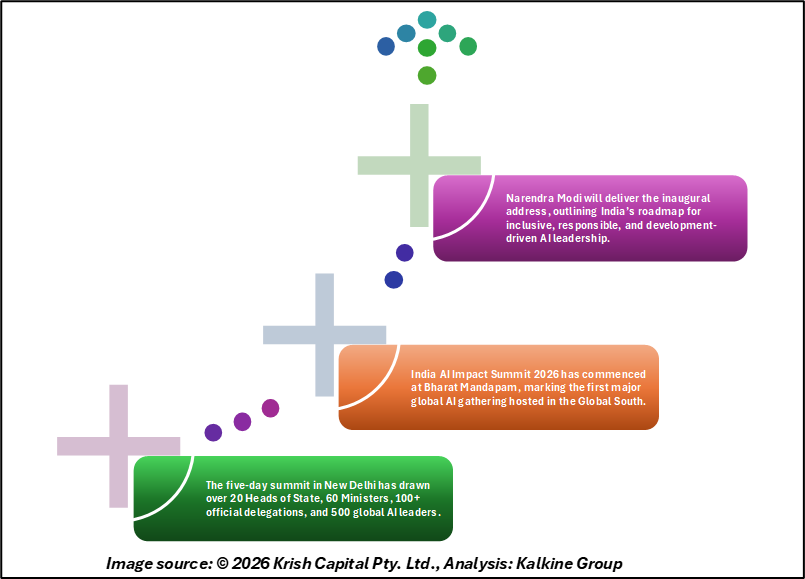
The India AI Impact Summit 2026 has commenced at Bharat Mandapam in New Delhi, marking the first large-scale global AI gathering hosted in the Global South. Scheduled from 16–20 February 2026, the five-day summit has brought together over 20 Heads of State and Government, 60 Ministers and Vice Ministers, more than 100 official delegations, and over 500 global AI leaders including CEOs, founders, CTOs, researchers, and philanthropic organisations. The scale of participation underlines India’s growing role as a digital and technological powerhouse shaping the future of artificial intelligence.
Prime Minister Narendra Modi is set to deliver the inaugural address on 19 February, outlining India’s roadmap for inclusive, responsible, and development-driven AI. His vision is expected to focus on leveraging AI to modernise governance, accelerate sustainable growth, and empower emerging economies.
AI for Growth, Governance & Global Collaboration
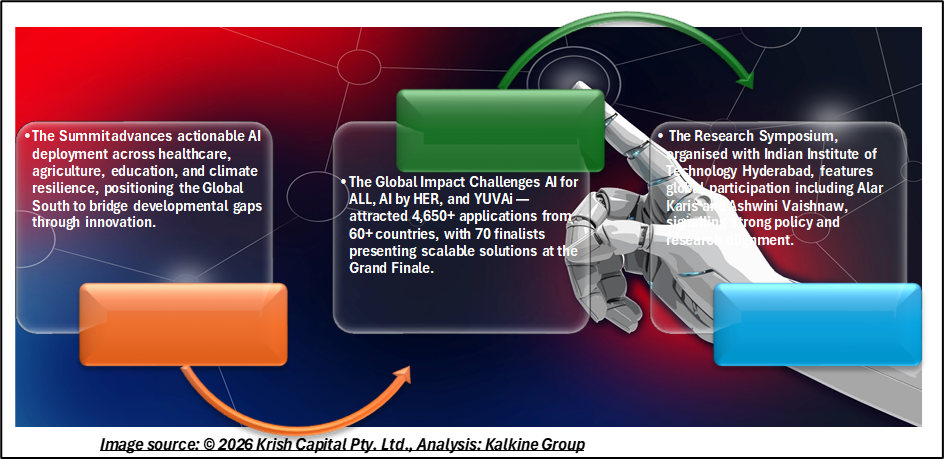
Anchored in the pillars of People, Planet, and Progress, the Summit aims to move beyond discussions and deliver actionable outcomes. The emphasis is on deploying AI in public systems such as healthcare, agriculture, education, and climate resilience. For countries in the Global South, AI represents not just technological advancement but an opportunity to leapfrog developmental gaps.
A key highlight is the culmination of three flagship Global Impact Challenges — AI for ALL, AI by HER, and YUVAi. Together, these initiatives attracted over 4,650 applications from more than 60 countries. After rigorous evaluation, 70 finalist teams will present scalable AI solutions during the Grand Finale and Awards Ceremony. These innovators will directly engage with policymakers, investors, and industry leaders, opening doors to funding, partnerships, and global deployment opportunities.
The Research Symposium on AI and Its Impact, organised in partnership with Indian Institute of Technology Hyderabad, received around 250 global research submissions. Distinguished participants include Alar Karis and Union Minister Ashwini Vaishnaw, reflecting strong international and domestic policy alignment.
Big Tech Advantage: How IT Majors Can Benefit
India’s leading IT giants stand to gain significantly from the policy momentum and global collaborations emerging from the summit. Companies like Tata Consultancy Services, Infosys, Wipro, and HCL Technologies are already deeply embedded in AI-driven transformation projects worldwide.
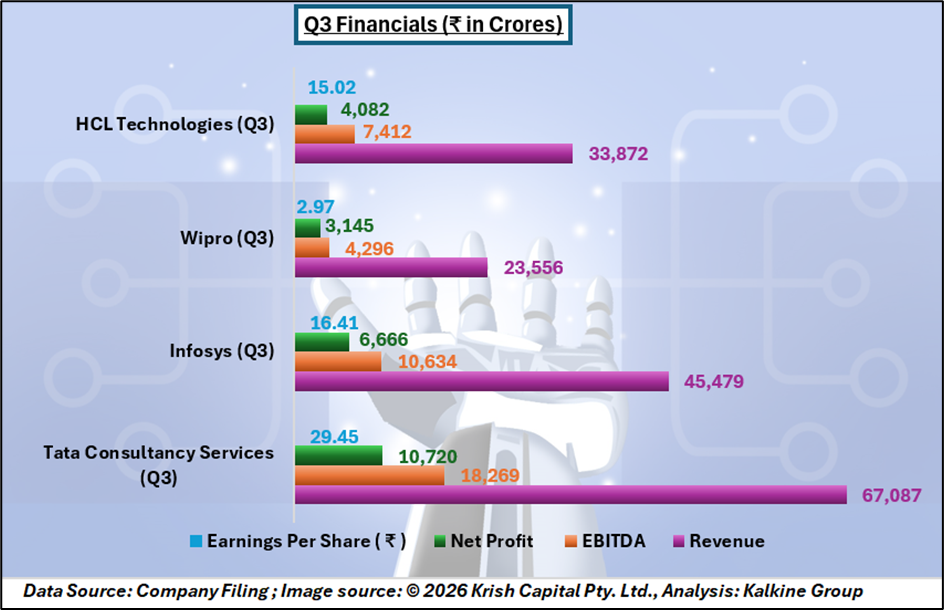
Their Q3 financials highlight strong operational capabilities. TCS reported revenue of ₹67,087 crore and net profit of ₹10,720 crore, while Infosys posted ₹45,479 crore in revenue and ₹6,666 crore in profit. Wipro and HCL Technologies also demonstrated stable earnings performance. Such financial strength positions them well to invest further in AI research, partnerships, and product innovation.
With governments prioritising sovereign AI infrastructure and ethical AI frameworks, these firms can secure large-scale public digital transformation contracts. The Summit’s focus on inclusive AI also opens new markets in Africa, Southeast Asia, and Latin America, where Indian IT firms already have a strong delivery presence. Additionally, AI-driven automation and analytics services can enhance their margins and long-term competitiveness.
A Strategic Turning Point for India
The India AI Impact Summit 2026 is more than an event — it is a strategic turning point. By convening global leaders and aligning AI development with inclusive growth, India is positioning itself at the heart of the next digital revolution. For policymakers, it offers a platform to craft responsible AI frameworks. For startups, it provides visibility and investment access. For IT majors, it unlocks new revenue streams and global partnerships.
Technical Summary

CNXIT is trading at ₹32,522.95. Immediate support is placed at ₹30,900, followed by stronger support at ₹27,000. On the upside, resistance stands at ₹34,600, with a higher barrier at ₹38,750. The index remains positioned between key support and resistance levels, indicating defined trading zones in the near term.

Conclusion: From Dialogue to Deployment
As the Summit progresses, its real success will lie in translating dialogue into deployment. If collaborations forged here evolve into concrete projects and scalable AI solutions, India could emerge as the global bridge between innovation and inclusive development. For Indian technology companies and the broader digital ecosystem, this moment represents not just opportunity — but leadership in shaping the AI age.