

Company Overview
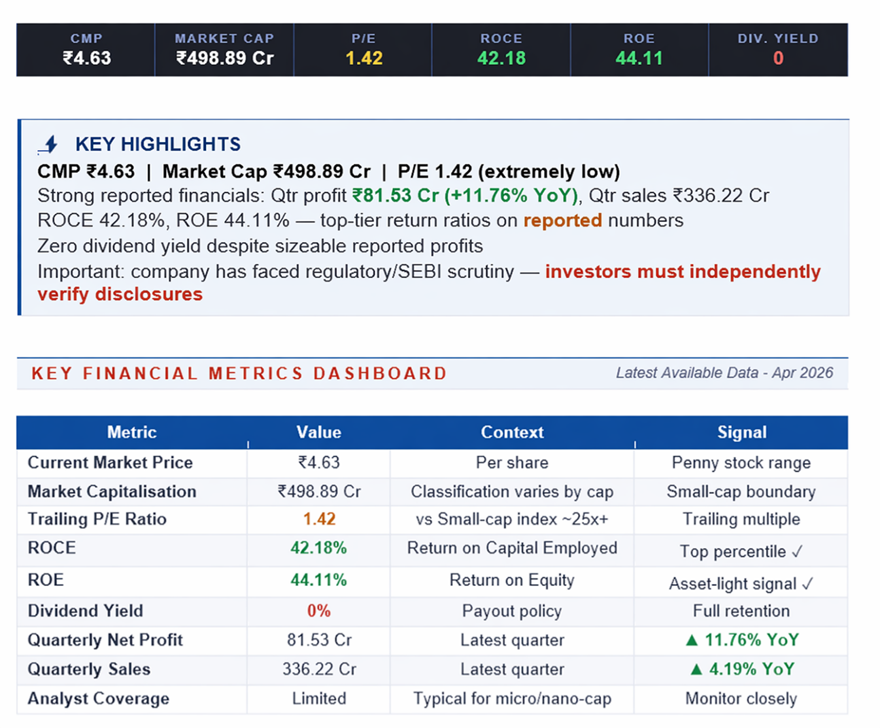
Mishtann Foods (BSE:MISHTANN) is an Indian agri-foods company primarily engaged in the processing, branding, and distribution of basmati rice and allied food products. With a market capitalisation of ₹498.89 crore and a share price of ₹4.63, Mishtann is a mid-sized penny stock that has historically attracted significant retail interest due to its low absolute share price, large reported revenues, and exposure to the Indian staple-foods theme.
The Indian basmati and packaged-foods industry is structurally attractive: rising per-capita incomes, urbanisation, and branded-foods penetration all support secular volume growth. However, the industry is also highly competitive, with large listed peers such as KRBL, LT Foods, and Kohinoor operating at scale with established export franchises.
Importantly, investors evaluating Mishtann must approach the stock with heightened diligence. The company has at times been the subject of regulatory scrutiny and media commentary regarding corporate governance and disclosures. Any investment decision should be preceded by a careful reading of the latest SEBI orders, annual reports, and auditor disclosures.
Price Performance
Mishtann trades at ₹4.63 per share, placing it firmly in the low-price penny-stock bracket. At this price point, the counter is extremely liquid by number of shares traded but highly volatile in percentage terms — a 1-rupee move is over 20% of the stock price.
Historical price behaviour in Mishtann has been characterised by periods of sharp rallies followed by meaningful corrections, driven as much by market sentiment and retail flows as by underlying fundamentals. Understanding that daily and weekly volatility will be significantly higher than for a conventional mid-cap is essential for any investor considering this stock.
Shareholder Returns
Despite reporting robust profitability, Mishtann currently pays no dividend (0% yield). For a company generating over ₹80 crore in quarterly profit on its reported numbers, the absence of any payout is a data point worth examining.
The question for Mishtann shareholders is whether retained earnings are translating into commensurate growth in book value, capacity, inventory-handling infrastructure, or brand — or whether cash is accumulating without a clear reinvestment plan. This is precisely the kind of question that investors should answer by reading the annual report and cash-flow statement in detail.
Financials
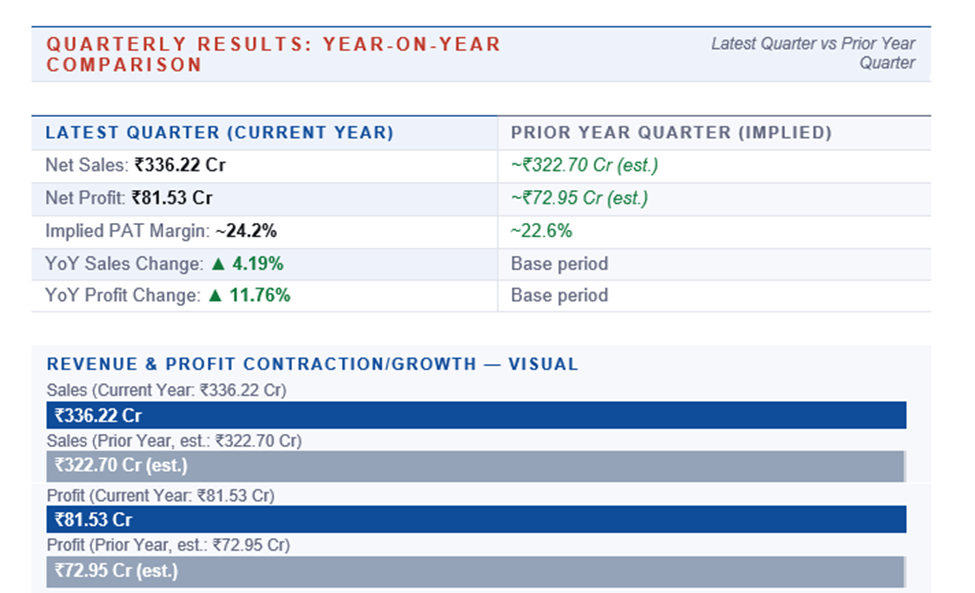
On the reported numbers, Mishtann shows an impressive financial profile. Quarterly net profit of ₹81.53 crore is up 11.76% YoY, on quarterly sales of ₹336.22 crore (up 4.19% YoY). Trailing ROCE of 42.18% and ROE of 44.11% are in the top decile of Indian listed companies.
The P/E of 1.42 is, on its face, one of the lowest among all listed equities of meaningful size — implying the market is either spectacularly mispricing the stock or is skeptical of the quality and sustainability of the reported earnings. The reasonable interpretation is that the valuation compression reflects concerns over earnings quality rather than operating performance. Investors must independently satisfy themselves regarding revenue recognition, receivable quality, related-party dealings, and the veracity of reported margins.
Risks
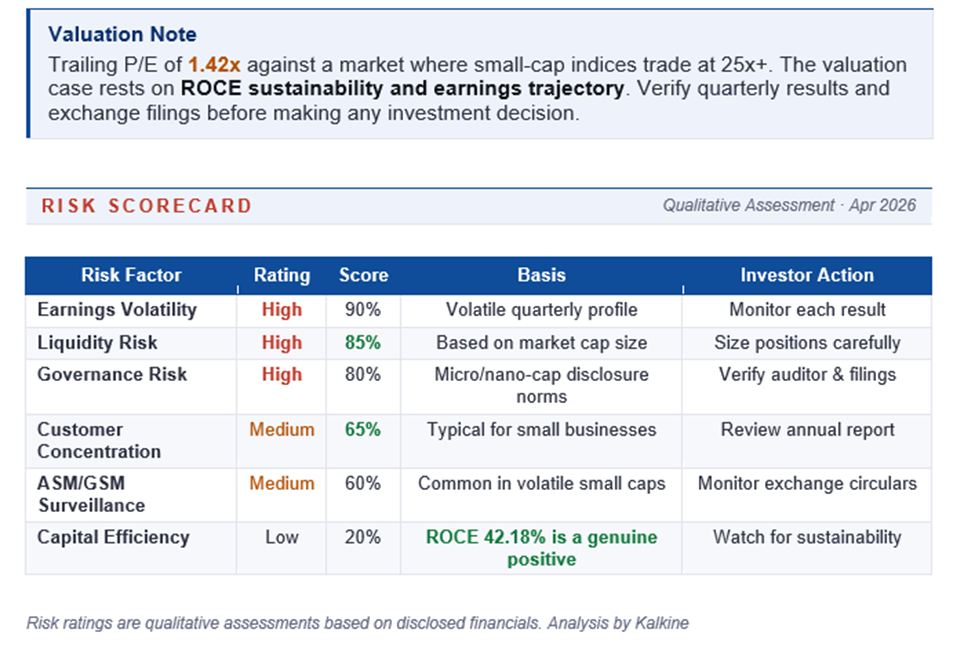
- Regulatory and disclosure risk: The company has faced regulatory scrutiny in the past; any new SEBI action, audit qualification, or restatement could trigger significant price impact.
- Governance risk: Investors must independently verify promoter holding, pledge status, related-party transactions, and auditor continuity.
- Earnings quality risk: The divergence between reported profitability and market valuation (P/E 1.42) reflects market skepticism that prudent investors cannot ignore.
- Industry risk: The basmati rice business is exposed to export-market dynamics, monsoon-driven paddy prices, and working-capital-heavy inventory cycles.
- Liquidity and volatility risk: Despite a reasonable market cap, sharp percentage moves are routine in this counter.
Business Strategy
On paper, Mishtann's strategy is anchored around branded basmati rice, supply-chain integration, and expanding distribution across domestic and export markets. Success in branded staples requires consistent product quality, retail-shelf presence, working-capital discipline, and progressive penetration into higher-margin SKUs.
For Mishtann, the strategic test is whether reported growth translates into durable brand equity and defensible market share. Transparent periodic updates on branded-sales mix, export share, and working-capital days would materially improve investor confidence in the strategy.
Valuation
Mishtann is one of the most extreme valuation puzzles in the Indian small-cap universe. At a P/E of 1.42, either the stock is one of the most undervalued opportunities available — or the market is pricing in a material probability of earnings restatement, regulatory action, or quality-of-profits concern.
Frequently Asked Questions
What does Mishtann Foods do?
Mishtann Foods is primarily engaged in processing, branding, and distribution of basmati rice and allied Indian food products.
Is Mishtann Foods safe to invest in?
The stock carries elevated risk relative to typical small-caps due to past regulatory scrutiny. It should be approached only by investors who have independently reviewed filings and are comfortable with speculative-grade risk.
Does Mishtann Foods pay dividends?
No. Despite sizeable reported profits, the dividend yield is 0%.
What is the market cap of Mishtann Foods?
Approximately ₹498.89 crore, placing it among the mid-sized penny stocks in the Indian market.