

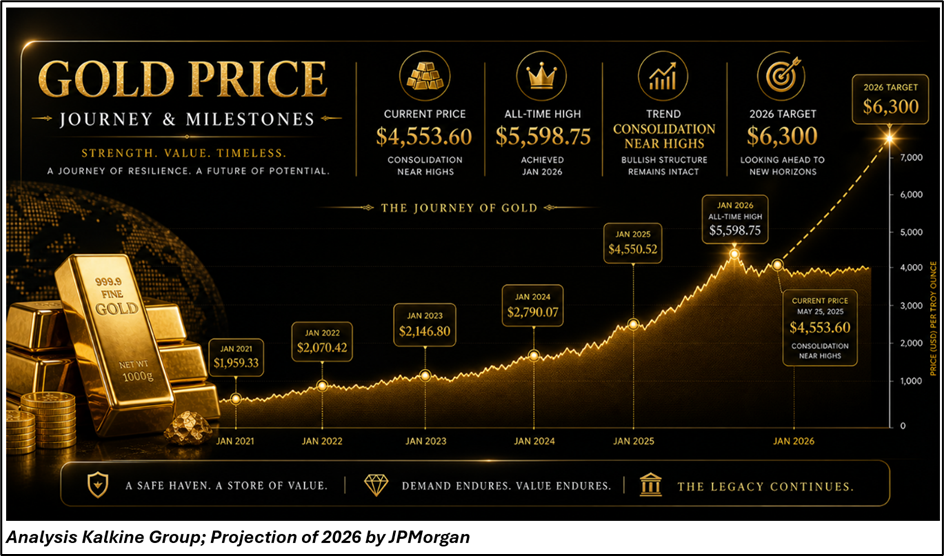
Global investment bank JPMorgan Chase & Co. has reiterated its constructive stance on gold, projecting prices could advance toward $6,300 per ounce by the end of 2026. The outlook reflects sustained confidence in gold’s structural demand, underpinned by macroeconomic shifts and persistent geopolitical uncertainty.
Gold continues to trade at elevated levels, currently hovering around $4,553.60 per ounce, following an exceptional rally over the past year. The metal recently scaled an all-time high of $5,598.75, highlighting the intensity of safe-haven demand and strong institutional participation. While recent price action indicates a phase of consolidation, the broader trend remains firmly upward.
Structural Drivers Supporting Gold
JPMorgan’s bullish thesis is supported by a combination of structural and cyclical factors. Central to this is continued central bank accumulation, as global monetary authorities diversify reserves away from traditional currencies and toward gold.
At the same time, expectations of a more accommodative policy stance by the Federal Reserve System continue to enhance gold’s appeal. Lower interest rates reduce the opportunity cost of holding non-yielding assets, encouraging greater allocation toward bullion.
In parallel, sustained inflows into gold-backed exchange-traded funds (ETFs) reflect consistent investor participation. Combined with elevated geopolitical risks, these dynamics have created a supportive environment for gold to test and sustain near-record levels.
Demand Outlook and Price Trajectory
JPMorgan expects robust central bank demand and continued investment inflows to remain key pillars supporting gold prices. The bank’s $6,300 projection by 2026 suggests that the current consolidation phase represents a pause within a longer-term structural uptrend.
Reinforcing this view, Bank of America has indicated that gold could approach $6,000 within the next 12 months, aligning with the broader institutional narrative of sustained upside potential.
Technical Summary
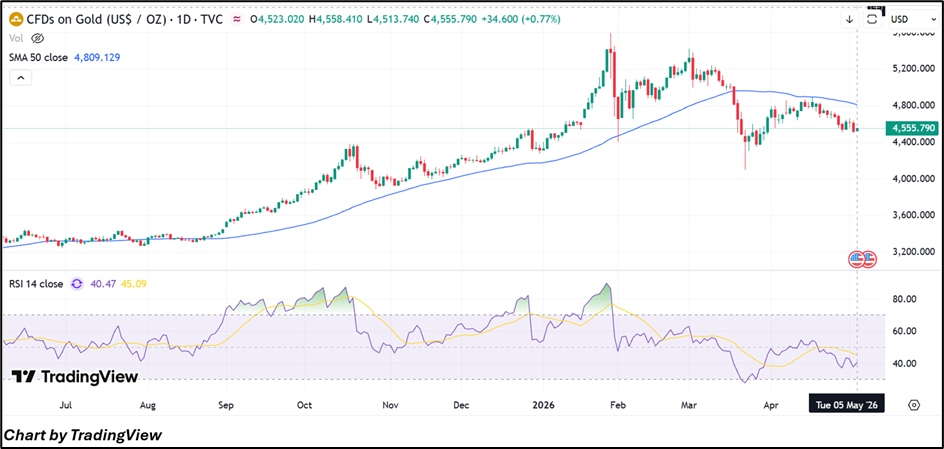
Gold is currently trading around $4,555.79, remaining below its 50-day SMA (~$4,809), indicating a short-term bearish bias within a broader uptrend. Price action shows consolidation after a sharp correction from recent highs, with lower highs forming on the chart. The RSI (~40) remains below the neutral 50 level, reflecting weak momentum and lack of strong buying interest. Immediate support is seen near the $4,450–$4,400 zone, while resistance is placed around $4,750–$4,800. A sustained move above the 50-day SMA could signal trend recovery, whereas continued weakness may lead to further downside consolidation.
Investment Perspective
The ongoing strength in gold prices signals more than cyclical momentum it reflects a structural realignment in global asset allocation. Increasing geopolitical fragmentation, currency volatility, and evolving central bank strategies are reshaping demand for safe-haven assets.
For investors, gold continues to offer a compelling blend of defensive resilience and long-term diversification value. While intermittent volatility may persist, the broader trajectory remains supported by strong institutional demand and favorable macroeconomic tailwinds.
Conclusion
Gold remains firmly positioned within a long-term structural uptrend, supported by strong institutional demand and macroeconomic tailwinds. While short-term consolidation and weaker momentum persist, the broader outlook stays constructive. Sustained central bank buying, easing rate expectations, and geopolitical uncertainty continue to reinforce gold’s role as a resilient strategic asset.
FAQs
- Why is gold still bullish despite recent correction?
Gold remains supported by central bank demand, easing rate expectations, and geopolitical risks, keeping its long-term outlook intact despite short-term weakness. - What are key support and resistance levels for gold?
Immediate support lies near $4,400, while resistance is seen around $4,800, with the 50-day SMA acting as a key technical barrier. - What could drive gold prices higher from here?
Rate cuts, ETF inflows, central bank accumulation, and geopolitical tensions could push gold toward higher levels in the medium to long term.