

Rajesh Exports Stock Remains in Focus Amid SEBI Probe and Potential PLI Setback
Rajesh Exports Ltd. (NSE: RAJESHEXPO), one of the world's largest gold refiners and jewelry exporters, remains under intense investor scrutiny after the Securities and Exchange Board of India (SEBI) issued an interim ex-parte order raising concerns over the company's financial reporting practices.
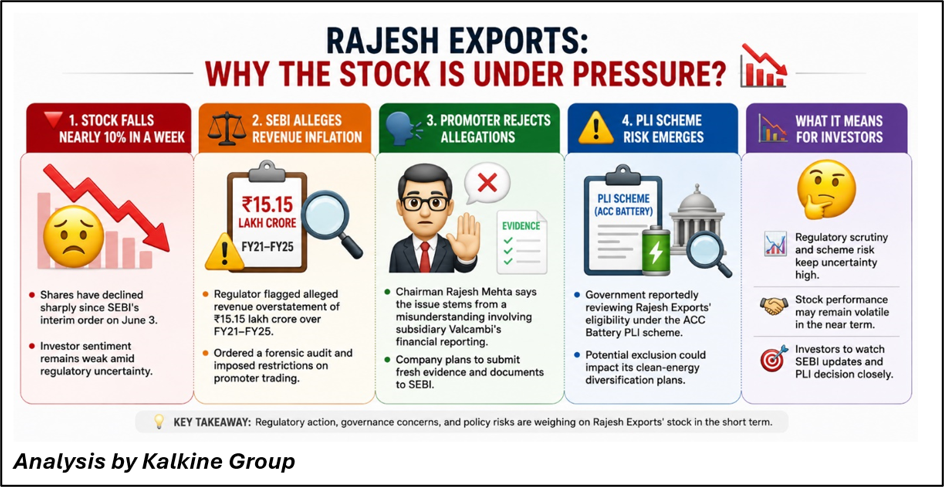
The stock witnessed significant selling pressure, falling nearly 10% since June 3 and touching an intraday low of ₹93.8 on June 8 as investors reacted to regulatory developments and reports that the government may reconsider the company's participation in India's battery manufacturing incentive program.
However, Rajesh Exports and its promoter Rajesh Mehta have strongly denied all allegations, asserting that the controversy stems from an accounting misunderstanding rather than any financial wrongdoing.
What Triggered the Selloff?
SEBI's interim order alleged that Rajesh Exports may have overstated its consolidated revenues by approximately ₹15.15 lakh crore over FY21-FY25. According to the regulator's preliminary observations, a substantial portion of the revenue reported by certain subsidiaries appeared inconsistent with available records.
The regulator also raised concerns regarding fund transfers involving entities linked to the group's lithium-ion battery business and ordered a forensic audit while restricting promoter trading activities until further review.
The developments triggered sharp investor concern, leading to a steep decline in the company's market valuation.
Promoter Rajesh Mehta Says SEBI Findings Are Based on a Revenue Calculation Error
Responding to the allegations, Founder and Chairman Rajesh Mehta stated that the issue primarily arises from a misunderstanding of the financial reporting of Swiss gold refinery Valcambi, a key subsidiary of Rajesh Exports.
According to Mehta, the company has already submitted hundreds of gigabytes of supporting documentation and plans to provide additional evidence within the next fifteen days.
He argued that SEBI may have mistakenly considered Valcambi's EBITDA or gross profit figures instead of its actual revenue generated from large-volume bullion transactions.
Using the example of a gold sale, Mehta explained that while a bullion transaction may generate revenue of ₹30,000, the gross profit may only be ₹1,000. Treating the profit figure as revenue would create a substantial mismatch and potentially lead to incorrect conclusions regarding reported sales.
Company Issues Multiple Clarifications to Stakeholders
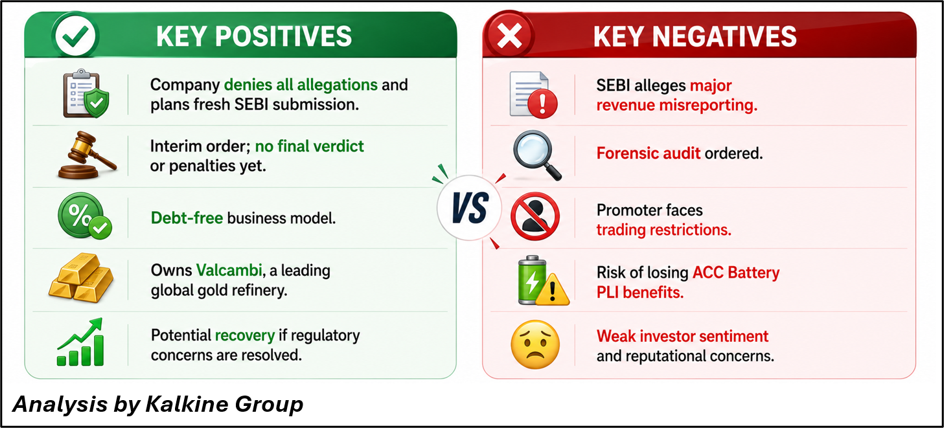
In official exchange filings dated June 4 and June 5, Rajesh Exports emphasized that SEBI's order is interim in nature and does not contain any conclusive adverse findings against the company. The company stated that it is actively engaging with the regulator and submitting supporting documents to address all concerns.
Rajesh Exports further maintained that its reported revenues are accurate and that the confusion largely stems from the interpretation of Valcambi's financial statements. The company asserted that SEBI's observations relate to suspected revenue discrepancies rather than earnings manipulation and highlighted that no penalties or fines have been imposed at this stage.
In a separate clarification, the company reiterated that it is debt-free, has not raised significant public capital since its IPO in 1995, and rejects media reports suggesting fraud, scams, or fabricated revenues. Management stated that it is preparing detailed explanations, documentary evidence, and additional submissions to address every concern raised by the regulator.
Fresh Headwind: PLI Scheme Participation Under Review
Apart from regulatory scrutiny, Rajesh Exports is facing uncertainty regarding its clean energy ambitions.
Reports suggest that the Ministry of Heavy Industries is evaluating whether the company should continue as a beneficiary under the Production-Linked Incentive (PLI) scheme for Advanced Chemistry Cell (ACC) battery manufacturing.
The ministry is reportedly examining SEBI's findings before making a final recommendation to Union Heavy Industries Minister H.D. Kumaraswamy.
Any adverse decision could impact the company's long-term battery manufacturing plans and broader diversification strategy beyond precious metals and jewelry.
Why Valcambi Is Central to the Dispute
Valcambi, the Switzerland-based precious metals refinery acquired by Rajesh Exports, is among the world's largest gold refining businesses.
The company has repeatedly emphasized that Valcambi's business model involves extremely high-volume bullion transactions with relatively thin margins. According to Rajesh Exports, misunderstanding this business structure could create the appearance of inflated revenues when comparing revenue figures against profit metrics.
Management argues that the revenue generated through bullion refining and trading naturally runs into massive figures while operating margins remain relatively small.
What Investors Should Watch Next
The coming weeks could prove critical for Rajesh Exports as:
- The company submits fresh documentation and explanations to SEBI.
- The forensic audit process progresses.
- The regulator evaluates the additional evidence provided by management.
- The Ministry of Heavy Industries decides on the company's ACC PLI eligibility.
- Investors await further clarification regarding Valcambi's reported financials.
The outcome of these developments will likely determine investor confidence and the future direction of the stock.
Technical Summary
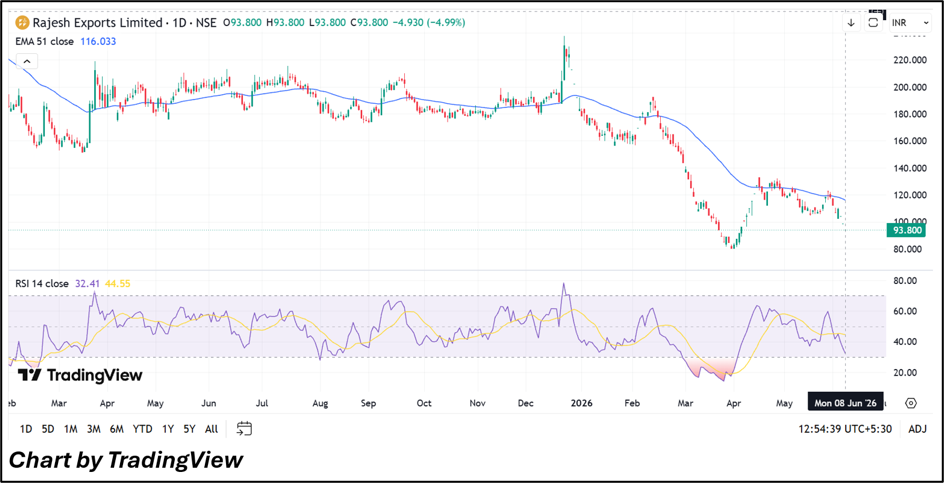
Rajesh Exports remains in a strong downtrend, trading at ₹93.80, well below its 51-day EMA of ₹116.03. The stock declined nearly 5% in the latest session, reflecting persistent selling pressure. RSI stands at 32.4, approaching oversold territory. Immediate support is seen near ₹90, while resistance lies around ₹100–116. A sustained move above the EMA is needed to signal trend reversal.
Conclusion
Rajesh Exports finds itself at the center of one of the most closely watched corporate controversies in the Indian market. While SEBI's interim order has raised serious questions regarding reported revenues and corporate governance practices, the company continues to strongly deny any wrongdoing and attributes the issue to accounting misunderstandings related to its Swiss refinery operations.
With fresh submissions expected shortly and government agencies reviewing the matter, investors are likely to remain cautious until greater regulatory clarity emerges. The next phase of disclosures and investigations could be decisive in shaping Rajesh Exports' reputation, growth plans, and stock market performance.
FAQs
Q1. Why are Rajesh Exports shares falling?
The stock has come under pressure after SEBI issued an interim order alleging possible revenue misreporting and governance concerns, leading to investor uncertainty.
Q2. What has Rajesh Exports said about SEBI's allegations?
The company has denied all allegations, stating that the issue stems from a misunderstanding related to Valcambi's revenue reporting and that supporting documents are being submitted to SEBI.
Q3. Is SEBI's order final?
No. The company has emphasized that the order is interim in nature and does not contain any conclusive findings or penalties at this stage.
Q4. What is the controversy surrounding Valcambi?
Rajesh Exports claims that SEBI may have compared Valcambi's EBITDA or gross profit with revenue figures, leading to apparent discrepancies in reported revenues.
Q5. How could the PLI scheme review affect Rajesh Exports?
If removed from the ACC battery storage PLI scheme, the company's long-term diversification and battery manufacturing expansion plans could face challenges.