

Highlights
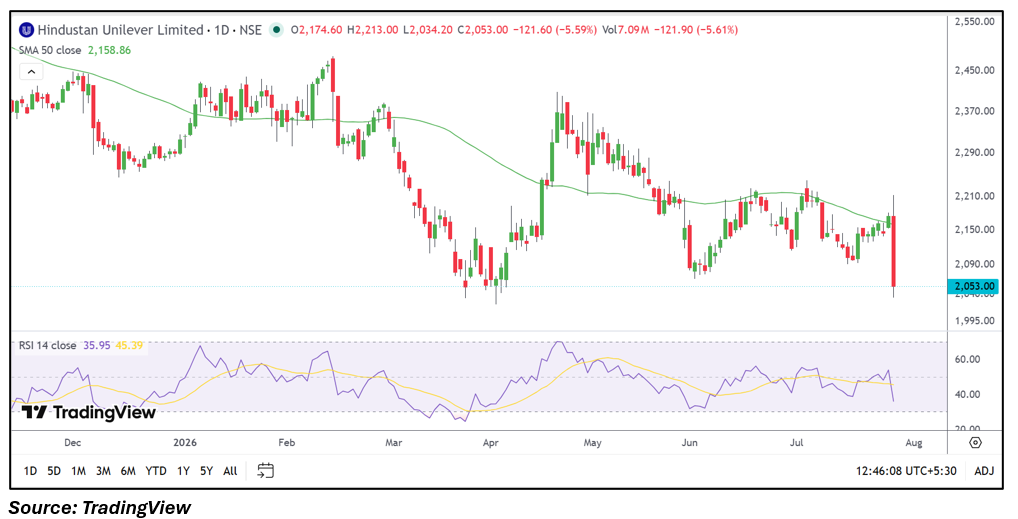
- Hindustan Unilever (NSE: HINDUNILVR) shares fell nearly 6% after Q1 FY27 earnings.
- Consolidated revenue from operations increased 10.3% year-on-year to ₹17,184 crore.
- Net profit slipped to around ₹2,673 crore despite strong revenue growth.
- Underlying volume growth improved 5% during the quarter.
- EBITDA margin narrowed to 23.0% amid rising input costs.
- Investors reacted to margin pressure and volume growth that slightly missed market expectations.
Overview
Hindustan Unilever (NSE: HINDUNILVR) is India's largest fast-moving consumer goods (FMCG) company, with a portfolio spanning home care, beauty and personal care, foods, nutrition, and refreshments. Its brands have a significant presence across urban and rural markets. Despite delivering its strongest revenue growth in more than three years, the company's shares came under pressure after investors focused on weaker profitability and margin compression in the first quarter of FY27.
Revenue Growth Remained Strong Across Businesses
Hindustan Unilever (NSE: HINDUNILVR) reported consolidated revenue from operations of ₹17,184 crore during Q1 FY27, representing a 10.3% increase from the corresponding quarter last year. The quarter also recorded underlying volume growth of 5%, reflecting continued consumer demand across several product categories. The revenue performance marked the company's strongest top-line expansion in approximately 13 quarters.
Profit Declines as Higher Costs Weigh on Earnings
Despite healthy sales growth, consolidated net profit declined by around 2% to 3% year-on-year to ₹2,673 crore, while standalone profit slipped to ₹2,631 crore. The moderation in earnings was primarily driven by higher tax expenses and increasing raw material costs, which limited the translation of revenue growth into bottom-line expansion.
Margins Face Pressure from Commodity Inflation
Operating profitability softened during the quarter as EBITDA margin contracted by 40 basis points to 23.0%. Rising prices of key commodities and continued supply chain costs placed pressure on margins. Management indicated that commodity price volatility remains elevated, requiring selective pricing actions and continued cost management to protect profitability.
Market Focus Shifts to Growth Quality
Although Hindustan Unilever (NSE: HINDUNILVR) reported encouraging revenue and volume growth, investor expectations had been higher following the recent recovery in the FMCG sector. The combination of lower profit growth, margin contraction, and volume expansion that was marginally below consensus estimates prompted investors to book profits after the earnings announcement.
Technical Outlook Reflects Short-Term Weakness
Technically, Hindustan Unilever (NSE: HINDUNILVR) has witnessed a sharp deterioration in near-term momentum following the post-results decline. The stock is trading around ₹2,056.00, below its 50-day simple moving average of ₹2,158.86, indicating that short-term weakness has strengthened. The 14-day RSI stands near 35.95, suggesting momentum has weakened considerably while approaching oversold territory.
Key Levels to Watch Ahead
Immediate support is placed near ₹2,034.20, followed by the psychological zone around ₹1,980.00. On the upside, immediate resistance is seen near ₹2,160.00, while a sustained recovery above this level could lead to a move toward ₹2,260.00 over the near term.
Summary
Hindustan Unilever (NSE: HINDUNILVR) delivered its strongest revenue growth in several quarters, supported by healthy volume expansion across its product portfolio. However, softer profitability, margin compression, and persistent raw material inflation overshadowed the robust top-line performance, resulting in a sharp decline in the share price. Going forward, investors are likely to monitor commodity cost trends, pricing actions, and margin recovery as key indicators of future performance.
FAQs
Q: Why did Hindustan Unilever (NSE: HINDUNILVR) shares fall after Q1 FY27 results?
A: The stock declined because lower profit growth, weaker operating margins, and volume growth that slightly missed expectations overshadowed strong revenue growth.
Q: How much revenue did Hindustan Unilever report in Q1 FY27?
A: The company reported consolidated revenue from operations of ₹17,184 crore, up 10.3% year-on-year.
Q: What was Hindustan Unilever's net profit during the quarter?
A: Consolidated net profit stood at approximately ₹2,673 crore, while standalone net profit was ₹2,631 crore.
Q: Why did EBITDA margins decline?
A: Margins narrowed mainly because of higher raw material costs, commodity inflation, and continued supply chain expenses.
Q: What will investors watch in the coming quarters?
A: Investors will closely monitor volume growth, commodity cost trends, pricing actions, and margin recovery to assess the company's earnings trajectory.