

Highlights
- Instamart’s Gross Order Value increased 40% year-on-year in Q1 FY27.
- Contribution margin improved to negative 0.2% of GOV from negative 4.6%.
- Swiggy plans to differentiate Instamart through own brands and exclusive assortments.
- The new Switch proposition will combine strategic product partnerships with platform-owned products.
- Management presented Instamart as Swiggy’s second-largest business.
Swiggy Limited (NSE:SWIGGY) used its Capital Markets Day to outline how Instamart may evolve beyond a platform associated mainly with rapid delivery of daily essentials. The company’s presentation indicates that its next phase will focus on a wider product assortment, platform-owned brands, exclusive stock-keeping units and improved unit economics.
The strategy reflects a shift from competing primarily on delivery speed toward creating products and selections that are not easily replicated across other retail platforms. Swiggy presented Instamart as its second-largest business and placed the platform within its broader approach of scaling initiatives that show potential, evolving selected concepts and exiting activities that do not meet scalability requirements.
Instamart reports higher GOV and lower contribution loss
Instamart recorded Gross Order Value of INR 7,907 crore in Q1 FY27, compared with INR 5,655 crore in Q1 FY26, representing growth of 40% year-on-year. At the same time, contribution margin improved to negative 0.2% of GOV from negative 4.6% of GOV in the corresponding quarter.
The combination of higher GOV and a narrower contribution loss suggests that the business expanded while moving closer to contribution breakeven. Swiggy described Instamart as the second player in the segment to demonstrate contribution-margin breakeven, although the reported Q1 FY27 margin remained slightly negative at 0.2% of GOV.
This operating progression provides the foundation for a strategy that extends beyond essential grocery delivery into discretionary and differentiated categories.
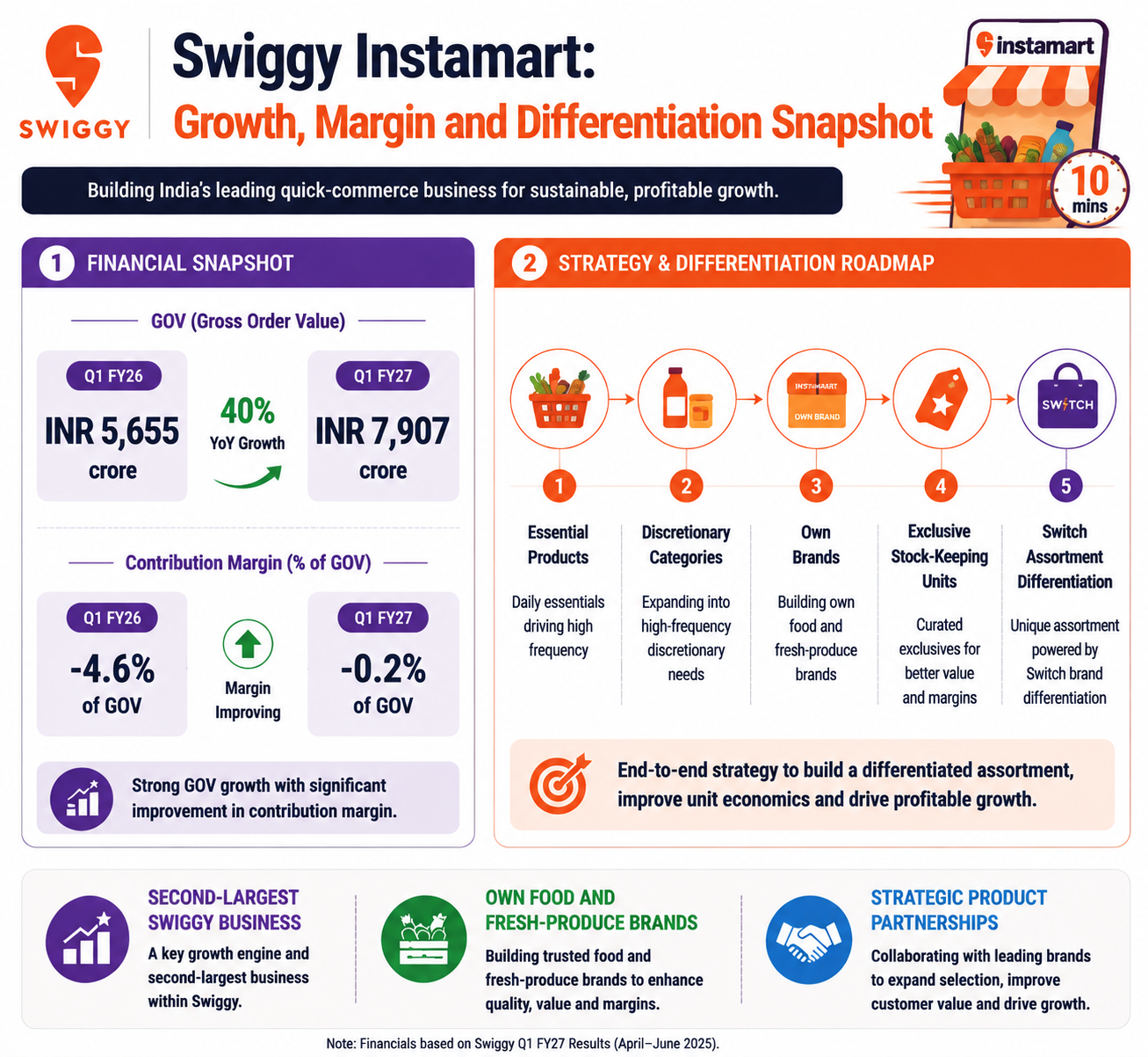
Data Source: Company Filings; Analysis: Kalkine Group
Moving from essentials toward a broader retail proposition
Swiggy indicated that Instamart is widening its role from delivering routine household essentials to serving a broader set of customer requirements. The presentation described the direction as moving “from essentials to discretionary,” suggesting that the platform plans to increase its presence across categories where product discovery, assortment and convenience matter alongside delivery speed.
A broader assortment can potentially increase the number of shopping occasions available on the platform. It may also allow Instamart to engage users for purchases beyond groceries, helping the company build a more diversified quick-commerce proposition.
However, the presentation did not disclose category-level revenue, order volumes or profitability. It therefore remains unclear how individual discretionary categories will contribute to Instamart’s financial performance.
Own brands become part of Instamart’s differentiation plan
Swiggy highlighted Noice, its own consumer brand developed through a multi-year effort. The company positioned the brand around product quality, accessible pricing and its wider role within the platform rather than treating it only as a standalone product label.
The company’s own-brand strategy may provide greater control over product selection, pricing and availability. It can also create products that are unique to Instamart, reducing direct comparison with identical goods available across competing platforms.
According to the presentation, the own-brand portfolio includes food products under No!ce and fruit-and-vegetable stock-keeping units under another platform label. Swiggy did not disclose sales, margins, product counts or customer adoption data for these brands.
Switch aims to create assortment-led differentiation
Swiggy also introduced Switch, a new Instamart proposition intended to support assortment-led differentiation. The model combines strategic brand partnerships with own-brand products available specifically through Instamart.
Through strategic partnerships, the platform intends to offer exclusive stock-keeping units, exclusive pricing or both. The approach covers non-food categories as well as greater width and depth within food categories. Alongside this, Instamart plans to use its own brands to provide products that are unique to the platform.
The strategy suggests that Swiggy wants Instamart to compete through selection and product availability rather than relying entirely on delivery time or promotional pricing. A differentiated assortment may help the platform attract repeat usage, although the commercial outcome will depend on customer demand and execution.
Innovation framework shapes the business direction
Swiggy presented its approach to new businesses through three possible paths: scale, evolve or exit. Instamart was placed in the scale category, while an earlier food initiative evolved into the company’s own-brand strategy. Another service was discontinued because the company considered its scalability limited.
This framework indicates that Instamart is expected to remain a central part of Swiggy’s platform. The company appears to be using its delivery network, customer base and operational infrastructure to support a wider retail model while monitoring financial discipline.
Conclusion
Swiggy’s Capital Markets Day presentation shows that Instamart’s next phase will focus on more than rapid grocery delivery. The company plans to broaden its assortment, develop own brands and introduce exclusive products through Switch while continuing to narrow contribution losses. Q1 FY27 GOV growth of 40% and contribution margin improvement provide an operating base for this strategy. However, the presentation does not provide detailed financial targets for own brands, category expansion or Switch, making future execution an important factor to monitor.
FAQs
Q: What was Instamart’s Gross Order Value in Q1 FY27?
A: Instamart reported Gross Order Value of INR 7,907 crore in Q1 FY27, compared with INR 5,655 crore in Q1 FY26.
Q: How did Instamart’s contribution margin change?
A: Contribution margin improved to negative 0.2% of GOV in Q1 FY27 from negative 4.6% in Q1 FY26.
Q: What is Switch?
A: Switch is an Instamart proposition focused on assortment-led differentiation through exclusive products, selective pricing arrangements and own brands.
Q: What role do own brands play in Instamart’s strategy?
A: Own brands are intended to provide products unique to Instamart while supporting greater control over assortment, pricing and platform differentiation.
Q: Did Swiggy provide revenue targets for Instamart’s own brands?
A: No. The presentation did not disclose revenue, margin or product-level financial targets for the own-brand portfolio.