

Highlights
- Store network expanded to 500 outlets across multiple Indian states in FY26 period.
- Revenue from operations stood at ₹ 66,968 Cr during FY26 reporting year.
- EBITDA margin recorded at 7.8 percent across FY26 financial performance cycle.
Avenue Supermarts Ltd (NSE:DMART) operates a supermarket retail chain under a value-based consumption model across India. The company follows a cluster-driven expansion approach, increasing penetration in Maharashtra, Gujarat, Karnataka, Tamil Nadu, Telangana, and other regions.
Store count increased from 214 stores in FY20 to 500 stores in FY26. The expansion strategy focused on strengthening presence in existing clusters rather than rapid geographic diversification.
Product categories include foods, non-food FMCG, and general merchandise & apparel. Foods remain the largest contributor, accounting for approximately 57 percent of revenue in FY26. The retail model continues to focus on essential household consumption categories across urban and semi-urban markets.
DMart Ready, the online grocery delivery platform, expanded from one city in FY17 to 25 cities in FY26, with concentration on large urban centres such as Mumbai, Pune, Bengaluru, Chennai, Hyderabad, and Ahmedabad.
Operating Performance: Revenue and Margin Trends
Revenue from operations increased from ₹ 30,353 Cr in FY22 to ₹ 66,968 Cr in FY26, reflecting steady multi-year expansion in scale.
EBITDA increased from ₹ 2,502 Cr in FY22 to ₹ 5,255 Cr in FY26. EBITDA margin moved from 8.2 percent in FY22 to 7.8 percent in FY26, indicating relatively stable operating margin range.
Profit after tax increased from ₹ 1,616 Cr in FY22 to ₹ 3,224 Cr in FY26. Variations in certain years were impacted by one-off tax adjustments as disclosed in the presentation.
Net cash flow from operations reached ₹ 4,168 Cr in FY26, supported by depreciation and working capital adjustments.
Operational Efficiency Metrics
Retail business area expanded from 18.1 million sq ft in FY22 to 39.8 million sq ft in FY26.
Like-for-like growth (24-month basis) moderated to 8.1 percent in FY26 from higher earlier levels.
Inventory turnover and fixed asset turnover ratios remained broadly stable across the period, indicating consistent asset utilisation.
Inventory days remained around low-30-day levels, while payable days remained near 7 days, reflecting structured working capital cycles.
Financial Position Overview
Return on net worth stood at 13.5 percent in FY26, while return on capital employed was 17.1 percent.
Total debt remained low relative to equity, with debt-to-equity ratio staying under control across FY22–FY26 period.
Share Performance
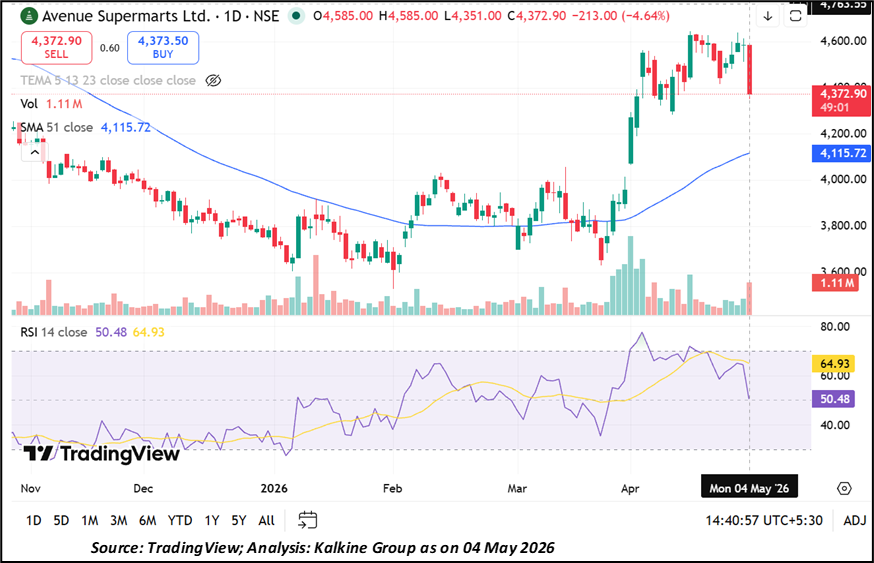
Avenue Supermarts Ltd (DMART) declined sharply in the latest session, trading at ₹4,372.90, down ₹213.00 (-4.64%). The stock traded between ₹4,585 and ₹4,351 with elevated volume of 1.11M shares.
It remains above its 51-day SMA of ₹4,115.72, indicating a broader uptrend. RSI cooled to 50.48 after touching overbought levels near 64.93, suggesting short-term profit booking and momentum moderation.
Key Risks
- Expansion into new geographies may impact operational consistency and cost efficiency.
- Supply chain and logistics cost fluctuations may affect operating margins.
- Demand variation in discretionary product categories may influence revenue mix.
- Competitive intensity in urban retail markets may affect pricing dynamics.
Summary
Avenue Supermarts Ltd (NSE:DMART) reported FY26 revenue of ₹ 66,968 Cr with 500 stores across India. EBITDA stood at ₹ 5,255 Cr with margin of 7.8 percent. Store expansion followed cluster-based strategy, while DMart Ready extended to 25 cities. Operational metrics showed stable turnover ratios and moderated like-for-like growth across the five-year financial period.
FAQs
- What is the store count of DMart in FY26?
DMart operated 500 stores across multiple Indian states under cluster-based expansion strategy in FY26. - How did revenue perform between FY22 and FY26?
Revenue increased from ₹ 30,353 Cr in FY22 to ₹ 66,968 Cr in FY26 over five years. - What is the EBITDA margin trend in FY26 presentation?
EBITDA margin moved from 8.2 percent in FY22 to 7.8 percent in FY26, showing slight moderation.