

Thomas Cook (India) Limited (NSE:THOMASCOOK), a leading integrated travel and financial services company, continues to leverage its diversified portfolio spanning travel services, foreign exchange, leisure hospitality, and digital imaging solutions. With operations across 28 countries and over 900 touchpoints, the company remains well positioned to capture both domestic and outbound travel demand recovery trends.
Q3FY26 Financial Performance Highlights
The company reported consolidated revenue from operations of ₹21,457 million in Q3FY26, reflecting a 4% year-on-year increase, supported by broad-based growth across segments. EBITDA rose 13% YoY to ₹1,554 million, while EBIT increased 13% to ₹1,140 million, indicating improved operating efficiency.
Profit before tax (PBT), excluding exceptional items, grew 20% YoY to ₹897 million, showcasing strong underlying business momentum. However, reported PBT declined to ₹596 million due to a one-time exceptional charge of ₹301 million linked to new labour code provisions. Net profit stood at ₹455 million, down 4% YoY.
Segment-Wise Performance Analysis
Travel and related services, the largest segment, generated ₹16,781 million revenue in Q3FY26, growing 3% YoY, driven by strong B2B demand and improving international travel trends. Financial services recorded ₹762 million revenue (+2% YoY), supported by digital adoption and forex product expansion.
Leisure hospitality and resorts delivered robust 12% YoY growth to ₹1,550 million, benefiting from higher occupancy, improved ARR, and expansion of resort inventory. Meanwhile, digital imaging solutions grew 5% YoY to ₹2,365 million, aided by higher global tourist footfall and new partnerships.
Strategic Developments and Growth Drivers
Management highlighted strong execution despite a volatile global travel environment. A key policy tailwind emerged from the Union Budget FY27, which reduced TCS on overseas tour packages to a flat 2%, expected to boost outbound travel demand.
Strategically, the company continues to invest in digital transformation, including AI-driven travel solutions and increased app-based bookings. Expansion initiatives such as forex delivery partnerships with Blinkit and new retail outlets further enhance accessibility and customer engagement.
Additionally, the hospitality segment’s expansion pipeline and international partnerships in digital imaging reinforce long-term growth visibility. The company’s strong balance sheet, with over ₹20 billion in cash reserves, provides flexibility for strategic investments.
Operational Trends and Industry Outlook
Despite macro headwinds such as geopolitical disruptions and muted inbound travel in select markets, the company demonstrated resilience through diversified revenue streams. Growth in Southeast Asia travel, corporate travel recovery, and strong leisure demand during peak seasons supported performance.
The shift toward short-haul destinations, increasing digital bookings, and experiential travel trends continue to shape demand dynamics. Management remains optimistic about sustained momentum heading into peak summer travel season.
Technical Summary
Thomas Cook India stock trades below its 50-day moving average, indicating a weak trend. RSI near 39 signals subdued momentum with mild oversold conditions. Price action shows lower highs and sustained downtrend, with resistance near ₹100 and support around ₹85, suggesting cautious near-term outlook unless reversal triggers emerge.
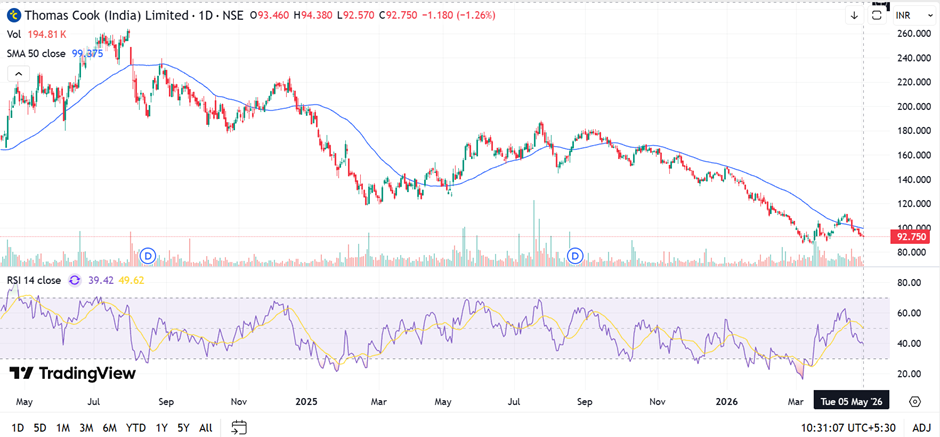
Chart by TradingView
Conclusion
Thomas Cook India delivered steady operational performance despite macro challenges, supported by diversification and digital initiatives. While near-term profitability was impacted by exceptional items, structural growth drivers remain intact. Policy tailwinds and travel recovery trends position the company for gradual earnings improvement, though execution consistency and demand visibility remain key monitorables.
FAQs
- What drove Thomas Cook India’s Q3FY26 revenue growth?
Revenue growth was driven by strong travel demand, hospitality expansion, and digital imaging performance despite global travel volatility and regional disruptions. - Why did net profit decline despite higher operating performance?
Net profit declined due to a one-time exceptional charge related to new labour code provisions, impacting reported profitability during the quarter. - What are key growth catalysts for Thomas Cook India going forward?
Key catalysts include outbound travel demand recovery, digital transformation, forex expansion, hospitality capacity growth, and favorable government policy changes supporting tourism.